
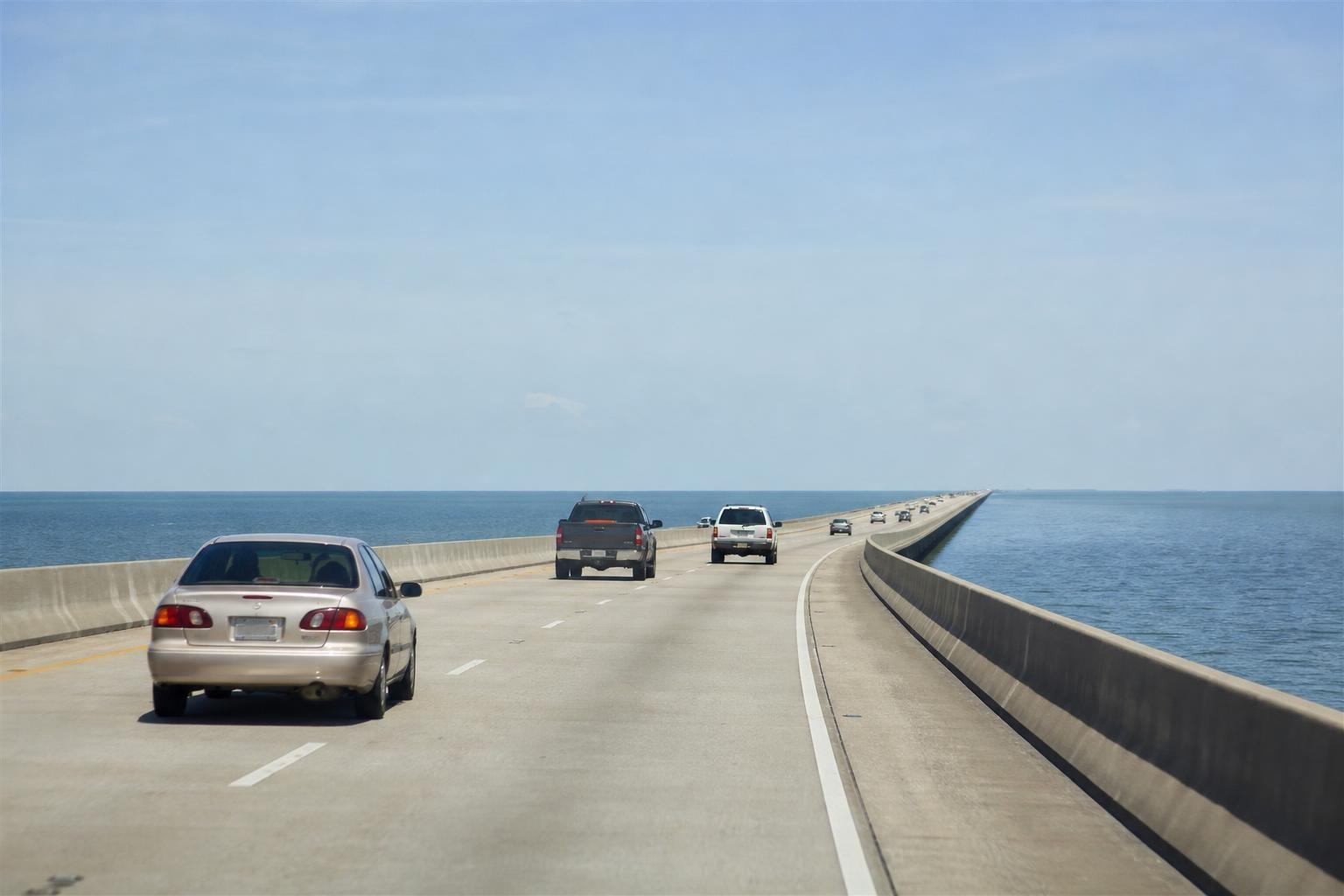
A road that appears to float above water has a way of shrinking the world to sky, surface, and the steady hum of tires. Out here, the shoreline slips from view, and the mind does something ancient: it listens for edges. Drivers talk about a subtle unmooring—“It feels like driving on the edge of the world,” one commuter said—yet the route is routine, clocked daily by thousands who know every seam and expansion joint by heart.
A line across a lake, and a trick of the horizon
The bridge is long, nearly 24 miles, and set just a few meters above the water, so the curvature of the Earth and the lake’s low, marshy banks erase the shoreline for a central stretch. On a clear day, there is still only water to the left and to the right, and a pencil-fine roadway that refuses to widen. The result is a theater of minimalism: guardrails, gulls, and a horizon that doesn’t blink.
Some first-time drivers ease up on the throttle, confused by distance without landmarks. Others settle into a calm, almost meditative cadence—white lines, dark water, repeating like a metronome. “Once you accept the emptiness, it becomes strangely beautiful,” a northshore resident told me.
Built to last where water never rests
The causeway is not a stunt; it is infrastructure, double-strung with two parallel spans that carry commerce, commutes, and weekend traffic between communities that share more than a shoreline. The older span opened in the late 1950s, the twin followed in the 1960s, and together they have weathered storms that remap coastlines. Engineers designed for fatigue, corrosion, and surge, choosing repetition—pile, cap, girder—over flourish.
“The philosophy was redundancy,” a bridge engineer once remarked. “If one element feels stress, the system absorbs it.” Expansion joints click a familiar rhythm beneath your wheels; navigation spans lift the silhouette just enough to let boats and wind slip under. Patrol units watch the flow like shepherds, easing speed in fog and spacing cars during pea-soup mornings when even gulls fly low.
What the water teaches the driver
Distance without landmarks is a teacher. It reveals how much the brain leans on edges, signs, and buildings to judge speed and space. Out here, the only ruler is the dash of lane paint and the slow ballet of taillights. Mist can make the roadway feel narrower; rain can blur the line between lake and asphalt. And when the sun is down, a long string of headlights turns the causeway into a glowing necklace pinned to the dark.
Veterans learn to watch the wind, which scribbles on the water in visible lines, and to feel for lateral gusts that tug at high-profile vehicles. They keep a relaxed grip, leave extra breathing room, and treat monotony like a curve that requires respect.
The commute that shaped a region
The bridge knits together communities on either shore, shrinking commute time, widening job markets, and threading family and food across a lake that once felt like a moat. Morning can taste like coffee and brackish air; evening can smell of heated tires and damp rope from crab boats ghosting beneath. “You don’t just cross a lake,” a chef from the southshore told me, “you cross a line between rhythms—city quick and northshore slow.”
There is a toll in one direction, a price of admission to a habit that becomes a lifestyle. Radio chatter keeps company; pelicans write calligraphy in the air; storm seasons redraw the shared calendar. The causeway is less a bridge than a promise that the opposite shore is, in fact, close.
Weather, wildlife, and the sound of steel
On still days the lake is glass, and you can trace the bridge’s twin spines to a point where geometry meets mirage. On rough days the chop turns slate gray, flecked with white caps that slap the pilings like impatient hands. Egrets drift; cormorants arrow low; now and then a fish breaks the surface and is gone before a second glance.
Rain changes the music. The slap on the deck becomes a steady drum, and tires carve ribbons through the sheen. Lightning throws a square of daylight onto the car’s interior, and for an instant the bridge is theater, each bolt a hard applause.
How to meet the middle miles
If you’ve never done the water-only segment, you can prepare without drama. The lake doesn’t ask for bravery; it asks for attention.
- Check fuel and tire pressure before you roll, and settle your playlist so your hands stay on the wheel.
- Keep a steady, legal speed, with generous following distance—the kind that leaves room for the unexpected.
- In fog or heavy rain, use low beams, not brights, and follow any posted advisories.
- If you feel drowsy, do not bargain with yourself; exit when you can or call for assistance.
- For breakdowns, stay calm, signal, and follow instructions from bridge patrols or signage.
The psychology of a straight line
Strangeness isn’t the enemy; unchecked autopilot is. The best antidote is small, present rituals: check mirrors, scan ahead, breathe in time with the windshield wipers. Let the openness be scenery, not a test. Somewhere in the center, you may sense a change—not in the road, which remains faithful, but in your own pace. It’s the quiet re-tuning that happens when boundaries fall away.
People come to love this crossing because it marries the ordinary to the sublime. It’s just a drive, and it is also a thin thread over a wide, breathing body of water. On some days, you’ll chase sunrise until it spills gold on the hood. On others, you’ll aim for a dim point and trust the line beneath you. Either way, the shore you can’t yet see is already there, waiting like a fact you’re about to remember.
