
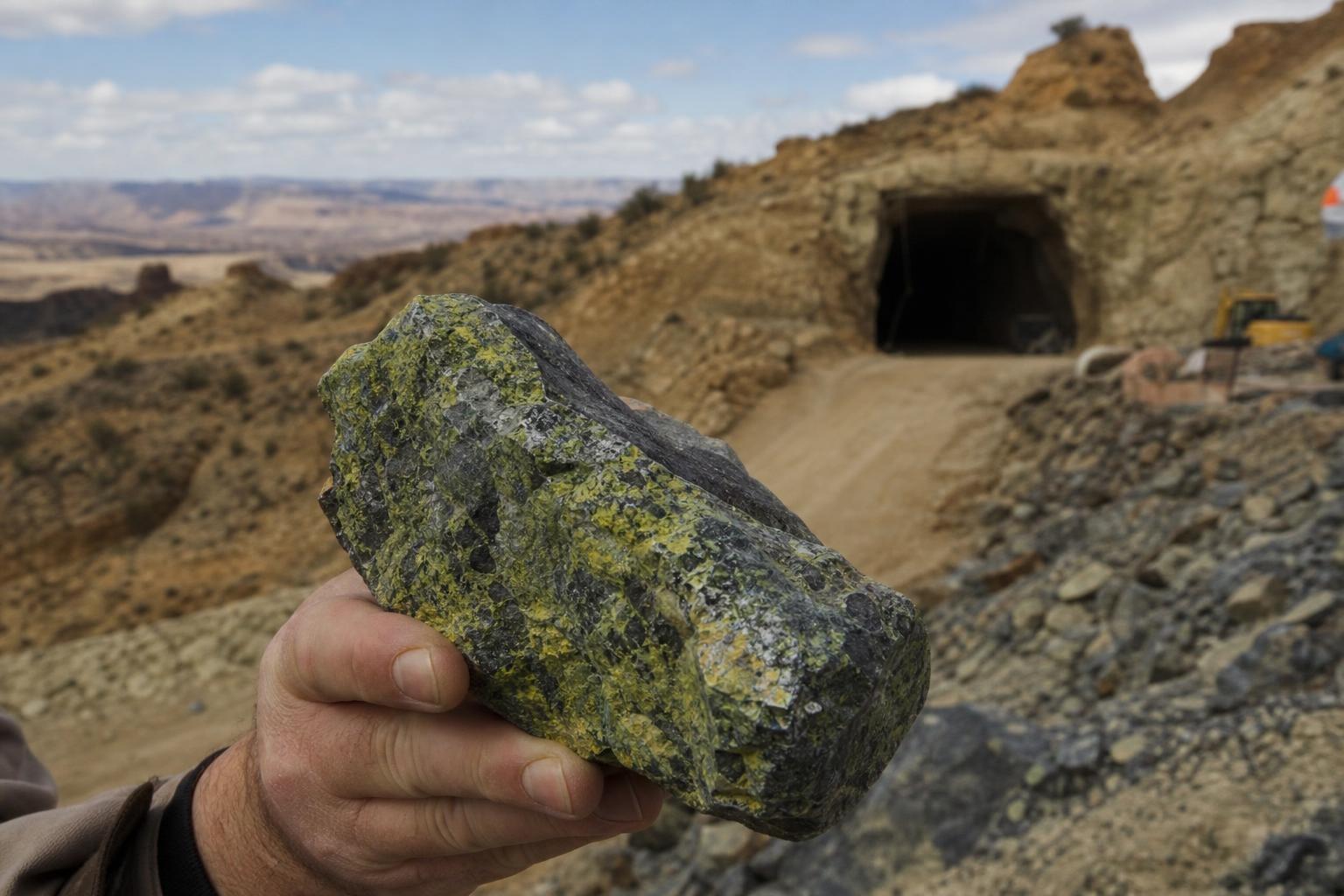
The road south of the South Rim rolls past piñon and juniper, then drops into a clearing of drill rigs, haul trucks, and yellow hard hats. Here, a compact shaft pierces the Kaibab limestone, raising buckets of pale, radioactive rock. What’s coming up is unusually rich by American standards, a cache of uranium ore that could feed reactors for years — and ignite a debate far beyond the forest line.
Why this ore matters
In a world racing to cut carbon, nuclear energy is back in focus. The United States wants more fuel that is both reliable and domestic, especially as Congress edges toward curbing imports from adversarial suppliers. Prices for uranium spiked above $100 per pound recently, reviving long-idled projects and investor interest.
Here, the grades are, according to state filings and company disclosures, among the highest in the country. Most U.S. deposits today hover at a fraction of a percent, but Arizona’s breccia-pipe bodies can jump an order of magnitude. Company literature calls these pipes “a very small surface footprint” with “world-class grades.” Those numbers, if sustained, make every ore bucket count — and make every risk heavier.
- The stakes: national energy security, regional economics, tribal sovereignty, groundwater protection, and the precedent set for mining near protected lands.
A mine in the monument’s shadow
The shaft sits on Kaibab National Forest land, roughly 10 kilometers from the national park’s boundary. In 2023, the president established the Baaj Nwaavjo I’tah Kukveni — Ancestral Footprints of the Grand Canyon National Monument, a sweeping protection that locked up new claims across a vast landscape. But existing, legally validated rights were grandfathered, leaving a handful of permitted operations to proceed.
That legal seam is where this project lives, against a panorama of cliffs, buttes, and the ancient river’s carve. The Havasupai Tribe, whose name means “people of the blue-green waters,” has opposed mining on the plateau for decades. “Water is life,” tribal leaders have long said, invoking springs and seeps that thread through limestone into the canyon’s heart.
The promise and the peril underground
Breccia-pipe geology is unusual: a near-vertical, pipe-like column formed by a collapse in the rock, concentrated with minerals over geologic time. In theory, that geometry allows a tight footprint and precision mining. Supporters emphasize minimal surface disturbance, closed-loop dewatering, and continuous monitoring. “These mines are small, fast to reclaim, and among the cleanest ways to produce uranium,” promotional materials insist.
Critics answer that hydrogeology mocks theory. The plateau’s stacked aquifers, fractured beds, and solutioned limestone can create sudden, poorly mapped pathways. A drill hole that seems dry in one season can surge in the next. Environmental groups point to historic spills, tank overflows, and storm-driven flooding at Western sites as warnings, not anomalies. “You don’t get do-overs with aquifers,” one advocate’s report argues.
There is also the question of time. Ore is extracted in bursts, then trucked more than 400 kilometers to a mill in Utah — a corridor of lined loads, dust controls, and highway checkpoints. The community sees every truck twice: once on the way north with fuel and steel, once on the way south with ore and risk. Supporters see steady paychecks, hotel bookings, and a jolt of tax revenue in remote towns.
Science versus certainty
What everyone wants is certainty, and what the plateau offers is complexity. Monitoring wells are drilled, sampled, and logged. Engineers publish hydrologic models, then update them when new data arrive. Opponents call those updates backpedaling; operators call them refinement. It’s a textbook clash between precautionary principle and adaptive management.
Even on radiation, the rhetoric can split. Regulators set occupational limits, companies post dosimeter graphs, and workers attend safety briefings. Yet the most fragile receptors — seeps feeding hanging gardens, springs sacred to Indigenous communities — don’t carry Geiger counters. They carry cultural memory and ecological threads that are hard to quantify and impossible to fully replace.
Policy winds, shifting sands
Federal agencies are nudging a different balance. The Department of Energy is seeding domestic supply, including advanced-reactor fuels, while Interior refines hardrock mining rules for 21st-century constraints. Lawmakers float bans on Russian uranium, which would tighten global flows and reward high-grade domestic tons. Each policy tweak echoes through the market, into payrolls, and across canyon echoes.
Meanwhile, the mine keeps its schedule: sink, sample, and ship. If grades and prices align, the operation will accelerate; if they don’t, it can pause, mothballed like so many Western projects awaiting the next cycle. That volatility is the industry’s habit — and the community’s persistent anxiety.
Edge of a wonder, weight of a decision
On quiet mornings, mule deer nose past the gate, and ravens ride thermals over the forest’s rim. The mine hums below, a narrow experiment in how modern societies balance immediate needs and enduring values. “Protect what is irreplaceable, power what we must,” says a bumper sticker at a nearby trailhead. Between those imperatives is a seam of rock, a lift of ore, and a choice the country keeps deferring — until the next truck rolls and the next spring runs clear, or doesn’t.
