
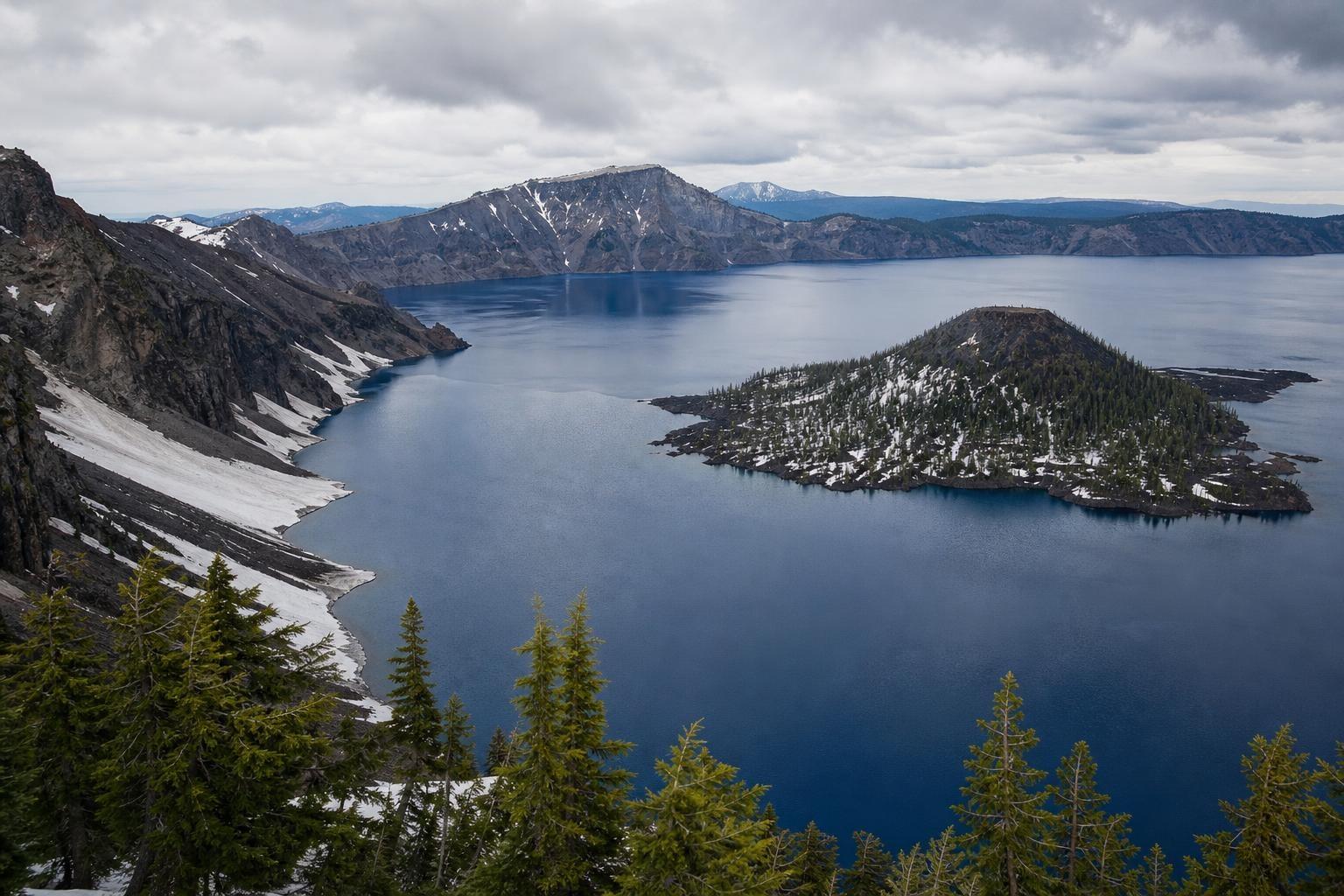
The first sight of this astonishing basin can feel like stepping into a dream. The water holds a color so saturated and so pure that many visitors whisper, “It can’t be real.” In that sudden hush, you grasp a simple, startling truth: this vast bowl is fed by the sky alone.
A mountain that fell into itself
Some 7,700 years ago, an enormous eruption tore apart Mount Mazama. The emptied magma chamber could not bear its own weight, and the summit collapsed. That implosion left a caldera, steep and silent, which would one day cradle the bluest water you may ever see.
Filled by weather, held by stone
Here no river feeds the lake, and no stream drains it. Every drop arrives as rain or snow, and every inch of level is balanced by evaporation and slow seepage through volcanic rock. The residence time of its waters stretches across generations, a long hush of patience between storms.
Clarity that startles the eyes
Because no muddy inflows deliver sediment, the water stays oligotrophic—extremely low in nutrients. Tiny particles don’t clutter the column, so light travels deeply, and the notorious blue is the color of wavelengths that survive the journey. Secchi disks often vanish beyond thirty meters, a measure of clarity that feels like a magic trick.
The physics of that impossible blue
Pure water absorbs reds and yellows more than blues, so scattered blue photons bounce back to your eyes. Add the dark caldera walls and the cloudless Oregon sky, and the bowl becomes a vast lens for light. “What you see is sky, stone, and water—nothing else,” as one ranger likes to say.
Snow country, sky reservoir
Winters bring hundreds of inches of snow, stacking drifts like silent cathedrals around the rim. Spring melt slides down pumice slopes, one droplet at a time, knitting the lake’s surface back to stillness. It is weather turned reservoir, storm turned mirror, season turned depth.
Islands, spires, and underwater mountains
Wizard Island, a cinder cone, rises like a story from the west side, its black lava stitched with stubborn pines. Across the basin, the Phantom Ship’s rock spires look like a small schooner in fog. Beneath the surface, unseen buttes and lava domes shape a drowned landscape as dramatic as any coastline.
Life in a lean, cold world
Original waters held no fish; the lake was too young and too isolated by stone. Stocking in the late 1800s introduced trout and kokanee, and small populations endure in this nutrient-poor realm. Zooplankton and tiny algae cycle slowly through the seasons, proof that even spare ecosystems can hum with quiet life.
Stories older than ash
For the Klamath people, this place is sacred ground. Oral histories speak of a mountain shattered by forces beyond human scale, a memory braided with the geology scientists describe. “Listen long enough, and the water will tell you its age,” a cultural elder once remarked in a spirit of reverence.
A living volcano, calmly watched
Though the crater holds peace, the volcano remains alive under layers of lava and time. Instruments track tiny tremors, heat, and shifting crust, a vigilant network of scientific ears. Calm is the default state, but patience is the landscape’s habit here.
Ways to meet the blue with care
- Stay on marked trails and give fragile slopes the courtesy of your footsteps.
- Pack out every crumb; even small inputs feed unwanted algae.
- Keep drones grounded; this quiet is part of the park’s protected soundscape.
- Let the water stay empty of coins and keepsakes; souvenirs belong in memory.
Weather, light, and the hour you choose
Arrive in early morning for a surface like poured glass, or linger at dusk when shadows sharpen the rim. After storms, the air turns almost crystalline, and the lake becomes a giant eye for the sky. On windy days the color grows steelier, a reminder that mood is part of the view.
What the shoreline teaches
Walk the rim and watch angles of light change the water’s voice. Stand near pumice and andesite, and feel volcanic history under your boots. Kneel, and you’ll see pebbles thirteen meters down as if within reach—clarity turned into vertigo.
The stillness that lingers after you leave
Even hours later, you may hear the lake’s slow breathing in your mind. The place works with absence as its raw material—no rivers, little noise, almost nothing added, almost nothing lost. In that pared-back equation, the sky writes its own story, and the water keeps it, brilliantly, forever.
