
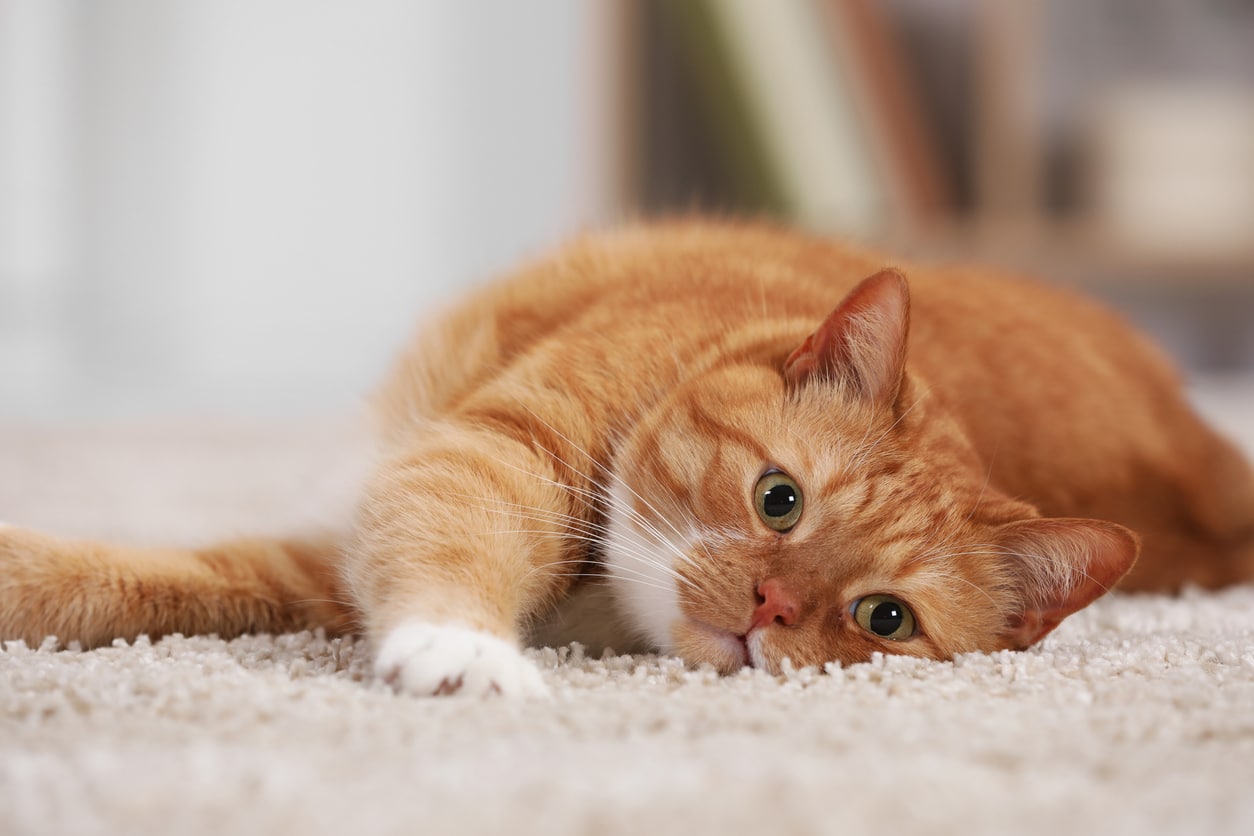
Orange cats are not rare in themselves: what is rare are orange females. About 80% of orange cats are males, with 20% females, i.e., four males for every female. The explanation lies in a gene carried on the X chromosome, identified in May 2025 by two independent research teams.
A single copy of the gene suffices for a male; a female requires two.
One X chromosome, two rules of the game
Like humans, the male cat carries an X and a Y chromosome, while the female carries two X chromosomes. The orange color gene, referred to as the O gene, is located exclusively on the X chromosome. A male who receives from his mother an X carrying the mutation will therefore be entirely orange, with no second X to compensate.
For a female, the equation is more complex. She must have the mutation on both of her X chromosomes, which implies a orange father (who transmits his single mutated X) and an orange or tortoiseshell mother, capable of also passing on a mutated X. A male orange, by contrast, can be born as soon as his mother passes him the correct X. This parental combination is statistically less frequent than the straightforward maternal inheritance needed by a male.
Breeding experiments illustrate this well. An orange male mated to a non-orange female yields no orange kittens: half the offspring are tortoiseshell females, the other half are black males.
ARHGAP36, the gene that remained elusive for decades
It has long been known that orange coloration depends on the X chromosome. The exact gene, however, remained unknown until May 15, 2025, when two studies published simultaneously in Current Biology identified it. One study came from Kyushu University (Japan), led by Hiroyuki Sasaki, the other from Stanford Medicine (USA), led by Christopher Kaelin, and both pointed to the same gene: ARHGAP36.
The two teams approached the problem differently. At Stanford, researchers first identified 51 X chromosome variants common to orange males, discarded 48 because they also occurred in non-orange cats, and among the remaining three selected a small deletion that increased the activity of a neighboring gene. In Kyushu, sequencing ten orange cats and eight non-orange cats revealed a 5.1 kilobase deletion in a noncoding region of the gene, present in all ten orange cats and in none of the eight others. It was subsequently confirmed by PCR on 40 additional samples.
Until then, ARHGAP36 had no known link to pigmentation.
This gene is normally not active in pigment cells of mice, humans, or non-orange cats. The deletion removes a regulatory region, causing the gene to be inappropriately turned on in melanocytes, producing roughly thirteen times more RNA than in cats of other colors. Stanford’s work shows that the resulting protein decreases the amount of PKA, an enzyme downstream of the Mc1r receptor, thereby diverting pigment production from eumelanin (black and brown) toward pheomelanin, which is responsible for orange tones.
Why females display patches
In a female carrying the mutation on only one X chromosome, each cell randomly inactivates one of its two X chromosomes, a process known as X inactivation. Depending on which X is retained, the hair region produces orange or black pigment, hence tortoiseshell coats and, when white is present, calico coats.
The Japanese researchers verified that this inactivation mechanism applies to ARHGAP36 in mice, cats, and humans. This validates the long-standing hypothesis used to explain color mosaics. Fully orange females carry the mutation on both X chromosomes, thus lacking any black regions.
Orange or calico males are extremely rare, and the same study provides the explanation. The calico male studied was heterozygous for the deletion, corresponding to the presence of an extra X chromosome (XXY configuration). In the literature, other possible causes include chimerism and mosaicism, or a mutation arising in only a subset of cells.
A mutation that seems peculiar to the domestic cat
According to the Stanford team, this mutation has not been observed in any other mammal. The ARHGAP36 gene, highly conserved across mammals, had previously been studied in cancer biology and development: it is normally expressed in neuroendocrine tissues, where its overexpression can promote tumors. The researchers therefore measured its activity in the kidney, heart, brain, and adrenal gland, finding no difference between orange and non-orange cats.
No health problems related to the mutation have been noted so far.
Because the gene is active in certain brain regions and in hormonal glands, Kyushu’s team does not rule out effects beyond coat color, but nothing demonstrates them. Stanford’s researchers, for their part, did not observe any difference in brain expression, leaving the question of behavior open. Accordingly, the famed temperament of orange cats remains, for now, outside the realm of genetic evidence.
In practice, the deletion can now be detected by PCR, the technique used in Kyushu to confirm the link to orange color. As for the 80% male ratio, it is a commonly cited rough figure that can vary across cat populations.
Sources: nature.com | ScienceDirect (sciencedirect.com) | Molecular and genetic characterization of sex-linked orange coat color in the domestic cat (pmc.ncbi.nlm.nih.gov)
Article prepared with the help of AI · Our method
