
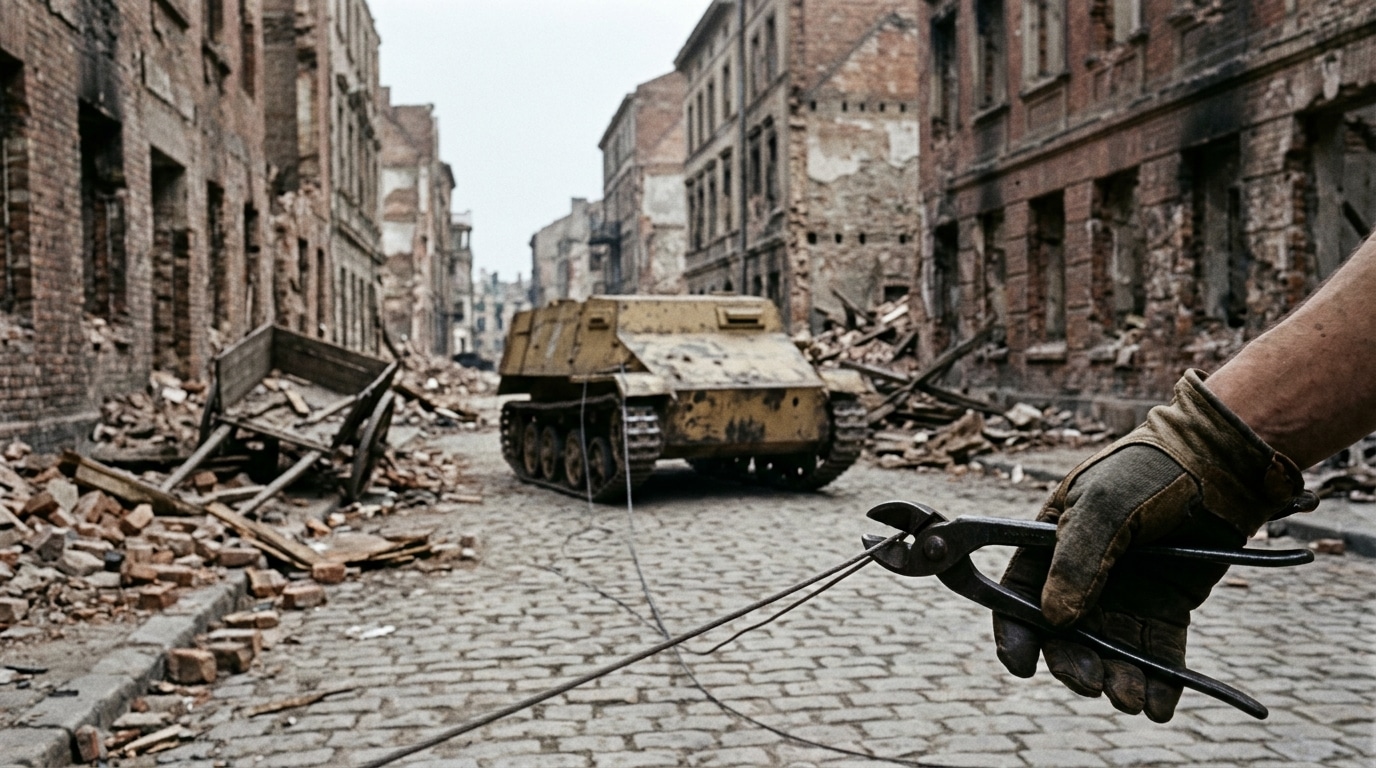
A small unmanned tank, carrying 60 kg of explosives, that advances toward its target on its own. The idea seems straight out of a science fiction film, but the Wehrmacht did indeed put it into service as early as 1942. Its name: the Goliath. Its weakness: a simple wire.
- The Goliath, a German mini-tank remotely controlled by a 650-meter cable, carried 60 kg of explosives and could be neutralized simply by cutting its wire, as the Poles did in Warsaw in 1944.
- Produced by Borgward and then Zündapp in more than 7,500 units between 1942 and 1944, the device cost about 3,000 Reichsmarks per unit but remained too slow and fragile to live up to its military promises.
- This dilemma between innovation and the vulnerability of the wire is echoed today with fiber-optic FPV drones used in Russia and Ukraine, which evade jamming but leave polluting cables on the battlefield.
- A miniature tank to destroy without risking a single soldier
- 650 meters of wire, the Achilles’ heel of a revolutionary weapon
- Borgward, Zündapp: two manufacturers for a device quickly outpaced by the war
A miniature tank to destroy without risking a single soldier
Imagine a small tracked box, barely taller than a knee, gliding silently toward an enemy bunker. No driver on board, no soldiers exposed to fire. This is precisely the principle of the Goliath, officially named Leichter Ladungsträger Sd.Kfz. 302 by the German army.
Its mission can be boiled down to one sentence: rush toward a target, whether it’s an enemy tank, a fortification, or a group of entrenched soldiers, and then explode on contact. A disposable weapon, designed to sacrifice machinery rather than human lives.
The concept didn’t originate in German offices. It drew inspiration from a French prototype found near the Seine in 1940, attributed to engineer Adolphe Kégresse, renowned for his work on tracked vehicles. The Germans retrieved the idea, refined it, and industrialized it for their own needs.
Two electric motors of 2.5 kW powered the device to about 10 km/h, a speed that seems modest today but was enough to approach a fixed target covertly. All this for a 60 kg explosive charge, capable of pulverizing a tank or shaving a section of a wall.
650 meters of electrical wire, the Achilles’ heel of a revolutionary weapon
On paper, the Goliath looked like a formidable innovation. In battlefield reality, its design concealed a glaring, simple, yet insidious flaw.
The operator controlled the device from a box fitted with a broom handle, connected by a three-strand cable unwound from a drum at the rear of the vehicle. This 650-meter wire provided steering, forward and reverse movement, and the triggering of the charge.
In other words, without this wire, the Goliath was nothing more than a motionless metal box. An enemy soldier didn’t even need to aim at the device: cutting the cable was enough to neutralize the entire machine.
Polish troops understood this perfectly during the Warsaw Uprising in 1944. They quickly identified this vulnerability and severed the cables from a distance, rendering several of these mini-tanks harmless. Produced by Borgward and then Zündapp, the Goliath rolled at around 10 km/h and depended on a 650-meter command wire that a single shell fragment was enough to sever.
Radio-controlled versions were indeed developed to free it from this cumbersome cable. But they arrived too late in the conflict, and suffered another major flaw: the Allies could jam the control frequency, making the device just as vulnerable, albeit by a different method.
Borgward, Zündapp: two manufacturers for a device quickly outpaced by the war
The production of the Goliath involved several German manufacturers, evidence that the army was seriously betting on this concept despite its obvious limits.
The early models, equipped with two electric motors, came from Borgward’s Bremen plants. The problem: each unit cost about 3,000 Reichsmarks, a high price for a disposable weapon. Not to mention the difficulty of recharging or maintaining these motors directly on the front, far from any infrastructure.
Facing these constraints, production evolved. The electric Sd.Kfz. 302 reached 2,650 units between April 1942 and January 1944. It was then replaced by more robust gasoline-powered variants: the Sd.Kfz. 303a, produced in 4,604 units, and the 303b, with 325 units, manufactured notably by Zündapp.
These figures are impressive in volume, but they also reflect a more nuanced reality. The Goliath never truly fulfilled its battlefield promises. Too slow, too fragile, too dependent on a wire or a radio frequency easily countered, it often disappointed the hopes placed in it by the German high command.
The history of this weapon illustrates a classic tension in military innovation: a bold idea, hampered by technical constraints that the combat context inevitably reveals.
What stands out in hindsight is the persistence of this technological dilemma nearly eight decades later. Since the spring of 2024, Russian forces, and then in 2025 Ukrainian forces, have massively deployed fiber-optic FPV drones, a solution designed precisely to escape electronic jamming that, according to General Pierre Schill, then-chief of staff of the French Army, had for a time neutralized about 75% of usual drones. The first model deployed at scale, the Knyaz Vandal Novgorodsky, proved effective in Kursk Oblast as early as August 2024, flying up to 60 km/h without its fiber breaking within a 10-kilometer radius, according to a specialist cited by RFE/RL. But as with the Goliath, this technology leaves tangible traces on the ground: the Conflict and Environment Observatory now warns about the accumulation of these abandoned cables, a new form of plastic pollution that soldiers even found tangled with bird nests, later donated to the National Museum of the History of Ukraine from World War II. The wire, whether copper or glass, remains a tether that hobbles anyone seeking to wage war remotely.
Sources : Leichter Ladungsträger Goliath Sd.Kfz. 302 – Oorlogsmuseum Overloon (oorlogsmuseum.nl) | Back to the Drawing Board – The Goliath Tracked Mine (military-history.org)
Article prepared with the help of AI · Our method
