
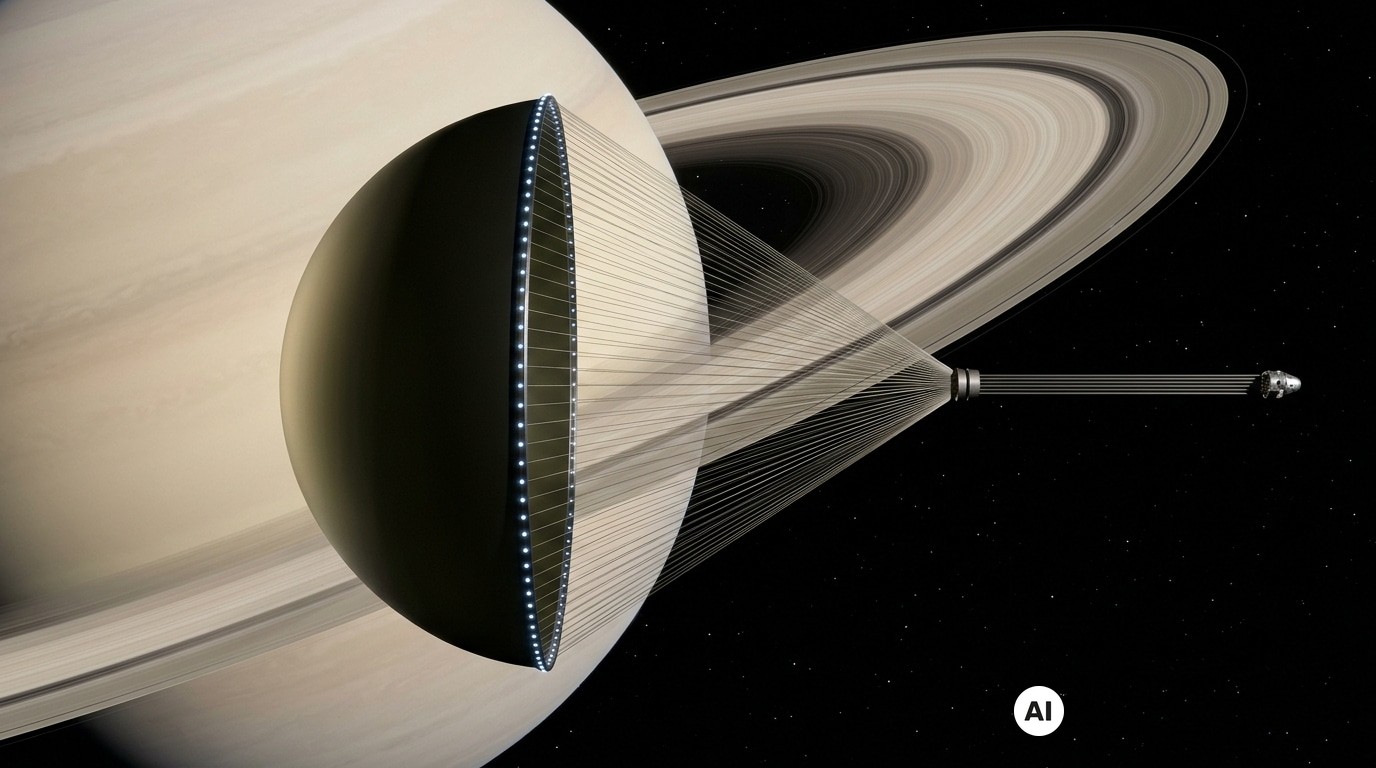
Propelling a spacecraft by detonating atomic bombs in front of its hull might sound like a disaster movie plot. Yet this concept, dubbed Medusa, was indeed theorized by a physicist from Los Alamos. A giant sail absorbs the blast from each explosion, cables and winches dampen the jolt, and the crew would enjoy, according to its inventor, a remarkably smooth journey.
- In 1993, physicist Johndale C. Solem published the Medusa concept in the Journal of the British Interplanetary Society to propel a spacecraft by nuclear explosions.
- A sail with a 500-meter radius, held by 10,000 cables, absorbs the blasts while winches transform the shock into a gradually applied and gentle thrust.
- This dream of nuclear propulsion persists today despite the end of DARPA’s DRACO program, with NASA’s SR-1 Freedom mission planned for before the end of 2028.
- A Los Alamos physicist revives the wild idea of nuclear propulsion
- Medusa: when a giant sail takes the blast of bombs
- Cables and winches to turn an explosion into gentle thrust
A Los Alamos physicist revives the wild idea of nuclear propulsion
In 1993, physicist Johndale C. Solem published in the Journal of the British Interplanetary Society a clearly titled article: Medusa, nuclear explosive propulsion for interplanetary travel. The aim is not to entertain the scientific community, but to address a very concrete problem. How can we send a human crew to Mars or beyond without exposing them to radiation or leaving them to languish for months in zero gravity?
Solem makes a blunt assessment. Galactic cosmic radiation, solar eruptions, muscle loss due to weightlessness, and the psychological strain of an extended confinement form a dangerous cocktail. The longer a voyage lasts, the more these threats accumulate. The solution he proposes can be summarized in one simple formula: you must go faster, with an engine capable of both high thrust and a high specific impulse, meaning great efficiency per kilogram of propellant consumed.
To achieve these performance levels, no conventional chemical engine suffices. Solem turns to a energy source that few still dare to mention in a civilian context: nuclear fission, not to heat a reactor but to generate thrust directly through a sequence of controlled explosions.
Medusa: when a giant sail takes the blast of bombs
In Medusa, a vast sail is deployed at the front of the vessel, somewhat like a sailor’s spinnaker billowing in the wind. Except here, it is not the air that pushes the fabric, but the blast of an atomic detonation. Nuclear charges are fired ahead of the ship and explode between the hull and this sail, which acts both as a shield and as an energy receiver.
This geometric choice is not incidental. By placing the sail far forward, Solem distances the explosion from the crew and spreads the shock wave over a surface large enough to avoid pulverizing the structure. In the Los Alamos report LA-12189-MS, published in October 1991, he details a sail with a 500-meter radius, deployed by rotation and held in place by 10,000 cables arranged like the spokes of an oversized bicycle wheel.
This architecture does not arise out of nowhere. It draws inspiration from the work of Ted Cotter, a Los Alamos researcher who, as early as the 1970s, envisioned a system that historian George Dyson called a rotating-cable pusher. Solem picked up this principle and refined it into a complete interplanetary spacecraft architecture.
Cables and winches to turn an explosion into gentle thrust
There remains a major problem. An explosion releases its energy abruptly, almost instantaneously. Transmitting this violence directly to the hull would crush the crew against the walls. This is where cables come into play. Under the force of the explosion, they unravel progressively from winches mounted on the ship, generating electricity in passing thanks to a motor-generator driven by their unwinding.
The vessel is then hauled toward its own sail, much like a climber hoisting themselves up a rope fixed above. The kinetic energy of the explosion is thus converted into a pull spread over time, rather than a single, destructive jolt. The mechanical system is simple in principle, even if it remains dauntingly complex to implement.
In 1994, Solem further refines his idea in a new JBIS publication. He introduces a programmed servo-winch capable of unwinding and rewinding the cables according to a precisely calculated sequence. His stated objective: to offer the crew an unusually smooth ride, despite the violence of each detonation that propels the ship forward.
This dream of nuclear propulsion for crewed exploration has never truly disappeared, even as it struggles to secure stable funding. DARPA terminated its DRACO nuclear-thermal propulsion program in 2025, and NASA’s 2026 budget contains no line for this type of technology, whether thermal or electric. Yet, at its Ignition event, NASA announced the SR-1 Freedom mission, a vessel equipped with roughly a 20-kilowatt nuclear-electric reactor, with a launch toward Mars planned before the end of 2028.
Medusa remained theoretical, but it illustrates a constant in space history: engineers have never really given up on the atom as a means to reach Mars.
Sources: Medusa: Nuclear explosive propulsion for interplanetary travel – ADS (ui.adsabs.harvard.edu)
Article prepared with the help of AI · Our method
