
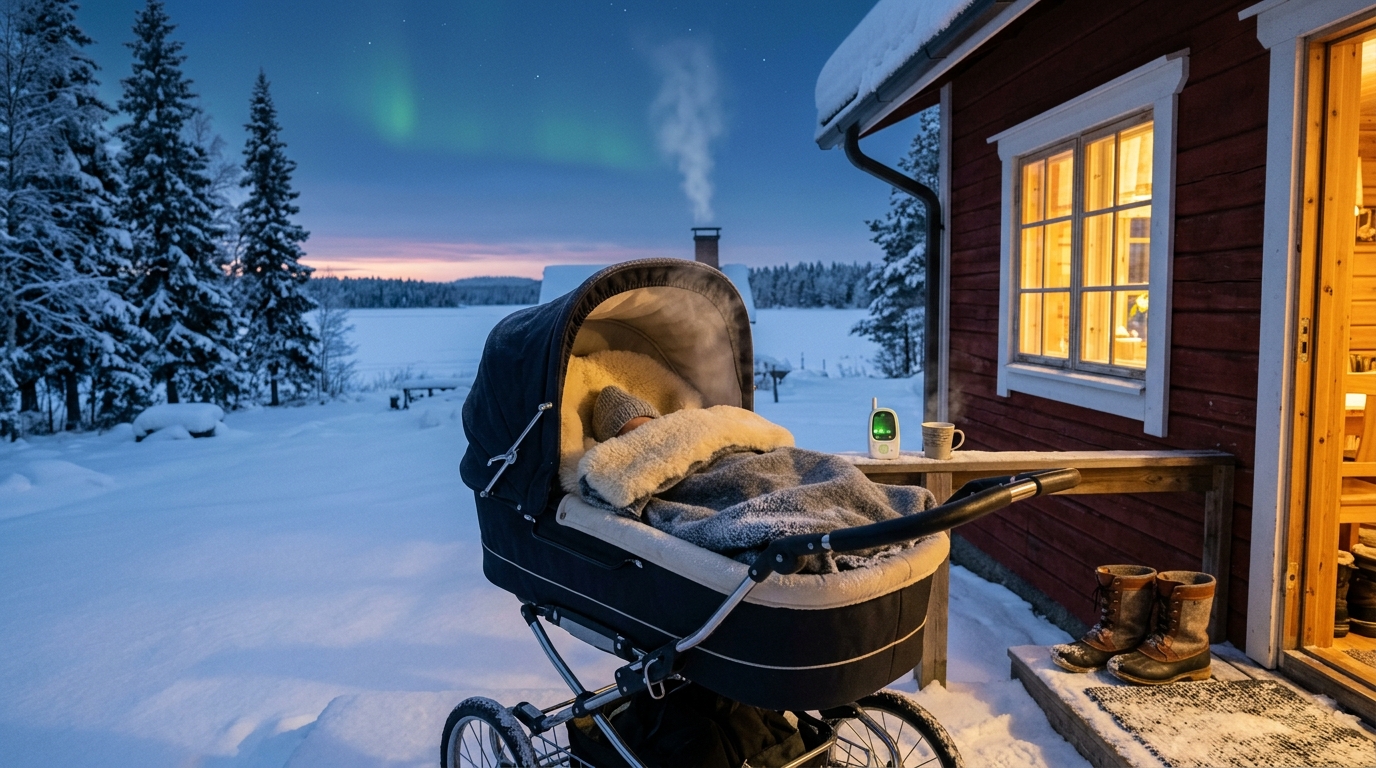
A clarification above all: in Finland, babies as young as two weeks old take their nap outside at -27°C. This isn’t an isolated anecdote, but a documented practice by researchers at the University of Oulu, who even identified the ideal temperature to help these little ones sleep as long as possible, tucked into the Nordic cold.
- Researchers at the University of Oulu have determined that around -5°C would be the ideal outdoor napping temperature for babies.
- A study of 116 Finnish children showed that outdoor naps lasted longer (1.5 to 3 hours) than indoor ones (1 to 2 hours).
- This extended duration would be explained by the tighter swaddling made possible by the cold, limiting movement without the risk of overheating.
- The cradle of cold: why -5 °C could be the perfect temperature for outdoor sleep
- Two-week-old babies outside at -27 °C: the Finnish study that challenges our certainties
- The colder it gets, the longer they sleep: what the 116 families observed in Oulu reveal
The Cold That Rocks to Sleep: Why -5°C Might Be the Perfect Temperature for Sleeping Outdoors
If you thought that an infant must absolutely sleep warm, under a cozy blanket and away from any draft, head to Finland to reassess that certainty. There, researchers at the University of Oulu have determined that a temperature around -5°C would constitute the perfect balance for outdoor napping.
Not too cold to endanger the baby, not warm enough to disturb sleep. At this precise threshold, Finnish parents know exactly how to dress their child: multiple layers, a sturdy snowsuit, a well-sealed nest. The equation becomes a win-win for everyone.
This figure is not a statistical fluke. It emerges directly from field observations among families who have practiced this habit for generations. A detail that changes our view of what we once believed to be pediatric common sense.
Two-Week-Old Babies Outside at -27 °C: The Finnish Study That Shakes Our Certainties
Head north to Oulu, a city in northern Finland where winters spare nothing. In this harsh climate, a team from the Institute of Health Sciences—comprising Marjo Tourula, Arja Isola, and Juhani Hassi—conducted a cross-sectional questionnaire study with the parents of 116 children under two years old, all followed by the city’s infant protection clinics.
The most striking finding is in the numbers: outdoor naps begin as early as two weeks old, with temperatures recorded during these sleep periods ranging from -27°C to positive values. In other words, newborns just out of the hospital already spend time asleep in a cold that would chill any French parent.
This tradition isn’t born from thin air. A 2011 thesis from the University of Oulu traces this recommendation to Finnish pediatrician Arvo Ylppö, who promoted it in the 1920s as part of a national public health policy. A century later, the practice persists, carried by generations of Finnish families convinced of its benefits.
The Colder It Is, The Longer They Sleep: What the 116 Families Observed in Oulu Reveal
The figures collected from families are unequivocal. Indoor naps lasted for one to two hours for half the children, while outdoor naps stretched from about one and a half to three hours for half the children. Cold would thus prolong sleep, contrary to what common sense might suggest.
How to explain this phenomenon? According to Marjo Tourula, the movement restriction imposed by thick clothing would play a central role. The cold would permit a tight swaddling without the risk of overheating, unlike what would happen in a heated room. A well-wrapped baby, almost unable to move, would fall asleep more deeply and for longer.
This hypothesis was explored further in a second study, published in Acta Paediatrica in 2010, which measured infants’ skin temperature as well as the duration of their sleep. The aim: to verify that surface cold felt remained controlled despite extreme outdoor temperatures.
One question remains unresolved, that of long-term health benefits. A Swedish pediatrician interviewed by the BBC tempered the prevailing enthusiasm. Some studies suggest that preschool children who spend a lot of time outdoors take fewer sick days. Others, however, show no notable difference. The scientific debate remains open on this particular point.
Nevertheless, this Finnish study provides a valuable perspective on Western habits, often guided by fear of the cold rather than solid data. While not necessarily translating the practice exactly to our latitudes, these findings invite us to reassess our protective reflexes. A baby’s sleep evidently obeys mechanisms more subtle than a thermostat set to maximum comfort.
Article prepared with the help of AI · Our method
