
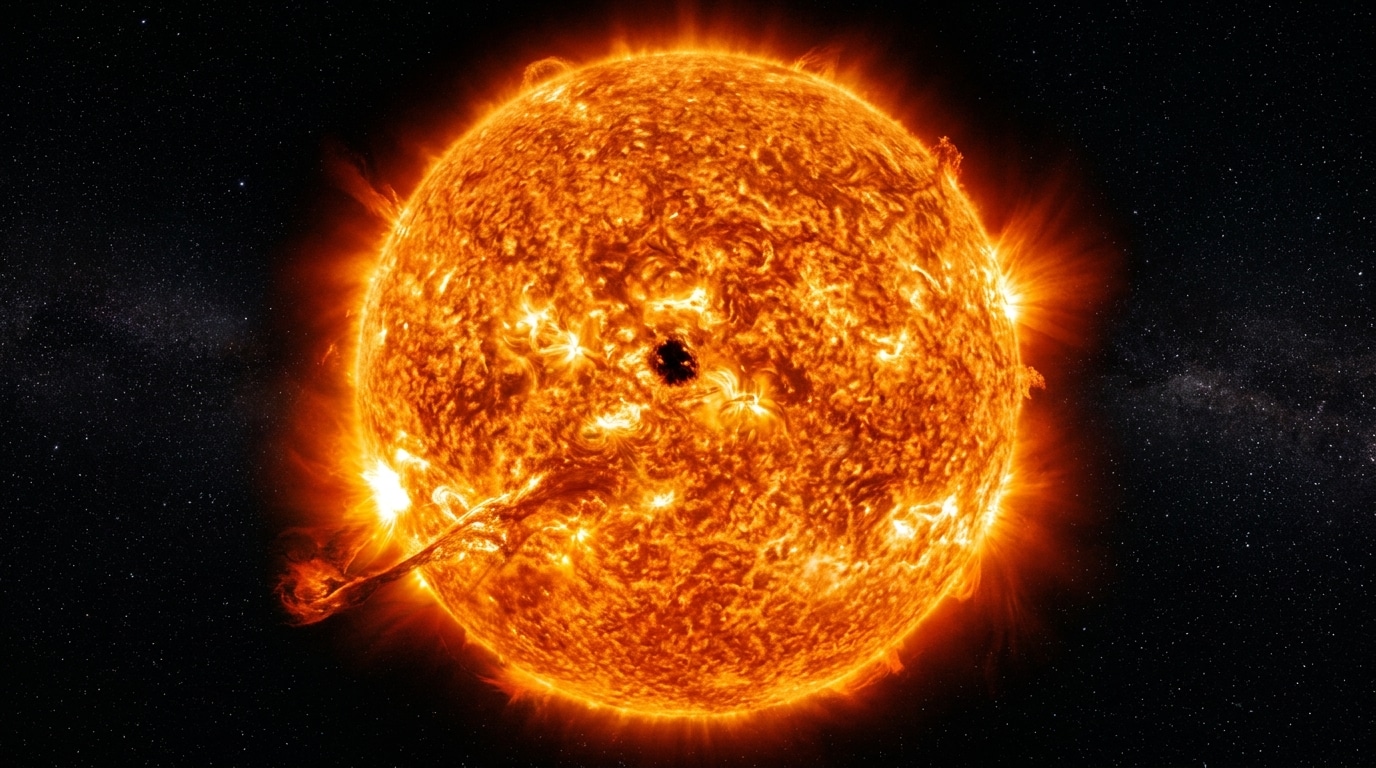
Imagine a boiler so colossal that it burns the equivalent of several thousand aircraft carriers in hydrogen every second. The Sun, our good old star, has been performing this feat for 4.6 billion years without ever faltering. With each cosmic heartbeat, it converts 600 million tonnes of hydrogen and witnesses 4 million tonnes of its own mass evaporate. A vertigo-inducing slimming regime that, on paper, should doom it. And yet, it endures, almost intact. How can a celestial body squander such a fortune of matter while preserving more than 99.9% of its initial mass? The key to this mystery lies in an equation that became famous in the last century and in the bowels of a nuclear furnace of scarcely imaginable power. Let us dive together into the heart of this luminous enigma.
At the heart of the Sun, an alchemy that transforms matter into light
To understand this cosmic sleight of hand, one must descend to the center of our star, where conditions resemble a furnace from hell. The temperature there teeters near 15 million degrees and the pressure crushes matter with unimaginable force. In this infernal cauldron, nuclear fusion unfolds, the hidden engine driving all stars. Hydrogen nuclei, the lightest of elements, collide and fuse to form helium, a little heavier.
But here is the crucial detail: the helium nucleus thus formed weighs slightly less than the sum of the starting pieces. This minuscule mass difference does not vanish by magic. It metamorphoses into pure energy, according to Albert Einstein’s famous relation linking mass and energy. In plain terms, nuclear fusion converts 4 million tonnes of solar mass into energy every second. It is this quiet conversion that lights our sky, warms our beaches, and helps crops grow in late summer.
Four million tonnes vanishing every second: the dizzying numbers
Let us pause to savour the scale of the phenomenon. Every second, the Sun converts into pure light a mass equal to that of a small mountain. On human scales, the world’s annual electricity production would be swallowed by the Sun in a fraction of a second. Our star is an energy machine of utterly outsized generosity.
And yet the energy that reaches us as light and heat represents only a tiny fraction of what the Sun radiates in all directions. Earth, a tiny globe adrift in vastness, intercepts only a negligible share of this deluge of energy. Nevertheless, that meager ration is enough to sustain the entire planet. A reminder, perhaps, of the true power of our star.
A cosmic balance that tips only slightly after 4.6 billion years
Here is the answer to our initial puzzle. Four million tonnes per second may sound colossal, but it is all a matter of scale. The Sun is so gigantic that its total mass is about 333,000 times that of our planet. In the face of this behemoth, losing a few million tonnes per second is almost like bailing out a spoonful of water from an ocean.
Let us do the arithmetic in our heads. Over its 4.6 billion years of existence, the Sun has converted only a tiny fraction of its vast reservoir into energy. The result: it now preserves more than 99.9% of its original mass. It is as if a person living a century would lose in total only one or two grams. Our star burns relentlessly, yet its treasure-chest remains so full that the expenditure is imperceptible.
What the Sun’s slow combustion tells us about our own future
This pharaonic but economical burning offers a precious clue about the destiny of our star. The Sun is today in the prime of its life, with roughly five billion years left to peacefully consume hydrogen before matters become truly complicated.
When its central reservoir begins to dwindle, the star will undergo a dramatic metamorphosis: it will puff up to become a red giant, likely swallowing the nearest planets. Rest assured, this apocalyptic scenario is not imminent. On the scale of a human life, and even of humanity itself, the Sun remains a steadfast and reassuring companion that rises each morning.
Thus, behind the apparent paradox of a Sun that sheds 4 million tonnes every second yet remains largely intact lies a wonderful lesson in physics and scale. Our star is a generous yet patient furnace, capable of burning for billions of years without truly diminishing its fortune. The next time you lift your eyes to a sunny afternoon sky, think of this invisible dance of nuclei that, millions of kilometers away, transforms matter into light. And if this slow alchemy is ultimately but the oldest and most faithful campfire of the Universe?
