
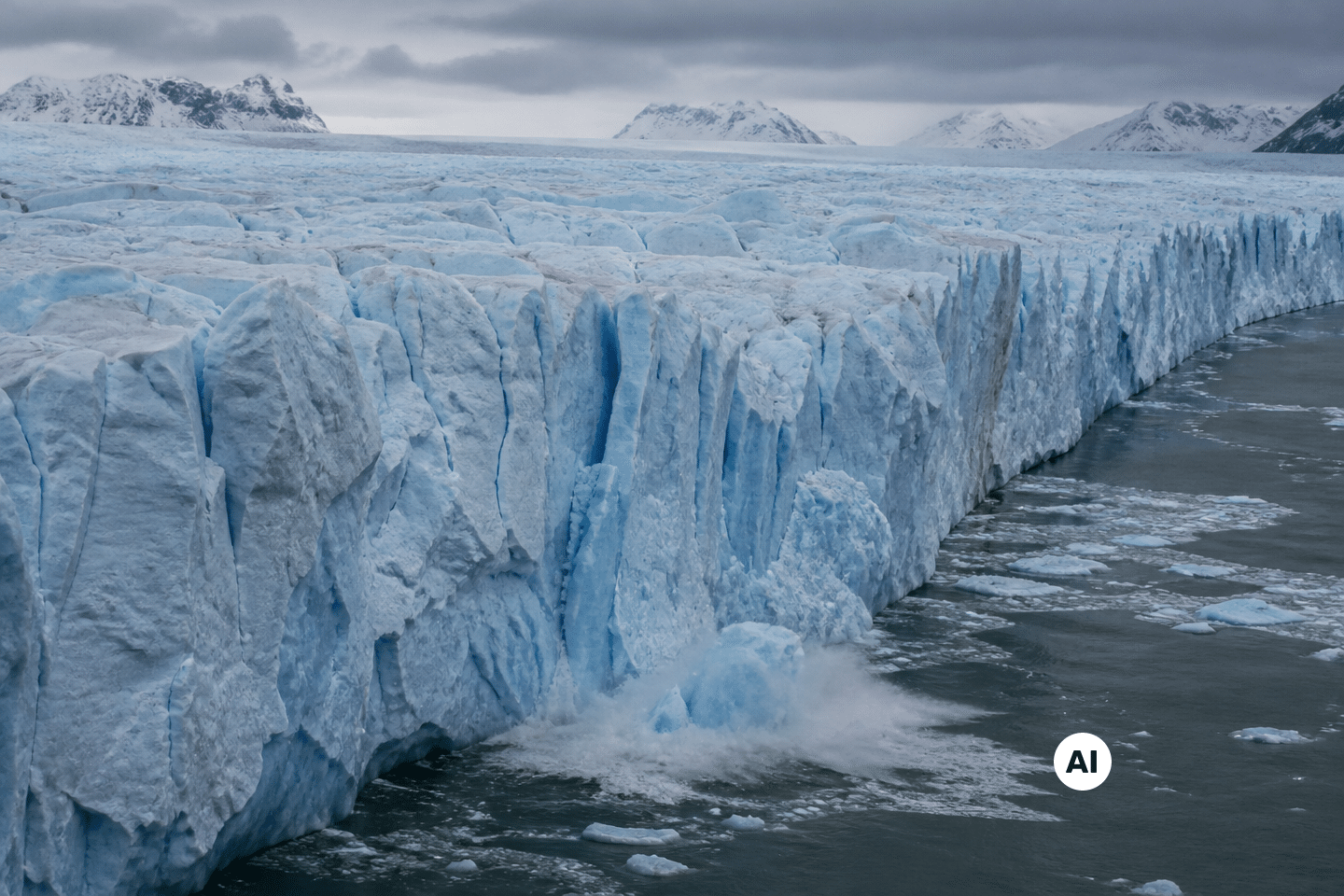
What if climate models have been underestimating for years one of the planet’s most closely watched glaciers? A new ice-sheet model, developed by glaciologists at the University of California, Irvine, and NASA’s Jet Propulsion Laboratory, projects that the melting of the Thwaites Glacier could contribute to sea level rise of up to 30 millimeters by 2100, twice as high as previous estimates.
- A new model predicts that the Thwaites Glacier could push sea level up by as much as 30 millimeters by 2100, twice the prior estimates.
- Researchers found that the “grounding line” is actually a broad zone several kilometres wide where warm seawater infiltrates beneath the ice in step with the tides.
- The Mouginot Ridge rocky crest, which still slows the glacier, is gradually weakening under these infiltrations, risking accelerated detachment and deterioration.
- The glacier hiding a fault twice as severe as expected
- When seawater infiltrates beneath kilometres of ice
- A rocky crest, the last barrier before the glacier’s runaway
The glacier hiding a fault twice as severe as expected
Thwaites is among the names that regularly appear in climate news, often paired with alarming nicknames. The study published in Nature Communications provides a precise measurement for this concern: up to 30 millimeters of sea level rise by 2100, even without further warming.
This figure doubles previous projections. This is not a mere statistical adjustment; it is a fundamental revision. Mattia Poinelli, the lead author and now a project scientist at UCLA with an affiliation to JPL, led this reconstruction built on more than three decades of observations.
Tracing the glacier’s history back to 1990, the researchers found that the observed change was four times larger than what traditional models predicted. In other words, the glacier was already moving much faster than previously thought, and the monitoring tools normally used failed to capture it adequately.
Thwaites is not an isolated case in West Antarctica. Located in the Amundsen Sea Embayment, it accounts for roughly one third of the mass loss of the entire Antarctic ice sheet. Understanding what happens beneath its surface therefore means grasping a significant portion of the future of global coastlines.
When seawater infiltrates beneath kilometres of ice
To understand why the old models were mistaken, one must revisit a central concept in glaciology: the grounding line. Until now, it was imagined as a thin, stable boundary—the precise point where ice resting on the bedrock begins to float on the ocean.
The research team offers a different picture, a grounding zone spanning several kilometres. Not a single line, but a moving space where the ice lifts and settles with the tides. This nuance changes the interpretation of the phenomenon altogether.
In this broad zone, warm seawater infiltrates deeply under the ice, across several kilometres. At each tidal cycle, it floods this space, pressurized and warmed by ocean currents themselves altered by climate change.
This mechanism resembles an internal attack. Rather than melting only on the surface, the glacier is eroded from below, in corners that were previously difficult to observe. It is precisely here that radar data from the Finnish ICEYE constellation made the difference, detecting kilometre-scale fluctuations that had been invisible until now.
A rocky crest, the last barrier before the glacier’s runaway
At the heart of this system lies a geological feature named Mouginot Ridge. This rocky crest acts as a natural fulcrum, somewhat like a wedge that would hold a heavy object on a slope.
For the moment, it still holds back the main trunk of Thwaites, slowing its march toward the ocean. But the processes observed in the grounding zone are accelerating precisely this detachment, gradually weakening the contact between the ice and this stabilizing crest.
Each intrusion of warm water, each tidal cycle, gnaws away at this bond a little more. The glacier’s flow accelerates, and with it its overall deterioration. The researchers emphasize that once this crest becomes unmoored, the glacier will continue to degrade, in a self-sustaining dynamic.
This new model does not simply revise a number upward. It reveals a physical mechanism previously poorly understood, capable of explaining why Thwaites is evolving faster than expected. It remains to be seen how this enhanced understanding will refine future climate projections, and how long this rocky crest will hold against the water infiltrating beneath its icy feet.
