
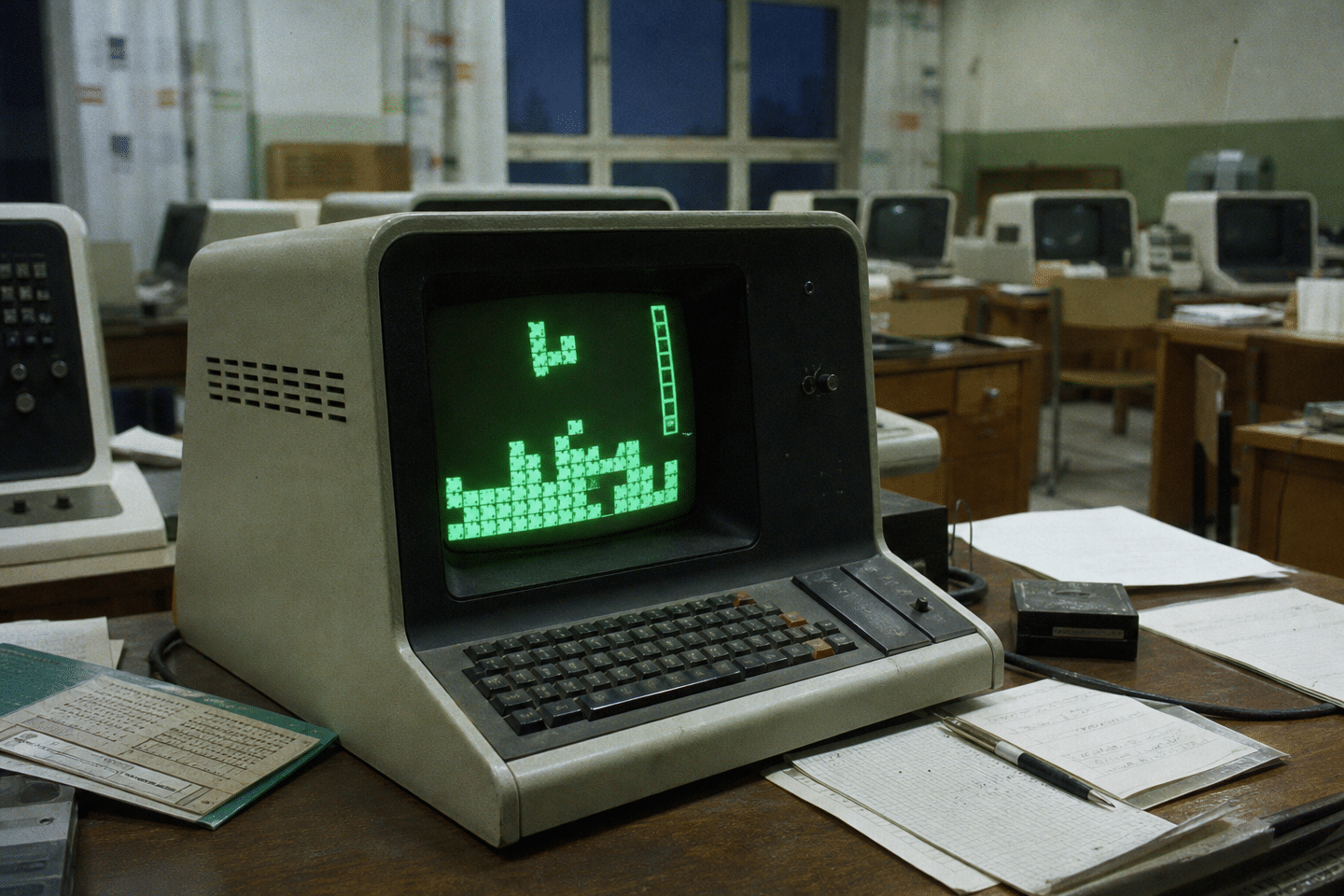
An almost inconceivable achievement for a teenager: in 2023, a 13-year-old accomplished what no human had managed before on the NES version of Tetris. His feat thrust into the spotlight a game born forty years earlier in a Soviet laboratory, on a machine no one would have imagined capable of spawning such a global phenomenon.
- Alexei Pajitnov coded Tetris in 1984 using Pascal on an Elektronika 60, a Soviet computer devoted to scientific calculations
- For a decade, the rights to Tetris were held by the government agency ELORG before The Tetris Company bought them back in 2005
- In December 2023, Willis Gibson, aged 13, became the first person to reach the kill screen at level 157 on the NES version
- A Soviet researcher tinkers with a game on an obsolete computer
- How a simple pastime escaped its creator’s control for years
- From the USSR to consoles around the world: the record-breaking success story
A Soviet researcher tinkers with a game on an obsolete computer
In 1984, Alexei Pajitnov works at the Dorodnitsyn Computing Center, affiliated with the Moscow Academy of Sciences. His tool of choice is the Elektronika 60, a Soviet clone of the PDP-11 from Digital Equipment Corporation. On paper, nothing extraordinary: the machine is mainly used for austere scientific calculations, far from any notion of entertainment.
Yet it is on this machine that lacks a proper graphics card that Pajitnov codes his idea in Pascal. No dazzling colors, no catchy soundtrack: the early stages of Tetris are played with text characters stacking on screen, like a simple word game displayed on a black backdrop.
The core idea is startlingly simple. Geometric shapes made up of four blocks, known as tetrominoes, fall from the top of the screen. The player must rotate and stack them to form complete lines, which vanish instantly. A straightforward principle, almost childlike, but with a remarkably addictive mechanic.
No one at the time could imagine that this pastime, born between two administrative tasks, would one day become a worldwide reference. Created in 1984 by Soviet programmer Alexei Pajitnov on an Electronika 60 computer, Tetris would go on to become the best-selling video game in history, with over 520 million copies sold across all platforms.
How a simple pastime escaped its creator’s control for years
In 1980s USSR, the concept of individual intellectual property was mostly absent. Pajitnov and his programmer colleagues are state employees, and the Academy cannot engage in commercial activity. As a result, all global rights to Tetris were entrusted to a government agency, ELORG, responsible for negotiating licenses abroad.
Pajitnov recalls signing, at the time, a document transferring the game’s rights to the computing center for ten years. In other words, for an entire decade, the game’s creator had very little leverage over its exploitation worldwide, even as Tetris began to conquer personal computers and then home consoles.
It wasn’t until 1996 that the situation truly shifted. Pajitnov joined forces with Henk Rogers, a key figure in the game’s commercial saga, to found The Tetris Company. This organization set out to reclaim management of the global licenses, long scattered across multiple publishers and platforms.
The turning point came in January 2005, when ELORG was acquired by The Tetris Company for 15 million dollars. Twenty years after its creation in a Moscow office, Tetris finally found a owner capable of centralizing the rights, far removed from the bureaucratic Soviet machinery that had long kept it distant from its own creator.
From the USSR to consoles around the world: the record-breaking success story
The figure often cited to describe Tetris as the best-selling video game of all time—520 million copies—deserves a closer look. It sums up sales across all platforms, from arcade machines to today’s smartphones, including home consoles and personal computers.
A significant portion of this total comes from Game Boy. On Nintendo’s handheld console, Tetris was bundled with the device, accounting for 35 million copies simply due to the association’s iconic nature. It’s difficult to imagine a better marketing vehicle than a straightforward title that came free with the machine.
The game’s longevity continues to surprise, even four decades after its inception. In December 2023, Willis Gibson, then 13, became the first human to reach the notorious kill screen of the NES version, at level 157, in under 39 minutes. Before him, only an artificial intelligence had earned credit for this achievement.
The term “kill screen” designates a precise technical milestone. On the NES, from level 29 onward, the blocks fall one cell per frame—a pace deemed far too rapid for nearly all players. Henk Rogers, head of The Tetris Company, personally congratulated Gibson during a video call, saying he had shared the news with Pajitnov himself.
From this latest anecdote emerges a clear truth: four decades after its creation on a now-forgotten Soviet computer, Tetris continues to generate records, evoke emotions, and foster vibrant communities of players. Few creations born from a bit of improvised programming can claim such a lasting legacy.
Sources :
- History of Tetris (tetris.wiki)
- Elektronorgtechnica (Wikipédia)
- A 13-year-old wunderkind is the first human to “beat” Tetris (Popular Science)
