
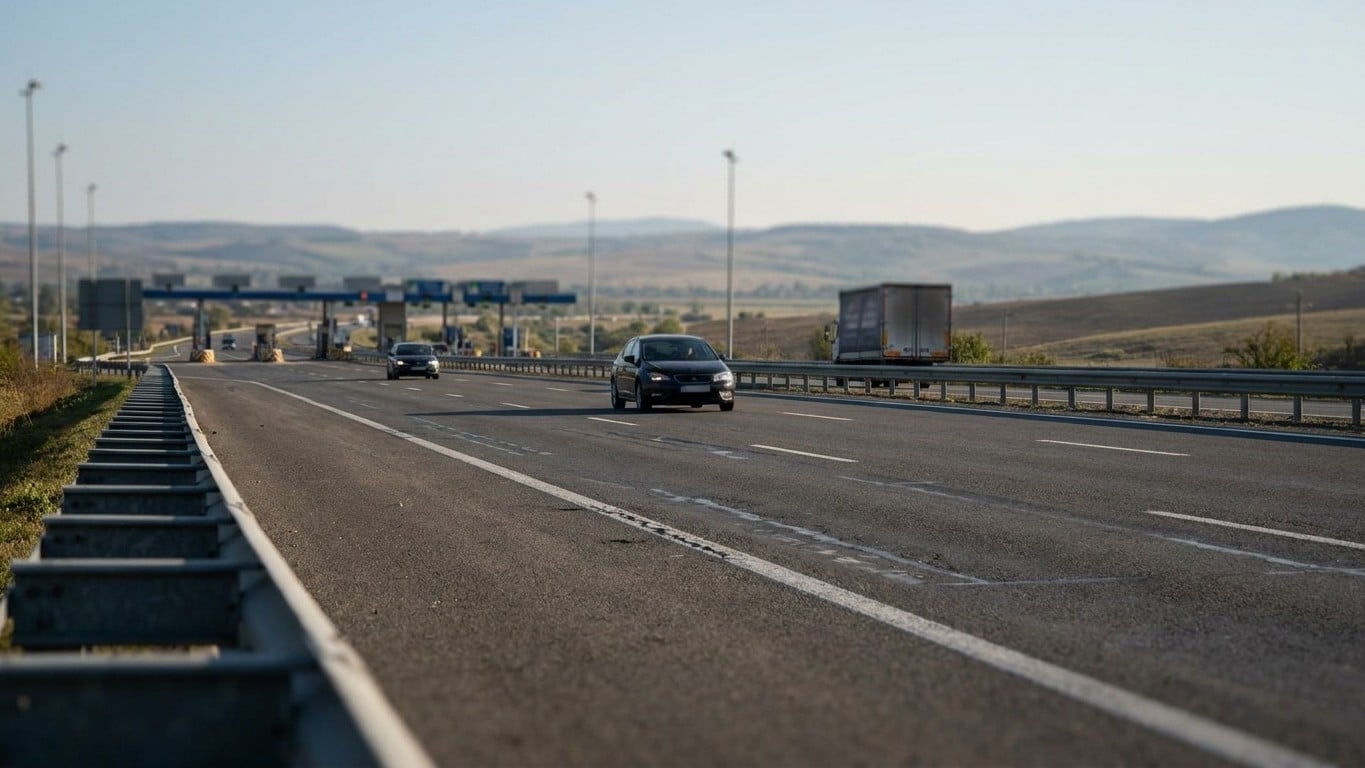
Twenty-two euros and sixty cents. That was the amount to pay, from its opening at the end of 2017, to cover the 150 kilometers between Langon and Pau on the A65 motorway. The price observed in 2017 for the 150 km of the A65 was €22.60, which works out to €0.151 per kilometer, making this plain‑land motorway the most expensive in France at its opening. A entry ticket commensurate with a pharaonic project: €1.2 billion invested to link two towns in the Southwest that the national road had already connected, albeit only poorly, for decades.
The story of this highway begins well before the first spade was turned. In 1994, a ministerial decision allowed the start of a first study, then on 20 January 1995, a consultation on 1,000-meter wide variants was launched. Fifteen years elapsed between the initial sketches and the official opening, on 16 December 2010. A delay that should theoretically have allowed refining every parameter of the project, notably its profitability. It did not really happen.
To note
- A government audit already doubted the usefulness of the project three years before its launch
- Traffic forecasts were halved in the early years of operation
- A hidden clause could compel local taxpayers to cover losses in the event of bankruptcy
A State Audit That Already Doubted the Project’s Usefulness in 2003
Three years before the concession bid was launched, a joint report by the General Inspectorate of Finances and the General Council of Bridges and Roads had sounded the alarm. In its February 2003 audit of major transport infrastructures, the mission wrote in plain terms that “given the parallel development of RN 10 between Bordeaux and Bayonne and the currently observed low traffic, this project (…) presents primarily regional stakes, for which the necessity of a concessioned highway end-to-end is not demonstrated at this time,” adding that the file did not sit at the same priority level for the State as other operations deemed more urgent.
A rare, straightforward warning for an administrative document. And yet it had no effect: with traffic estimated at 6,000 vehicles per day, the need for a concessioned highway end-to-end between Langon and Pau, according to this report, was not demonstrated, yet the highway was built despite the reservations. The call for bids for concession was launched in June 2003, just months after the audit’s publication. The project, delayed by six months for environmental reasons, finally began in July 2008, with three protected species (the European mink, the white-clawed crayfish, and the fadet des laîches) forcing the concessionaire to revise its ecological plan mid-way.
The Traffic, or the Gap That Never Closed
Two years after opening, the numbers were already off course. In 2012, the A65 recorded about 5,700 vehicles per day, versus 7,660 forecast. The environmental groups that had opposed the project, and had conducted their own counts, pressed the point the following year: in 2013, SEPANSO Aquitaine, ARLP, and LEA counted 5,436 vehicles on average per day, while the forecasts used to justify the highway predicted 10,397 vehicles per day—nearly double the actual figures. The following year, again, a new count showed 5,242 vehicles per day, a decrease, even as heavy goods vehicles could no longer use the parallel departmental road.
The concessionaire, for its part, offered rosier figures without denying the problem. Its president stated in April 2014 that traffic had risen by 6% compared with 2012, following a 4.2% increase in 2012, while acknowledging that there remained a 20% gap between forecast and actual figures. A twenty percent gap, four years after opening, is not trivial for a structure whose financial equilibrium rests entirely on the number of cars crossing its toll booths.
Since then, traffic has risen, but not enough to catch up with the original lag. The LOTI balance sheet drawn up by the State’s services confirms this persistent discrepancy: the traffic gaps between the DUP forecasts and current observations are significant; the 2014 traffic, three years after opening, averaged around 6,300 vehicles per day. Today, according to data released by the operator itself, an average of 7,500 vehicles use the A65’s 150 kilometers each day, a figure confirmed by Aliénor’s technical director, who mentions “traffic in the order of 7,500 vehicles per day with peaks recorded mainly during February and summer holidays.” When compared with the 10,000 to 14,000 daily vehicles hoped for by the project’s promoters at maturity, the gap remains substantial, roughly halving the level of usage that had been sold to elected officials and financiers to justify the investment.
Who Pays the Bill When a Highway Disappoints?
The question goes beyond accounting. The 2011 Aliénor annual financial report confirmed a substantial deficit of about €35 million, with revenue standing at €35 million, about 30% below the target set in the concession contract. A net loss, in the first full year of operation, which eventually was resolved thanks to debt renegotiation: after restructuring its borrowings to lower financial charges, the concessionaire announced a first balanced year.
The financial arrangement had been designed so that the private sector would bear the risk alone. The A65 was financed entirely by the concessionaire, with no public funds, aside from an in‑kind contribution from the Aire-sur-l’Adour bypass, the €1.2 billion construction cost being borne 20% by the shareholders’ equity and the remainder by project finance debt. But a clause, discreet at the time of the debate, shifts the dynamics in case of stark failure: a default clause places the burden on local authorities, who would have to reimburse the construction costs to Aliénor if it withdrew from the project due to profitability issues. In the event of a collapse of the economic model, local taxpayers could ultimately shoulder the bill for a structure whose usefulness had been questioned by the State itself fifteen years before its commissioning. Since December 2022, the highway has changed ownership: it now belongs to the APRR group, while Aliénor continues to handle daily operation, toll collection, and maintenance.
Sources: lyonturin.eu | aquitaineonline.com
