
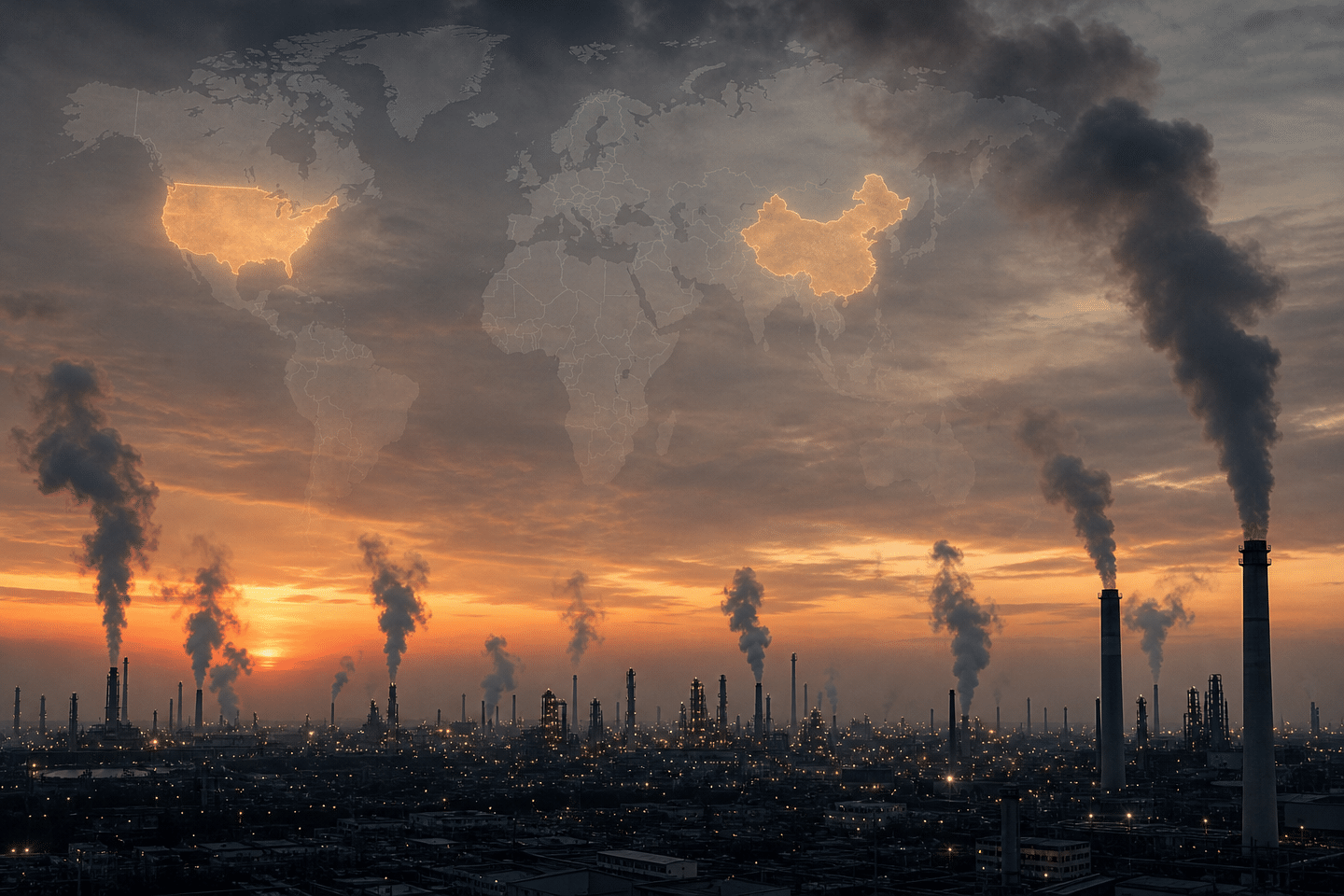
Yes, this figure exists and it comes from a study. A team led by Javier Gonzalez, from the University of Bath, estimates that human metabolism produced 2.05 billion tonnes of CO₂ in 2015. The work, published in The Lancet Planetary Health, indicates that the total was 1.18 billion tonnes in 1985, representing a 74% increase over thirty years.
This total is modeled rather than measured directly; no one weighed the breath of 7.5 billion people.
How we arrive at 2.05 billion tonnes
The team relies on 9,006 metabolic measurements taken from people spanning from early childhood to old age. These CO₂ production data were cross-referenced with global population statistics and body weight data. The calculation yields an estimate for every year from 1985 to 2015. The total thus rises from 1.18 to 2.05 billion tonnes.
Demography explains most of the increase. The world population grew from about 4.9 to 7.5 billion people between 1985 and 2015, and more than 60% of the rise is attributed to this growth rather than a noticeably more active metabolism in individuals.
Per person, that amounts to roughly 750 grams of CO₂ per day, across all ages. This figure results from simply dividing the 2015 total by the 7.47 billion inhabitants on the planet that year. A child produces less than an adult, which explains the value of age-stratified measurements.
Why the Germany comparison does not hold up
A version of the figure circulates claiming it equates to Germany’s annual emissions. That is inaccurate, since in 2015 Japan emitted about 1.2 billion tonnes of fossil and industrial CO₂ and Russia about 1.6 billion, two totals that are lower than the CO₂ exhaled, and Germany emits less than Japan.
On a global scale, the burning of coal, oil and gas, plus cement production, released between 34.7 and 35.4 billion tonnes of CO₂ in 2015, according to databases. The statistical service of the ministry in charge of Ecology lists 35.8 billion tonnes in 2016, excluding land use. Adding land-use changes (around 6.5 billion tonnes), the total climbs to 41.2 billion. The exhaled CO₂ then accounts for about 5% of this volume.
For 2025, the Global Carbon Budget projected a record of 38.1 billion tonnes of fossil CO₂, i.e., more than 18 times the metabolic total of 2015.
The authors emphasize that they do not claim that breathing alone drives climate change.
Short cycle versus fossil carbon
The CO₂ we exhale originates from the food the body converts into energy, and it returns to the atmosphere within a short cycle. Fossil carbon, by contrast, comes from coal, oil and gas drawn from beneath the surface, which adds carbon to the ambient air. Over the decade 2015–2024, about 50% of anthropogenic emissions remained in the atmosphere, 29% were absorbed by the ocean, and 21% by terrestrial ecosystems, according to the Global Carbon Budget.
Models that track the planet’s carbon balance rarely incorporate human respiration. The authors argue that it should appear in the accounts of cities as well as in those of the globe, because in dense areas the metabolism of residents carries a non-negligible weight in local carbon fluxes.
China, India and the rest of the curve
In detail, China and India together account for about 744 million tonnes in 2015, more than one-third of the total exhaled globally. The researchers also tested the impact of different dietary patterns on the 2015 estimate. The series, however, stops at that year, and no newer data are published in the study.
If per-person production remained at the 2015 level, the total would reach roughly 3.2 billion tonnes around 2084. With a global population of about 8.2 billion, the same rule of three would yield nearly 2.25 billion tonnes today, a calculation that the study does not publish.
Sources: statistiques.developpement-durable.gouv.fr | ncbi.nlm.nih.gov | edgar.jrc.ec.europa.eu
