
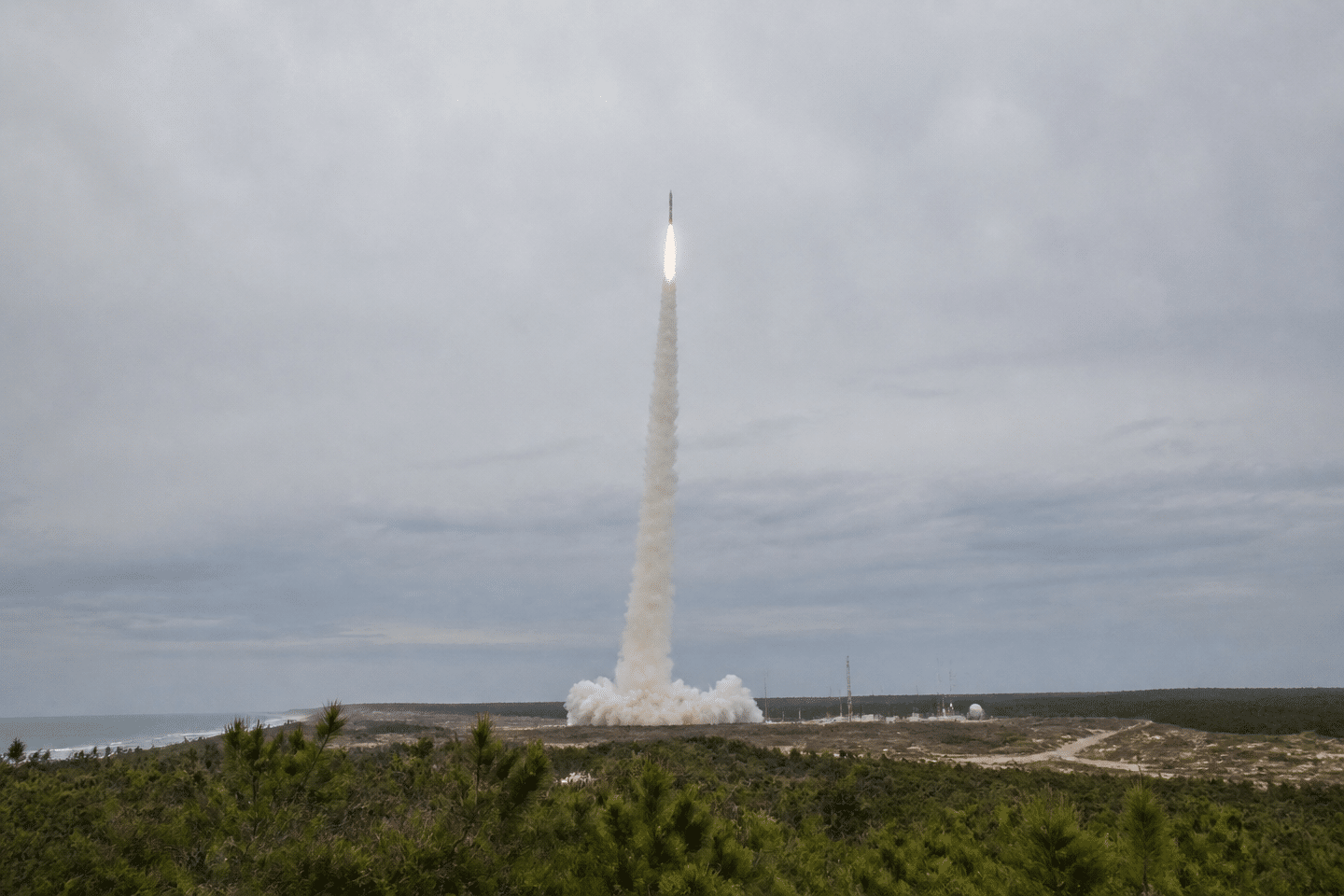
No need for a colossal launch pad or a space rocket to advance France’s nuclear deterrence. From the dunes of the Landes, a discreet device capable of carrying 300 kilograms to several hundred kilometers in altitude has just restored to France a capability it had lost. Its name: SyLEx.
- The SyLEx sounding rocket, launched from the DGA test center at Biscarrosse on November 4, can carry up to 300 kg and reach 200–400 km altitude in its single-stage version
- This first operational flight carried equipment related to the development of the strategic M51.4 missile, the naval element of France’s nuclear deterrence
- Designed by ArianeGroup under the DGA, the system will evolve into a two-stage version capable of carrying up to 600 kg, with future potential applications for hypersonics and civil experiments
- A discreet launch from Biscarrosse that shifts France’s military posture
- Nuclear deterrence tested at 300 kilometers altitude
- From the M51.4 missile to hypersonics, a rocket with multiple lives
A discreet launch from Biscarrosse that shifts France’s military posture
On November 4, a sounding rocket lifted off from the DGA’s test center in Biscarrosse, in the Landes. It looked unremarkable on the surface, no thunderous media coverage, just a technical flight conducted away from the spotlight. And yet, this launch marks a significant milestone for French military sovereignty.
It was the first operational flight of SyLEx, an acronym for System for Launching Experiments. This flight followed an initial demonstration carried out on November 28, 2025, which had already validated the system’s concept.
Designed by ArianeGroup under the DGA’s leadership, SyLEx serves a precise objective: France seeks greater independence in testing high-altitude military technologies. In other words, the ability to test its own equipment autonomously.
This sovereign capability for suborbital testing, i.e., flights that skim space without ever entering orbit, had disappeared from the French landscape for some time. SyLEx now fills that gap.
Nuclear deterrence tested at 300 kilometers altitude
The leg of the flight on November 4 carried a sensitive payload: equipment related to the development of the strategic M51.4 missile. This missile is not a minor technical detail; it constitutes the naval component of France’s nuclear deterrence.
The Minister of the Armed Forces, Catherine Vautrin, herself stressed the importance of these experiments for the M51.4. A clear signal: this program occupies a strategic place in France’s current military priorities.
In its single-stage configuration, the version used for this launch could carry up to 300 kilograms of payload. But the system has a much broader growth margin, as it can reach altitudes between 200 and 400 kilometers depending on the chosen settings.
French authorities did not disclose the exact nature of the experiments conducted on the M51.4 during this flight. A silence that is not surprising for a program so closely tied to defense secrecy.
From the M51.4 missile to hypersonics, a rocket with multiple lives
SyLEx is not limited to a single use. The system exists in two configurations: the already-tested single-stage version, and a two-stage variant, currently under development with the DGA, which should enable up to 600 kilograms of payload.
Beyond the strictly military aspect, the sounding rocket also serves civilian applications. Atmospheric reentry, microgravity experiments, materials and sensor testing — all arenas where SyLEx can function as a flying test bed.
Catherine Vautrin also mentioned another potential field of application: hypersonic demonstrators, those craft capable of traveling at several times the speed of sound. She, however, gave no details on the specific experiments contemplated in this domain.
The overall cost of the program and the precise schedule for the two-stage version remain undisclosed. A discretion consistent with the sensitive nature of these tests, but one that leaves several questions about the project’s future unanswered.
What remains is that SyLEx is already taking shape as a versatile tool, straddling military research and scientific experimentation. A small, unobtrusive device launched from the Landes, which could well accompany France on multiple technological fronts in the years to come.
Source : ArianeGroup
