
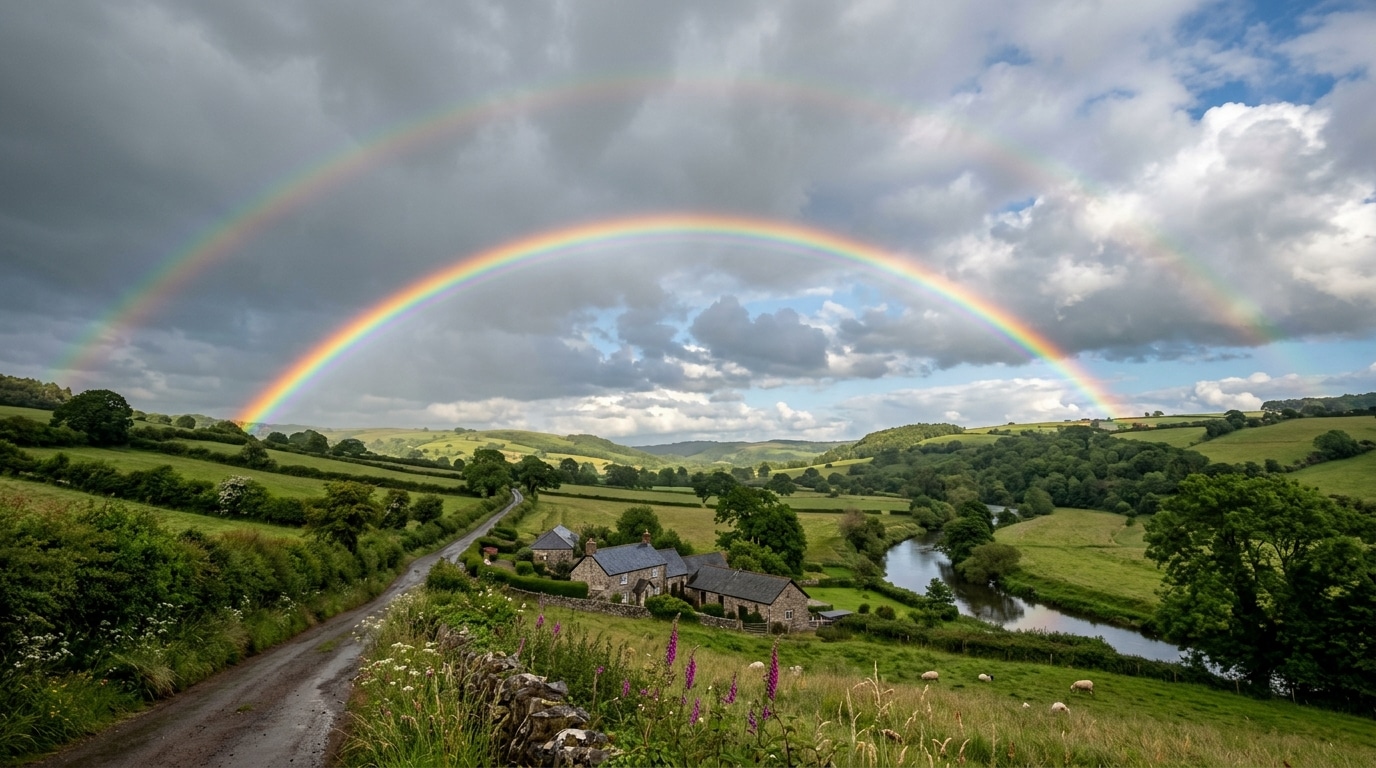
Between October 19 and 25, 2026, Météo-France logged 279 mm of rainfall in Salon-de-Provence, more than three months’ worth of typical precipitation in a single week. Aigues-Mortes received 187 mm and Flamanville 106 mm over the same period, while in Corsica the Solenzara station surpassed 600 mm in 24 hours during a Mediterranean episode. These intense bursts, followed by abrupt clearings, create exactly the conditions the light needs to stage itself in the sky. For behind every shower that yields to sunshine lies a small, fascinating optical ballet—the rainbow, and sometimes its more discreet big brother, the double rainbow. Here is how light tells, drop by drop, the story of its own trajectory.
- The primary rainbow results from a single reflection of light inside the drop, with red on the outer edge, while the secondary rainbow involves two reflections, which is paler, where red sits on the inside
- these optical phenomena are favored by intense rainy episodes followed by clearings, as observed in late October 2026 in the Southeast and in Corsica
- despite these heavy precipitations, French soils remained, by the end of October 2026, among the 10% driest for the season nationwide, and the risk of new heavy rain persists in several departments of the Southeast
- When rain and sun meet, light tells its story
- How light curves and splits into colors in a raindrop
- Why the second rainbow reverses the order of colors and fades in brightness
- What double rainbows reveal about the path of light in water
- A light phenomenon that continues to fascinate both young and old
When rain and sun meet, light tells its story
A rainbow forms only when two ingredients meet at the same moment: water droplets still suspended in the air and a sun peeking directly behind the observer. This is typically observed after a thunderstorm or a shower, when the clouds tear open while the air remains humid. The recent rainy episodes in the Southeast and Corsica, followed by bright blue skies, thus provided an ideal ground for this phenomenon. For it to appear, you must have the sun behind you and clear clouds in front, otherwise light simply has no chance to pass through the droplets in the right direction. It is this precise encounter between grazing light and air still saturated with water that turns a simple end of shower into a colorful spectacle.
How light bends and separates into colors inside a raindrop
What happens inside a raindrop almost feels like magic, but it all comes down to the physics of light. As the beam enters the tiny drop, it slows down and refracts because it moves from air, a less dense medium, to water, a denser one. It then reflects once inside the drop and exits again by refraction. This double change of direction splits the white light of the sun into its constituent wavelengths, i.e., its colors. Violet, with the shortest wavelength, is deviated the most, while red, with the longest wavelength, is deviated the least. That’s why violet always sits at the bottom of the arc and red at the top. For the curious: a rainbow is actually a full circle, but from the ground we only see a portion, the rest hidden by the horizon. From an aircraft, however, the rainbow can sometimes be seen in its full circular form.
Why the second rainbow reverses the order of colors and fades in brightness
The secondary rainbow appears when light experiences two reflections inside the droplets, as opposed to just one for the primary arc. This extra path yields a rainbow that is generally less bright, positioned a little farther out, with colors in the reverse order: red sits on the inner side of the secondary arc, while it borders the outer edge of the primary arc. The Royal Meteorological Institute indeed emphasizes this mechanism: the double reflection inside the drop, rather than a single one, explains why the hues are inverted and why this secondary arc looks paler. In terms of angles, the primary arc emerges at 42° for red, while the secondary arc comes out at 50°, which naturally places it above the first in the sky. In between, a darker band remains visible: it marks the end of the primary arc and the start of the secondary arc. This zone has a precise name, the Alexander’s Band, named after Alexander of Aphrodisias, the Greek philosopher of the 2nd century who described it first. A detail that shows that sky observation is not a recent activity.
What double rainbows reveal about the path of light in water
Seeing a double rainbow is really reading the light’s journey in each droplet in real time. Noting the color inversion between the two arcs makes it possible to visualize concretely the number of reflections the rays have undergone—one for the lower arc, two for the upper one. It’s also a useful rule of thumb to keep in mind during periods of heavy rain, such as those observed recently in the Southeast or Corsica, where sudden showers followed by clear skies create exactly the conditions for this kind of observation. One word of caution: these phenomena occur most often in an unstable meteorological context, with a risk of heavy rain and thunderstorms that does not vanish as soon as the sky clears. The Var and Alpes-Maritimes regions, for example, were placed on orange rain-flood vigilance during a Mediterranean episode, and a new risk of heavy precipitation, potentially up to 200 mm between Hérault, Gard and Bouches-du-Rhône, was announced in the Southeast. Since September 2026, Météo-France’s vigilance system has also incorporated more precise infra-departmental information to better anticipate these episodes of wind, rain-flood, thunderstorms, or snow and freezing rain. Admire a rainbow, yes, but always keep an eye on the sky’s progression behind you.
A light phenomenon that continues to fascinate both young and old
Despite the intense rainfall episodes recorded in recent weeks, French soils remained, by late October 2026, among the 10% driest for the season nationally, even though a noticeable improvement had been seen in Brittany, Normandy, Hauts-de-France, PACA, and Corsica. This contrast between violent showers and still-parched soils illustrates how French weather can deliver striking episodes over short periods. And it is precisely in these moments of transition, between heavy rain and sudden clearing, that rainbows offer their grandest spectacle. Whether simple or double, this phenomenon remains one of the easiest to observe, with no special equipment needed—just turn your back to the sun at the right moment.
Ultimately, the double rainbow is nothing more than a free physics lesson offered by the sky, each time a shower crosses a sunbeam. Understanding why the red changes place from one arc to the other is also about learning to read the atmosphere’s whims better, between violent Mediterranean episodes and soils that are still struggling to recharge. The next time intense rain gives way to a break in the clouds, the simple reflex is this: turn your back to the sun, look up, and enjoy this double game of light and color, all while keeping an alert eye on the vigilance bulletins if the sky remains unstable.
