
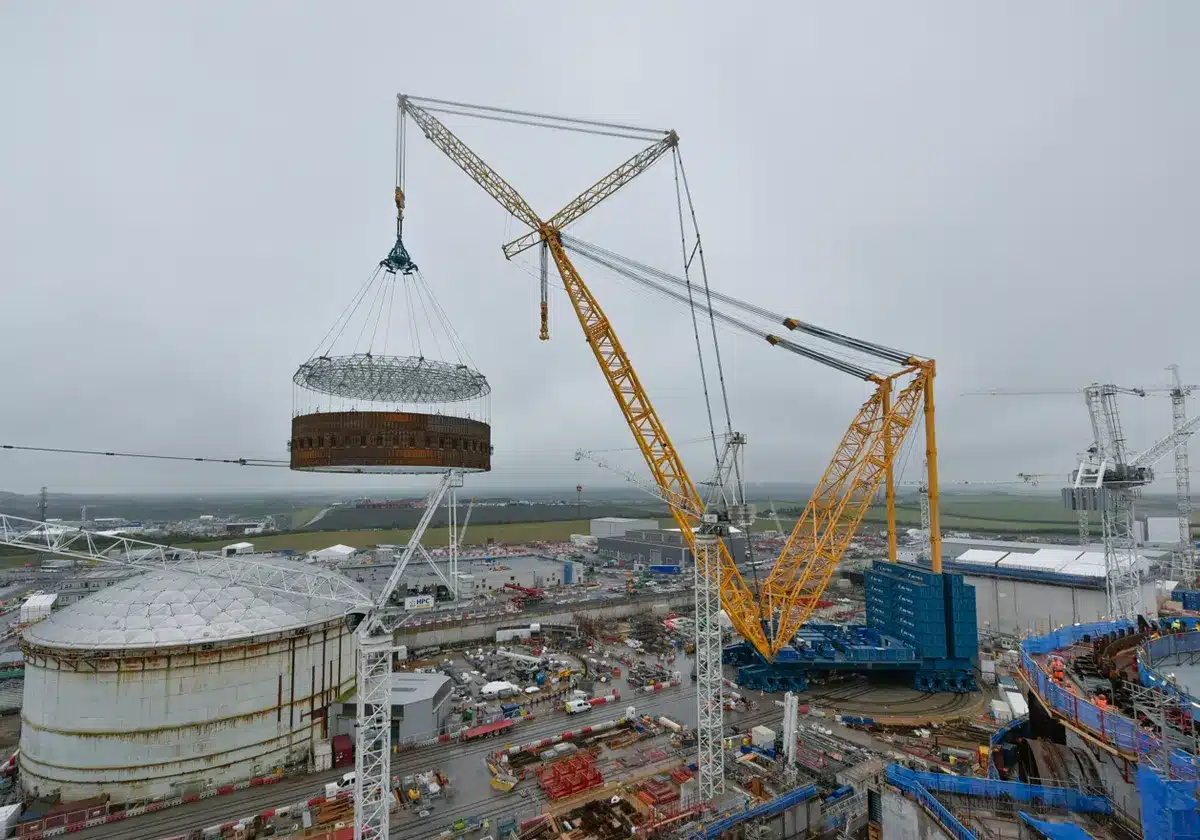
The SGC-250, better known as “Big Carl,” is the largest onshore crane ever designed. With a vertigo-inducing height of 250 meters and an impressive lifting capacity, this machine stands as a true titan of modern engineering. Primarily used for complex construction projects and specialized worksites, Big Carl pushes the boundaries of what technology can achieve in the realm of lifting.
Impressive Technical Specifications
Big Carl, belonging to the Belgian company Sarens, is a technical tour de force. Its imposing design allows it to reach heights of 250 meters in an upright position, making it one of the tallest lifting machines in the world. One of its most striking features is its ability to lift up to 5,000 tonnes, the equivalent of 1,000 cars. This capacity is enabled by its twelve high-performance engines operating in synchrony.
In terms of mobility, Big Carl is equipped with wheels mounted to a track assembly, enabling it to rotate 360 degrees within a 100-meter radius. These supplementary wheels provide some maneuverability on the site, allowing the crane to move along the tracks while maintaining exceptional stability.
Her Specialty: Oversized Construction Projects
Big Carl is not used for traditional lifts. It was designed specifically to meet the needs of specialized construction projects where exceptionally heavy loads must be handled. One of the first major projects it participated in occurred in 2022, when it successfully positioned a 304-tonne steel lining ring onto a reactor at the Hinkley Point C nuclear power plant in the United Kingdom.
This giant machine finds its true utility in the context of the growing modularization in the construction sector. Rather than building a refinery or a nuclear plant piece by piece on site, companies nowadays prefer to pre-assemble massive modules in controlled environments, then transport and install them at their final locations. It is precisely in these complex situations that Big Carl excels. Thanks to its ability to lift exceptionally heavy modules, it enables rapid, safe, and precise installation of these colossal structures.
Big Carl Against Its Maritime Rival: Sleipnir
Although Big Carl holds the title of the largest onshore crane, there exists another giant that surpasses this machine in lifting capacity. Sleipnir, a floating crane mounted on a Dutch semi-submersible vessel, can lift loads of up to 10,000 tonnes per crane. It was named after Odin’s eight-legged horse and is primarily used in offshore energy projects, notably for the installation and dismantling of offshore platforms.
While Sleipnir is stronger in lifting capacity, Big Carl remains the most imposing land crane in the world, with capabilities tailored to terrestrial sites where mobility and precision are crucial. Consequently, in a hypothetical “face-off” between these two giants, Sleipnir would likely have the edge in lifting power, but Big Carl would win out in onshore versatility.
The Future of Heavy Construction: Toward Even More Powerful Machines?
The rise of construction projects that require increasingly powerful and specialized lifting capabilities shows that demand for machines like Big Carl continues to grow. Industry giants in the lifting sector, such as Sarens, keep pushing the boundaries of engineering to meet this growing trend toward modularization and increasingly complex projects.
If the SGC-250 currently sits at the pinnacle of onshore lifting technology, the future may hold even more capable machines. Advances in engines, mechanical systems, and automation will no doubt enable the design of machines able to tackle ever more ambitious projects, while reducing costs and construction times.
