
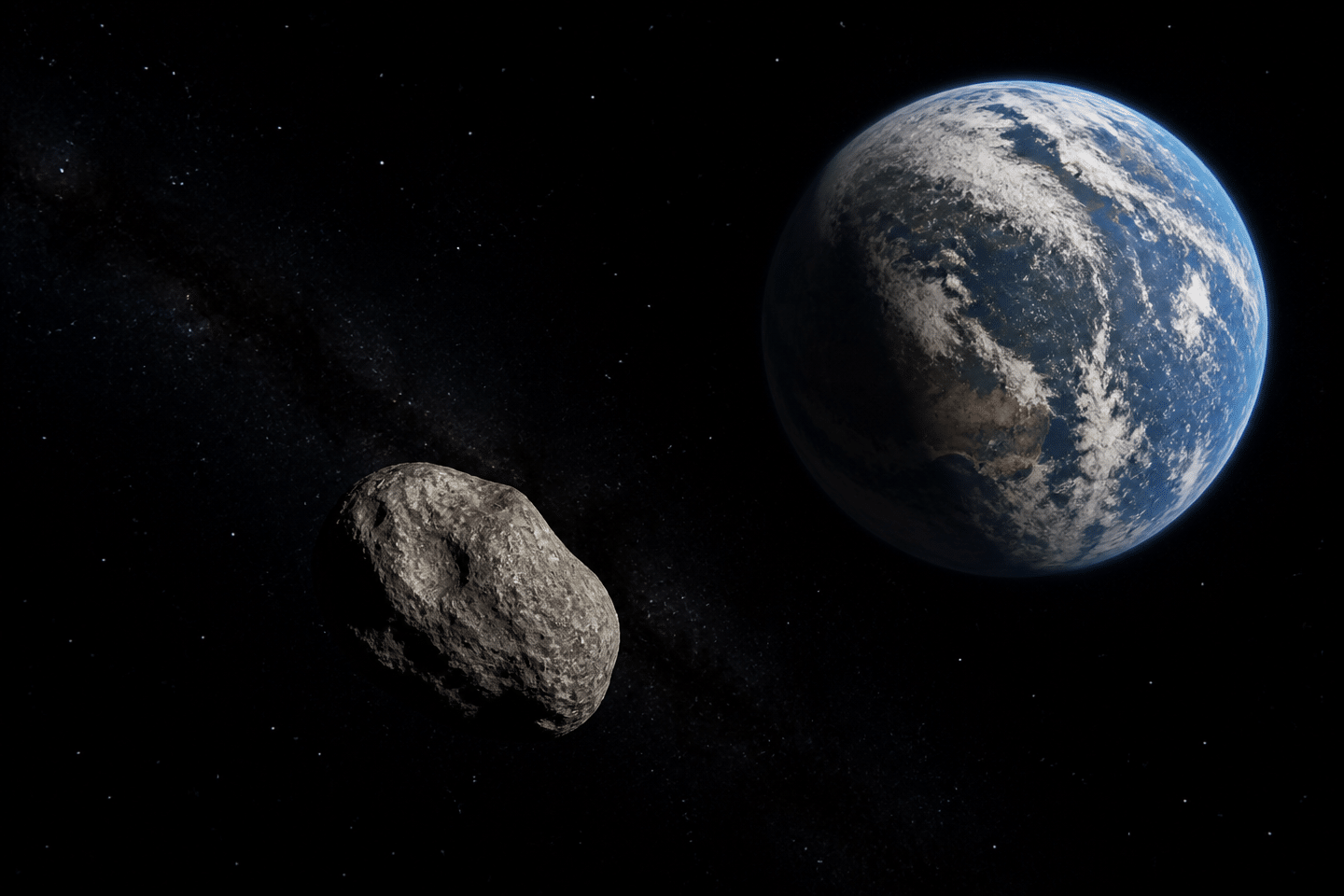
A two-meter space rock has been circling our planet for months without anyone noticing. Don’t panic: even if it did collide, the atmosphere would pulverize it before it could reach the ground. This mini-moon named QQ8 is poised to depart, after a quiet, several-months-long stay.
- QQ8, a two-meter rock captured by Earth’s gravity in April, was detected only in summer by astronomers and confirmed by the Minor Planet Center.
- Two times larger than the average size of mini-moons (75 cm), QQ8 will pass at about 568,000 km from Earth, i.e., farther than our real Moon.
- QQ8 will depart Earth’s orbit in December to resume its solar journey, with a possible closer pass in about ten years.
- A discreet visitor unnoticed for six months
- A rock larger than the average of Earth’s mini-moons
- Countdown to the grand departure into space
A discreet visitor unnoticed for six months
Credit: © Robert Lea
The object was captured by Earth’s gravity in the spring, somewhere around April. No one saw it arrive. It was only several months later, in midsummer, that astronomers spotted its trace in the sky.
The discovery was subsequently confirmed and made public by the Minor Planet Center, affiliated with the International Astronomical Union. The delay is easily explained: a two-meter rock lost in the vastness of space remains an extremely unobtrusive object, even for the sharpest instruments.
This kind of close approach isn’t exceptional in itself. QQ8 crosses Earth’s path about once every ten years. This time, however, its passage was close enough for our planet to gravitationally capture it, turning it into a temporary satellite.
Its minimum distance to Earth should approach around 568,000 kilometers, about 177,000 kilometers more than the average distance to our real Moon. A distant visitor, therefore, but a very real one.
A rock larger than the average of Earth’s mini-moons
With a two-meter diameter, QQ8 is not a giant celestial body. But on the scale of mini-moons, this pebble stands out.
A recent modeling study estimated the typical size of these ephemeral companions at around 75 centimeters, for a usual stay of about nine months around Earth. QQ8 thus far exceeds this typical size by a substantial margin.
According to the same study, our planet could host up to six mini-moons simultaneously, often arising from fragments torn off the Moon’s surface itself. A quiet ballet that plays out above our heads at all times, without us realizing it.
The larger an object, the more likely it is to linger. Researchers estimate that a three-meter rock could remain captured by Earth’s gravity for ten to twenty years.
Countdown to the grand departure into space
Here is QQ8. It will stay around for Christmas! Its sojourn in Earth’s orbit is slated to end in December, before it resumes its journey toward the Sun at the very start of the next year, according to current estimates.
The object is actually following its own solar orbit, completed in 359 days, i.e., about 0.98 Earth years. A trajectory almost mirrored to our own, which explains why it crosses our path so regularly.
Once released from Earth’s pull, QQ8 will resume its solitary journey around the Sun. It will probably take about a decade before another close approach occurs, with no guarantee that it will be captured this time.
This silent ballet serves as a reminder of how crowded the space near Earth remains with small objects that we often detect too late to foresee. QQ8 has never posed any danger, but its story underscores the discreet way these wandering rocks traverse our cosmic neighborhood, if only for a moment.
Sources :
- Earth has captured a new mini moon (Space.com)
- Welcome Earth’s new mini moon (Gizmodo)
- EarthSky
