
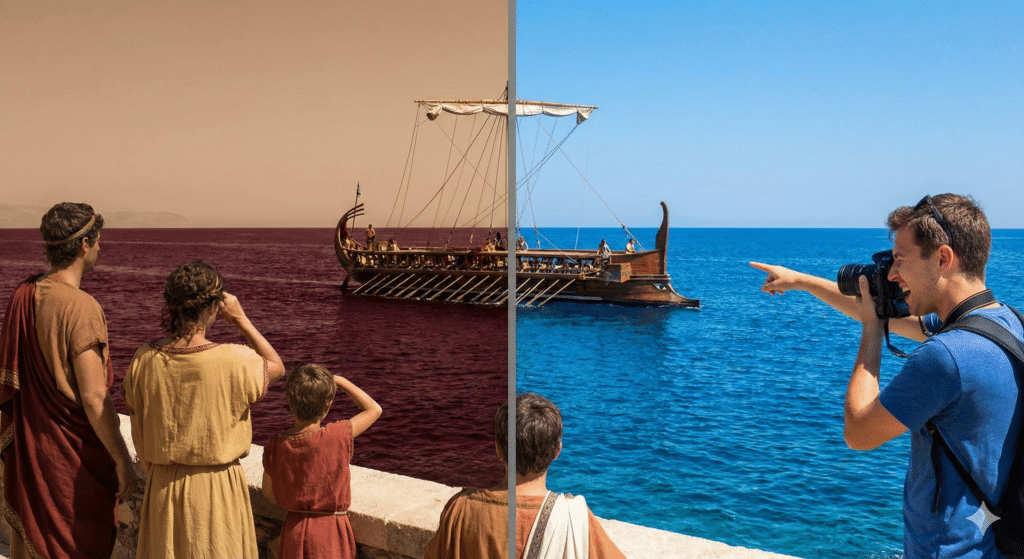
If you looked up at the sky three thousand years ago, what would you have seen? Blue, of course. Yet, if you had asked a Greek from Antiquity, he would probably have answered that the sky was white, or bronze-colored. This isn’t a question of eye anatomy, but a riddle that has fascinated linguists and neuroscientists since the 19th century: humanity seems to have been collectively “blind” to blue for most of its history. This historical curiosity hides, in fact, a deeper truth about how our brain works: we do not see the world as it is, but as our language allows us to break it down.
The Odyssey Enigma
Everything begins in 1858, when William Gladstone, who would become the British Prime Minister, becomes engrossed in Homer’s work. By analyzing the Iliad and the Odyssey, he notices a troubling anomaly: the poet describes the sea as the “color of dark wine,” sheep as “purple,” and honey as “green.” But never, not once, does the word “blue” appear. Intrigued, the philologist Lazarus Geiger then scrutinized ancient texts from all corners of the world — the Indian Vedas, the Icelandic sagas, the Quran, the Hebrew Bible, and the old Chinese tales. The verdict is unambiguous: none of these civilizations possessed a word to describe blue. This color, so ubiquitous for us, was invisible to them.
The Order in Which Colors Emerged
Researchers have discovered that languages develop color vocabularies following a precise and universal sequence. First black and white (or dark and light). Then red (the color of blood and wine). Then yellow and green. Blue consistently appears last.
The pragmatic explanation: in nature, blue is exceedingly rare. There are no blue animals, no blue edible plants, and few blue rocks. The sky is the sole exception, but without a tangible blue object to compare it with, it was simply perceived as “clear.” Without a survival utility, the brain did not bother creating a mental category for this wavelength of light.
The Himba Experiment: Seeing the Invisible
But does the absence of a word truly imply an absence of perception? This is the central question of linguistic relativity. To answer it, psychologist Jules Davidoff traveled to Namibia to study the Himba tribe, which lacks a distinct word for blue (it is conflated with green).
When shown a circle composed of 11 green squares and a single blue square (obvious to us), the Himba struggled to spot the intruder. By contrast, they possess multiple words for different shades of green. When shown a circle of green squares where one was a shade only very slightly different (invisible to a Western eye), they detected it instantly.
This study proves that language does not merely describe reality: it filters it. If your language does not draw a boundary between two colors, your brain literally stops perceiving the difference.
Scientific source: Davidoff, J., Davies, I., & Roberson, D. (1999). Colour categories in a stone-age tribe. Nature.
