
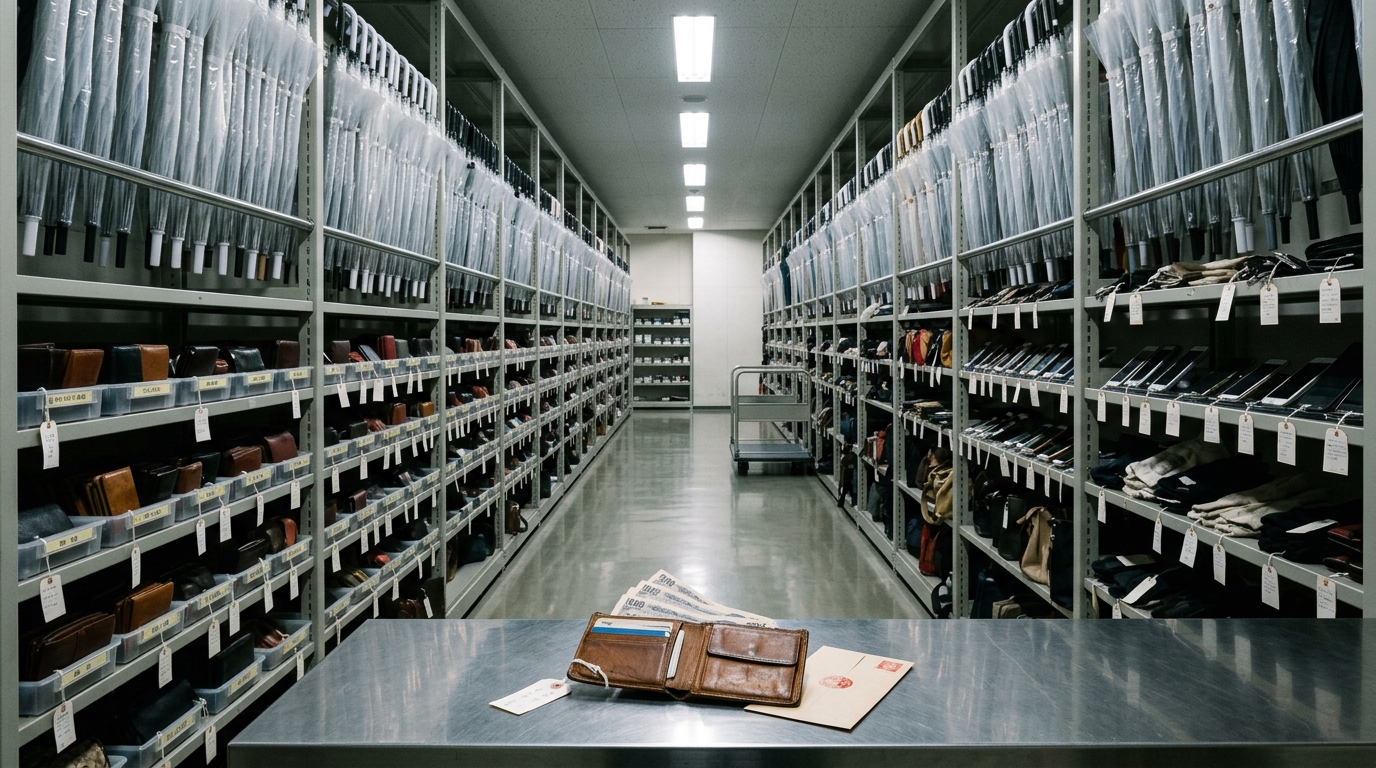
In Tokyo, losing your wallet isn’t necessarily a catastrophe. In 2025, residents handed in to police stations more than 4.5 billion yen found on the street or forgotten somewhere, an absolute record. Even better, more than two-thirds of this sum found its way back to its rightful owners. A system that is as surprising as it is impressive.
- In 2025, 4.51 billion yen worth of found items were reported to the Tokyo Police, a record for the fourth year in a row
- About 3.23 billion yen were returned to owners and 587 million yen given to finders with no claims within three months
- 628 million yen were transferred to the Tokyo Metropolitan Government coffers due to lack of ownership or claim
- 4.51 billion yen: the forgotten loot that lands with Tokyo’s police every year
- 3.23 billion returned, 587 million to finders: the Japanese honesty mechanism rewarded
- 682 million vanished into municipal coffers: what happens to money with no owner or claim
4.51 billion yen: the forgotten loot that ends up with Tokyo’s police every year
The figure is staggering: 4,508,820,000 yen, roughly 27 million euros, were handed to the capital’s law enforcement agencies in 2025. This amount, disclosed by the Tokyo Metropolitan Police’s Found Objects Center, marks a fourth consecutive annual record. Year after year, Tokyoites report ever larger sums found on the streets, in public transit, or in shops.
This sum represents only a portion of a broader phenomenon. In total, 4,538,244 items were found and reported that year, a record since statistics began in 1940. That corresponds to a 3% rise from the previous year, proof that the reflex to report even the smallest discovery remains deeply rooted in Japanese habits.
Among the year’s most notable discoveries was a briefcase containing 27 million yen found at a shopping center in the Minato ward. The owner was eventually identified and able to retrieve the item. A striking case that alone illustrates the scale of this well-oiled system.
More than 70% of these declarations come from public-facing establishments, such as supermarkets. Losses of coins at self-checkout machines form a significant portion, a seemingly minor detail that, when added up, accounts for several billions of yen every year.
3.23 billion returned, 587 million to finders: the Japanese honesty machine rewarded
Across the total amount collected in 2025, about 3.23 billion yen was returned to its owners. This is the core of Japan’s lost-and-found system, a mechanism functioning as a chain of trust linking citizens, businesses, and the police.
Japanese law precisely frames this process. If the owner recovers their property, the finder is entitled to a reward ranging from 5% to 20% of the recovered value. A legal incentive that converts an act of civility into a potentially profitable gesture for everyone, without ever turning it into a disguised commercial transaction.
When no owner steps forward within three months, the logic shifts. About 587 million yen was thus directly paid to the individuals who had reported their find, in the absence of any identified claimant. The money then passes to the finder by default, the law recognizing that the finder deserves to keep what they legitimately reported.
However, this restitution rate should be viewed in context. Tokyoites reported losing 8,325,160,000 yen in 2025, meaning only 54.2% of the money lost was actually reported to the police. A figure that reminds us that, despite Japan’s reputation for honesty, a sizeable portion of lost money never surfaces.
682 million evaporated into municipal coffers: what happens to money with no owner or claim
There remains a final category: money that nobody wants, or more precisely, money for which no one claims ownership within the allotted time. When neither the original owner nor the finder steps forward in time, the sum eventually becomes part of the Tokyo Metropolitan Government’s coffers.
In 2025, this amount stood at roughly 682 million yen. The law indeed provides for a transfer of ownership to the finder after three months, then to the local government if it does not claim the sum in the following two months. An administrative safety net designed to prevent money from remaining in limbo indefinitely.
This sum boosts the municipal budget, a kind of recurring supplementary revenue. In 2024, the equivalent amount stood at 660 million yen, confirming a year-on-year upward trend. Other 2024 figures followed a similar logic, with 3.23 billion returned and 570 million given to finders, sums very close to those seen in 2025.
This system, as meticulous as a well-oiled clock, illustrates a distinctly Japanese approach to managing the common good. Nothing is truly lost; everything eventually finds a legal and traceable destination, whether in the pocket of a relieved owner, the hands of an honest finder, or the city’s own budget.
