
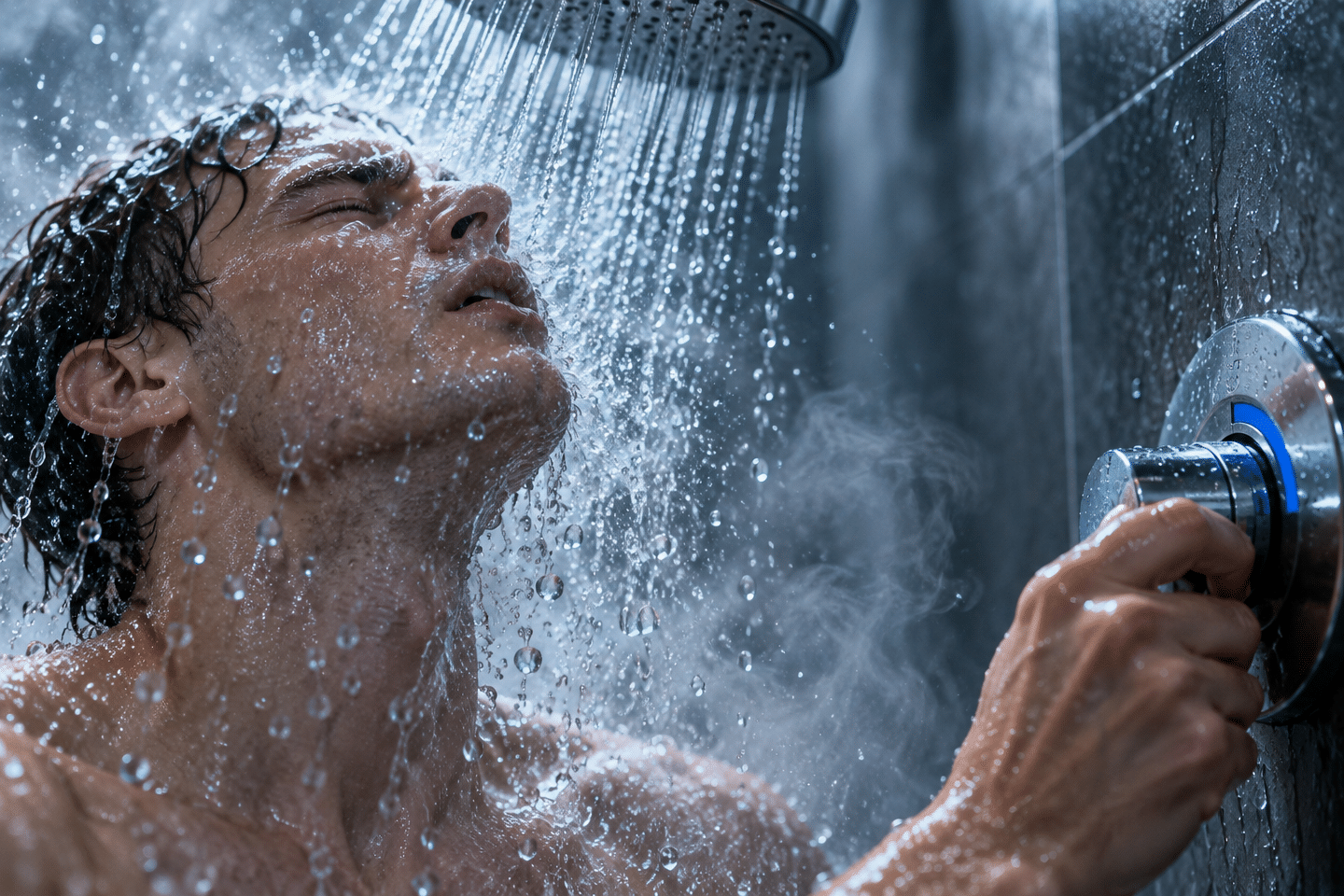
There is the cold shower you endure when the water heater dies or when the kids have drained all the hot water, and there is the one you choose. A team from the University of Basel in Switzerland tested the latter option on 719 volunteers over twelve weeks. The result goes far beyond a simple question of energy savings.
- Over 719 volunteers tracked for 12 weeks, cold-shower adherents took 31% fewer sick days than the control group.
- Despite initial discomfort, 91% of participants wanted to continue and 64% did, mainly motivated by a renewed burst of energy.
- Each participant would also have reduced their CO2 emissions by about 15 kg over the study period, equivalent to a 100-kilometer car trip.
- 719 volunteers, twelve weeks and a discovery that changes everything
- 31% fewer sick days: the figure that surprises researchers
- Why enduring cold water becomes easier after two weeks
719 volunteers, twelve weeks, and a discovery that changes everything
Researchers recruited 719 people aged 18 to 65, all in good health and especially resistant to the idea of taking a cold shower on their own initiative. The protocol, on paper, was simple: shower as cold as the plumbing allowed, for twelve full weeks.
In practice, many gave up very quickly. The study, which has not yet undergone peer review, shows a high dropout rate in the first two weeks. Once past this hurdle, dropouts dwindled markedly.
That is precisely the point that interested the research team. The goal was not only to measure the benefits of cold water on the body, but to understand what motivates someone to sustain a demanding commitment over time, far from the stereotypes about quick abandonment of such resolutions.
31% fewer sick days: the figure that surprises researchers
Here is the result that captured the authors’ attention. Participants in the “cold shower” group took on average 31% fewer sick days than those in the control group, which remained faithful to its usual hot shower.
The detail does not end there. Those exposed to the cold also reported 26% fewer days of illness, i.e., days when they felt unwell but did not take sick leave. A more discreet indicator, but just as telling.
These figures are not coming from nowhere. A prior Dutch study, conducted with 3,018 participants, had already noted a 29% reduction in sick leave among a group of cold-shower participants. The consistency between the two experiments strengthens the idea that this link is not mere statistical luck.
The Dutch study, however, did not observe a significant reduction in the number of reported sick days. The researchers attributed this to a simple explanation: the symptoms were less intense, allowing participants to keep working without taking time off.
Why sticking with cold water becomes easier after two weeks
The true feat of this Swiss study lies in the perseverance observed. Despite the discomfort reported by the vast majority of participants when exposed to cold, 91% said they intended to continue the routine after the study ended. And 64% actually did.
The effect most frequently cited by volunteers was not health, but energy. Many compared the sensation to a strong cup of coffee, an immediate jolt that seems to offset the initial discomfort.
For Dr. Lena Glaser, the study’s lead author, this lasting adherence is explained by how the change is perceived. “When people perceive a personal benefit from changing their behavior and do not feel they are giving up something, they are more motivated to persist,” she explains.
She emphasizes, however, that this is not about depriving oneself of all comfort. “If we deprive ourselves of all pleasure, it will eventually harm our well-being and mental health. And getting sick isn’t good for the environment either,” she adds, before noting that the water does not need to be icy every day.
Beyond the avoided sick days, the researchers also quantified the environmental impact of the gesture. Over the twelve weeks of the experiment, each participant would have reduced their CO2 emissions by about 15 kilograms, equivalent to a 100-kilometer car trip. This calculation is based on a typical five-minute shower, using 45 liters of hot water heated from 15 to 40 degrees.
That said, no one is obliged to become a staunch advocate of frigid showers every morning. Between the comfort of a hot shower and the conviction of a cold spray, there is likely a reasonable middle ground, one where the body gradually acclimates without the pleasure of washing disappearing completely.
The preprint article is available on the University of Basel website.
👉 A small gesture for Space Group? Follow us on Google, add us to your bookmarks, and find us on Google News so you don’t miss any discoveries.
