
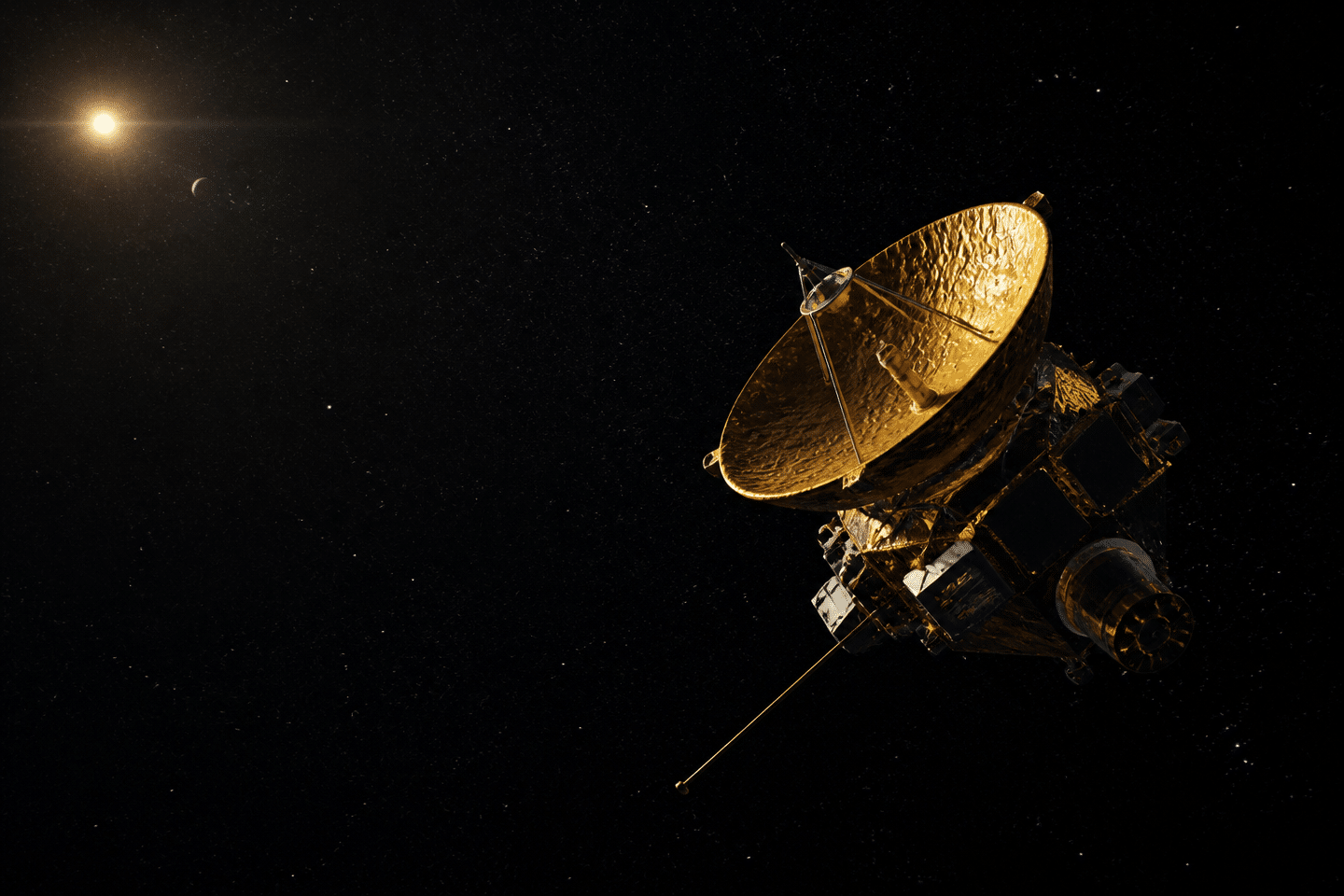
For two days, the farthest spacecraft ever sent by humanity remained silent, at roughly 26 billion kilometers from Earth. Then its signal came back, with no engineer having had time to intervene. Voyager 1 appears to have repaired itself, an episode that JPL calls unprecedented in nearly fifty years of the mission.
- Voyager 1 remained silent for 48 hours before its signal spontaneously resumed, with no intervention from engineers.
- The JPL favors the hypothesis of an automatic fallback to backup thrusters, calling the episode unprecedented in 47 years of the mission.
- The energy from the plutonium power source declines by about 4 watts per year, forcing the gradual shutdown of instruments to preserve the mission.
- Forty-eight hours of silence at 25 billion kilometers
- How a 47-year-old probe repaired itself
- A survival mode born from energy scarcity threatening the mission
Forty-Eight Hours of Silence at 25 Billion Kilometers
The Deep Space Network, comprised of three antennas spread around the globe, continuously monitors the two Voyager probes. It was this network that raised the alarm when Voyager 1 stopped replying for two consecutive days.
For a probe this distant, silence is not trivial. Voyager 1 is approaching the symbolic threshold of a light-day in distance, roughly 25.89 billion kilometers. At this scale, communicating with the probe requires a substantial amount of time.
Then, without an immediate explanation, the signal reappeared. Voyager 1, the farthest spacecraft ever sent from Earth, had resumed contact after briefly losing the thread.
How a 47-Year-Old Probe Repaired Itself
What stands out to the teams at the Jet Propulsion Laboratory is the timing. The probe resolved the problem even before engineers could send any corrective instruction from Earth.
Kareem Badaruddin, the Voyager mission lead at the JPL, called this event unprecedented. A probe launched 47 years ago that can diagnose and self-correct a fault, at a distance where rapid intervention isn’t possible, is extraordinary.
The favored hypothesis is a safe mode. A group of thrusters may have gone offline, automatically replaced by backup thrusters, much like an electrical system switching to an alternate circuit. The exact cause of the outage remains under investigation.
A Survival Mode Born from Energy Scarcity Threatening the Mission
Voyager 1 and its twin Voyager 2 were launched in 1977, taking advantage of a rare planetary alignment to fly by Jupiter, Saturn, Uranus, and Neptune. Since then, the two probes have crossed into interstellar space and continue to send data.
Their power comes from a plutonium generator, whose output inexorably declines. Each probe loses about 4 watts per year from the 470 watts available at the start. Engineers must therefore shut down instruments one by one to preserve the mission.
In this logic, an operation nicknamed Big Bang allowed, in September, the replacement of three Voyager 1 instruments with energy-saving alternatives. A similar maneuver had already been carried out on Voyager 2 six weeks earlier. The JPL has not provided further details on this point.
This spike of autonomy underscores the delicate balance on which the mission rests. Voyager 1 continues to explore a territory no one had ever reached before, but every incident reminds us that its energy, it will not return.
👉 A small gesture for Space Group? Follow us on Google, add us to your favorites and find us on Google News so you don’t miss any discoveries.
