
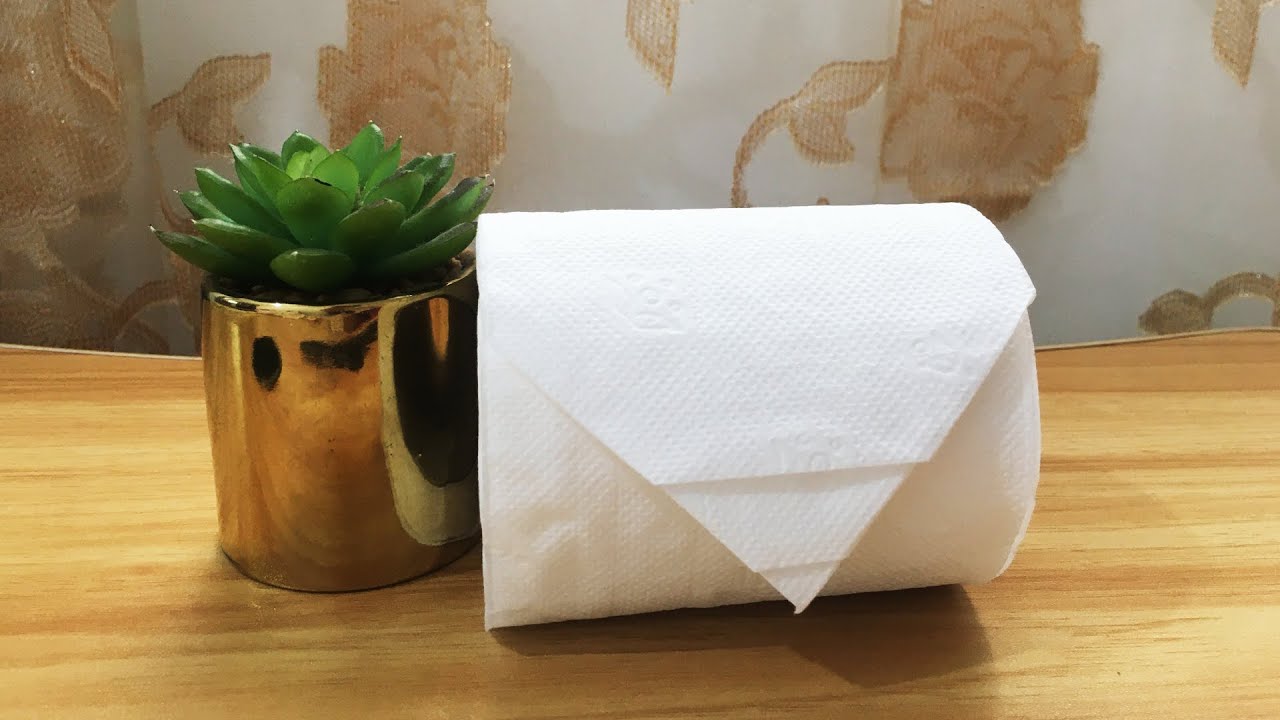
When you step into your hotel room, one seemingly insignificant detail always dominates the bathroom: the tip of the toilet paper roll is meticulously folded. Far from mere decoration, this tiny slice of cellulose conceals a powerful sanitary reassurance strategy. Even more fascinating, researchers today regard this worldwide practice as living proof of a dizzying mechanism of biological evolution. Here is how a gesture that appears absurd ended up contaminating humanity as a whole.
The Perfect Illusion of Absolute Cleanliness
At first glance, the hygienic origami, affectionately nicknamed “toiletgami” by hospitality professionals, seems to have no real functional utility. Yet it is a formidable psychological weapon massively deployed by this industry.
The primary aim of this geometric fold is to send an immediate visual cue to your brain. Upon discovering this pristine tip, you subconsciously infer that the room has just been sanitized by the cleaning staff.
This small symmetrical triangle creates an indispensable mental barrier. It gives you the gentle illusion that no stranger touched this roll before you, even though it is very likely the remainder of the roll started by the previous occupant.
The Invisible Virus That Has Infected Our Brains
If the sanitary trick is undeniably brilliant, the real mystery lies in the rapid spread of this gesture across the world. That is where science steps in, turning a seemingly banal anecdote into a fascinating case study.
British researcher Susan Blackmore has made this practice a foundational example to illustrate the famous theory of memes, originally formulated by the eminent evolution biologist Richard Dawkins.
In behavioral science, we do not speak of humorous Internet memes. A meme is a unit of cultural information that travels from one mind to another, functioning exactly like a biological gene seeking to reproduce by any means.
Evolution Through Blind Contagion
In nature, Darwinian selection consistently favors traits that carry a survival advantage. But meme theory posits that certain ideas can proliferate virally, even if they are fundamentally useless.
The toilet paper triangle embodies this evolutionary anomaly to perfection. From Manhattan to the far corners of Asia, millions of workers faithfully reproduce this fold every morning, often without ever knowing its origin or true purpose.
Our species is biologically wired to imitate our peers almost automatically. A simple hygienic ritual invented in the last century has thus transformed into a tacit and international cultural norm.
The next time you pull on this tiny point of paper, remember that you are not just destroying origami. You are holding in your hands the spectacular result of a behavioral replication on a planetary scale.
👉 A small gesture for Space Group? Follow us on Google, add us to your bookmarks and find us on Google News so you don’t miss any discoveries.
