
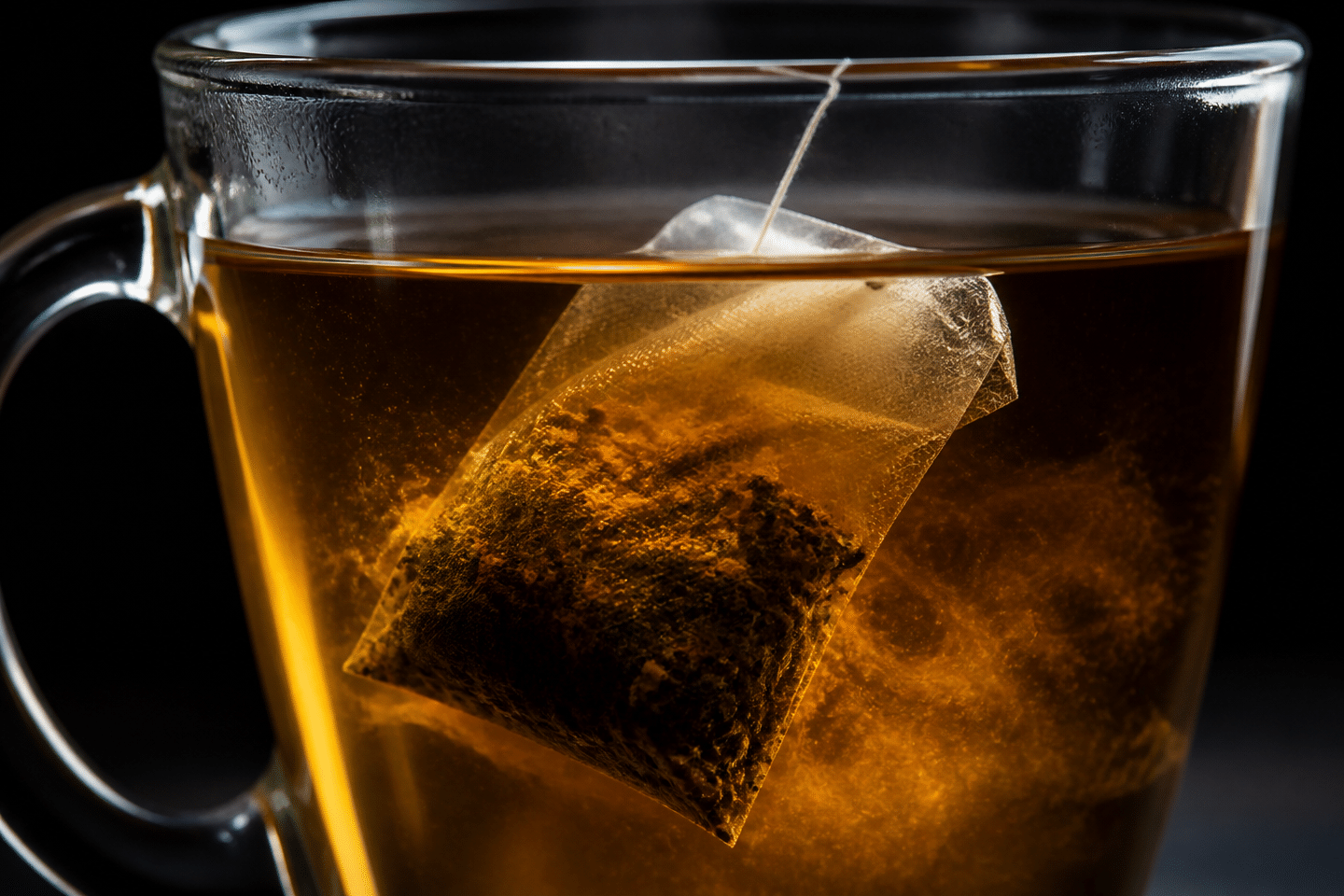
A seemingly banal act like steeping a tea bag in hot water could have unforeseen consequences. The cause: some tea bags are made of plastic, a material that degrades when heated. As a result, if your cup of tea was brewed with a plastic tea bag, you may also ingest thousands of microplastics. Researchers aimed to measure the extent of this phenomenon, brand by brand.
- Nylon tea bags release between 555 and 2,498 microplastics per cup, versus 0.3 to 2.4 for loose-leaf tea
- Trace amounts of bisphenol A (BPA) and phthalates were detected in all analyzed plastic bags, likely stemming from the adhesive
- The method used does not detect nanoplastics, so the actual number of ingested particles could be much higher
- Up to 2,498 plastic particles in a single cup
- The chemical cocktail behind the sachet glue
- Billions of nanoparticles that current analyses can’t even see
Up to 2,498 plastic particles in a single cup
Researchers at Recep Tayyip Erdogan University decided to compare two worlds that share the same supermarket shelf: bagged tea and loose-leaf tea. They selected 14 brands of tea bags and 14 brands of loose tea, both black and green, all bought in Turkey.
Out of the 14 bags tested, only four were made from polyamide, a form of nylon. The other ten relied on paper or cellulose, more traditional materials. This difference in composition would prove decisive.
To replicate what happens at home, the researchers plunged each bag into boiling water for three minutes, the typical infusion time. Then they counted, under a microscope, the particles released into the water.
The numbers speak for themselves. Plastic tea bags release between 555 and 2,498 particles per cup. Loose-leaf tea, by contrast, contains only 0.3 to 2.4 particles, probably originating from the environment, agriculture, or manufacturing equipment. The gap is so wide that there is little doubt about the source of the problem.
👉 A small gesture for Space Group? Follow us on Google, add us to your favorites, and find us on Google News so you won’t miss any discoveries.
