
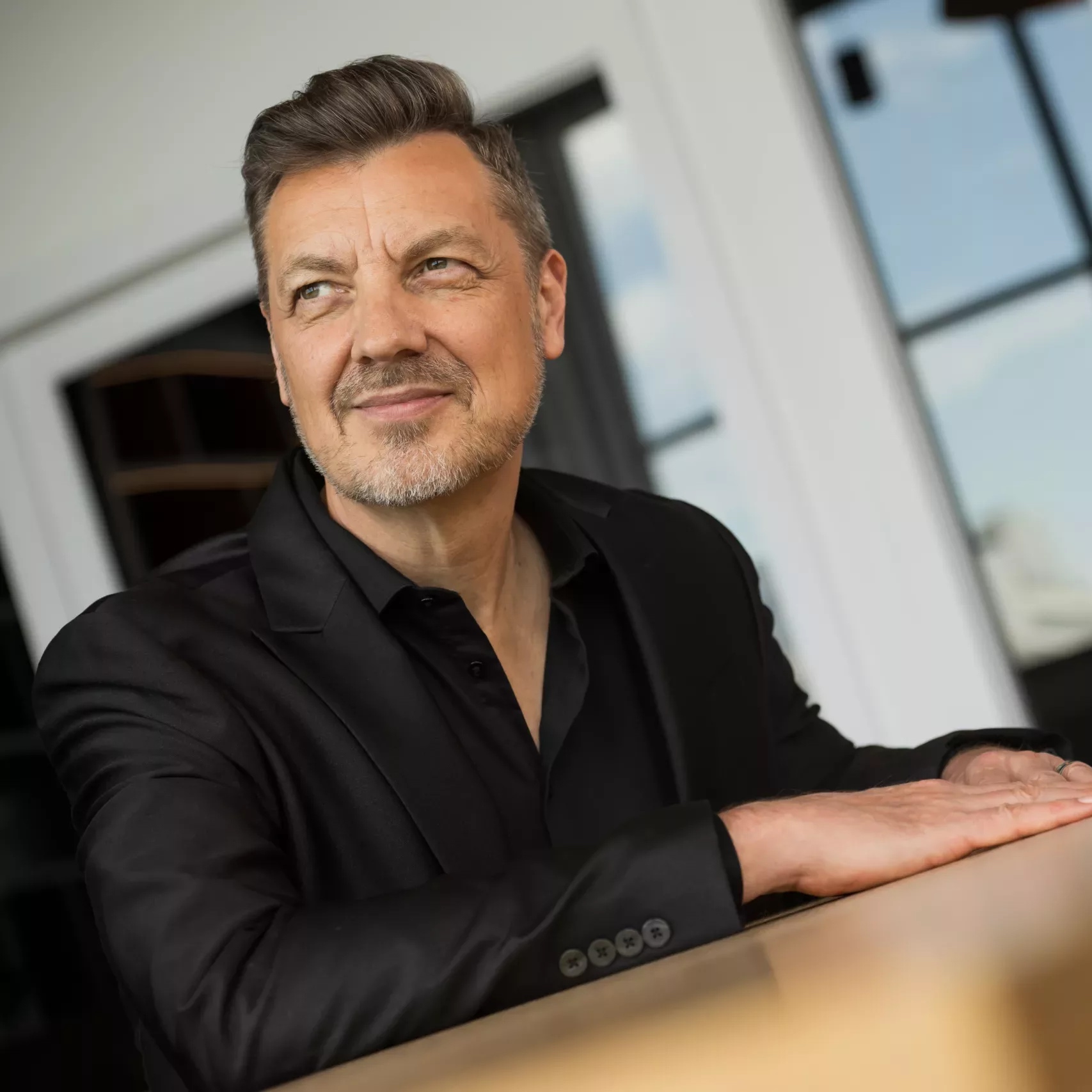
Thirty years spent at IBM, Apple, Sony and then Neopost, before stepping onto the stage to talk about innovation and, in recent years, about artificial intelligence. Philippe Boulanger, an international speaker represented by the speakers’ agency Lespeakers, defends a thesis contrary to the prevailing discourse on AI: the main obstacle to its adoption in business would not be technical or budgetary, but cognitive and cultural. While he is preparing the release of a book with Dunod in 2026, we asked him about what truly blocks organizations regarding AI, and about the experimentation that has become his hallmark, which makes it visible on stage in just a few minutes.
You’ve been talking about innovation for a long time. Why has artificial intelligence become a central axis of your work?
“What made me become a speaker was first and foremost frustration. I’ve seen too many powerful ideas die inside organizations, not because they were bad, but because they were poorly understood, poorly defended, or stifled by corporate culture. I’ve watched brilliant employees become cautious, smart managers defend the status quo. The real obstacle to innovation wasn’t solely technological. It was human — in biases, fears, limiting beliefs, and the absence of psychological safety.
Artificial intelligence is today the arena where this mechanism is most clearly and quickly visible.”
Specifically, what problem are you solving when a company brings you in for AI?
“I help organizations solve a problem that is almost always underestimated: they want to innovate, but their own internal mechanisms prevent ideas from circulating, being tested, and turning into tangible results. The problem isn’t only technological. It is human, cultural, and organizational.
What I come to address is this contradiction: AI is officially desired, but often unconsciously held back. My role is to make the invisible barriers visible, then give teams a common language and concrete experiments to move from intention to action.”
You use a bike with inverted handlebars in your talks. Why this choice, seemingly far removed from AI?
“My signature experiment is my bicycle with inverted handlebars. When you turn the handlebar to the left, the wheel turns to the right, and vice versa. Everyone knows how to ride a bike, everyone believes they can adapt quickly, and yet almost no one does it spontaneously.
This experiment reveals in a few minutes the danger of certainties, the difficulty of unlearning, the brain’s resistance to a new model, the fear of looking ridiculous in front of colleagues, and the importance of psychological safety. It is exactly what teams go through with AI: understanding a tool intellectually does not prevent the brain from resisting when it comes time to truly change the way it works.”
What, in your view, is the most common mistake of companies that struggle to get AI adopted by their teams?
“Employees often have ideas, managers sometimes see the blockers, leaders know the company must evolve, but everyone remains trapped by biases, fears, silos, or a lack of psychological safety. A team can be brilliant and yet silent if it does not feel authorized to make mistakes in front of others.
Or AI is learned by trial and error: you phrase it wrongly, you try again, you adjust. In a culture where error is sanctioned rather than integrated into learning, this trial-and-error phase is experienced as a risk of exposure rather than as a normal step, and some teams simply avoid the tool.”
What do organizers and participants most often take away after your visit?
“Feedback most often highlights four elements: clarity, energy, interactivity, and concrete usefulness. I’m often told that I make topics like innovation, artificial intelligence, cognitive biases, and psychological safety immediately comprehensible.
My aim isn’t merely for the audience to leave saying ‘that was fascinating.’ My aim is that they depart with an actionable question: what do we need to test, change, or decide right now?”
You formalize all of this within a framework you call Intelligence Innovationnelle®. What does it consist of?
“I am convinced that the main problem of innovation isn’t a lack of ideas, nor even solely a lack of technology or budget. It is what prevents ideas from being tested, defended, and transformed into real innovations.
That is why I created the Intelligence Innovationnelle® system, a human-centered framework that rests on six pillars: vision and strategy; culture and psychological safety; communication and decision-making; organization; methods; talents. The adoption of AI is today an integral part of it; it is the subject of my next book, to be published by Dunod in 2026.”
Philippe Boulanger speaks at conferences, in French and in English, on the adoption of artificial intelligence and innovation in organizations. He is represented by the Lespeakers agency. His updates and talks can be found on his personal website.
👉 A small gesture for Space Group? Follow us on Google, add us to your favorites and find us on Google News so you don’t miss any discovery.
