
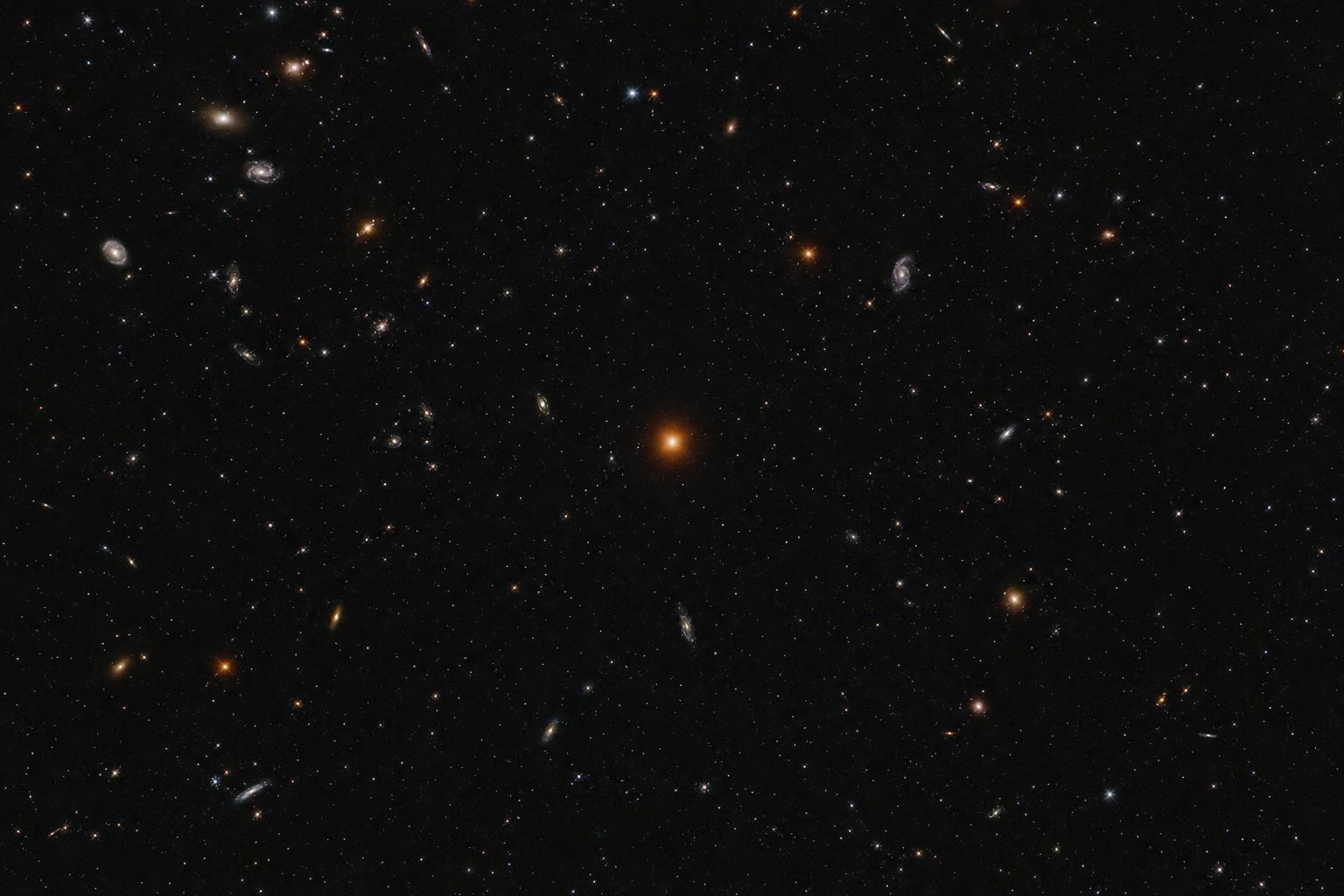
A startling new observation from the James Webb Space Telescope has revealed a black hole roughly 50 million times the mass of the Sun, seemingly adrift with almost no visible galaxy around it. Astronomers are stunned because this runs counter to decades of theory about how supermassive black holes and their host galaxies grow together. As one researcher put it, “This object shouldn’t exist where and how we’re seeing it.”
A heavyweight in a lightweight neighborhood
In most cases, the central black hole is just a tiny fraction of its host galaxy’s mass, typically about 0.1% of the galaxy’s bulge. Here, the balance looks wildly skewed: a cosmic heavyweight apparently sitting in a featherweight, barely-there environment. “It’s like finding a skyscraper in a small village,” one astronomer quipped, emphasizing the stark mismatch.
Such an overgrown black hole challenges well-known scaling relations, like black hole mass versus stellar velocity dispersion. Those relations are the backbone of our story about coevolution—how feedback from the central engine regulates star formation, and vice versa. If those ties can be broken, our narrative about galactic growth may need a major rewrite.
How could it form so fast?
The core puzzle is timing. To become this massive, a black hole must either start with a large seed or grow at blistering speeds under sustained accretion. Standard pictures begin with stellar-mass remnants from the first stars, then climb the ladder through long epochs of gas feeding. That path struggles to reach tens of millions of solar masses without a correspondingly rich host.
“Either the seed was huge, the growth was extraordinarily efficient, or both,” notes one team member. Each route has serious trade-offs—from how to avoid radiation-driven blowout during accretion, to how to assemble enough fuel in such an anemic galactic setting.
- Leading ideas on the table include: very massive direct-collapse seeds; short bursts of super-Eddington feeding; runaway star-cluster mergers; or more exotic primordial black holes.
What the data actually show
The Webb data combine sensitive imaging with detailed spectra, revealing unmistakable signs of a vigorously accreting engine—fast-moving gas, high-ionization emission, and a bright central continuum. Around it, only a faint smudge of stellar light appears, with little of the structure you’d expect from a mature galaxy. The contrast between core and surroundings is unusually steep, especially at rest-frame optical and near-infrared wavelengths.
Could something be fooling us? Gravitational lensing can amplify distant sources, but lensing usually leaves geometric fingerprints—multiple images or arcs—that observers know how to check. Another possibility is extreme dust obscuration, hiding a compact, star-forming host that only longer-wavelength telescopes can reveal. Tidal stripping might tear a galaxy down to its nucleus, leaving the black hole nearly naked after violent interactions or even a high-speed recoil.
“We have a few plausible tricks of nature to rule out,” the team has cautioned. That process requires broader wavelength coverage, deeper exposures, and independent confirmations from other facilities.
Why this breaks the playbook
For years, the coevolution playbook held that galaxies and their central black holes grow in lockstep, policed by feedback that throttles star formation and moderates black hole feeding. This object suggests the center can sprint far ahead of the pack, at least in certain early-universe conditions. If so, some galaxies may begin life “black-hole first,” only later building the bulk of their stars.
That scenario would naturally create dramatic outliers to the familiar scaling relations, exactly what Webb is now starting to find. It also implies that our simulations may be missing fast channels for funneling cold gas into very small regions, or underestimating how quickly massive seeds can assemble.
“We might be staring at a chapter of cosmic history we didn’t know was missing,” said one scientist, underscoring how a single object can pry open big questions.
What happens next
The immediate priorities are clear: push for deeper JWST imaging, probe longer wavelengths to search for obscured stars, and measure cold gas reservoirs with millimeter arrays. Facilities like ALMA can map molecular gas and dust, while X-ray and radio observatories can test the engine’s power and the surrounding environment. High-resolution spectroscopy will refine black hole mass estimates, accretion rates, and outflow signatures.
On the horizon, next-generation telescopes—the Extremely Large Telescope, the Giant Magellan Telescope, and the Thirty Meter Telescope—could resolve the host’s faint structure. Meanwhile, LISA in the 2030s may detect low-frequency gravitational waves, revealing whether rapid black hole growth owes more to mergers or to furious, sustained accretion.
For now, the cosmos has delivered a tantalizing paradox: a giant engine with almost no visible machine around it. And that paradox is doing what great discoveries do—forcing us to ask sharper questions, rebuild our models, and look again, more carefully, at a universe that keeps outrunning our expectations.
