
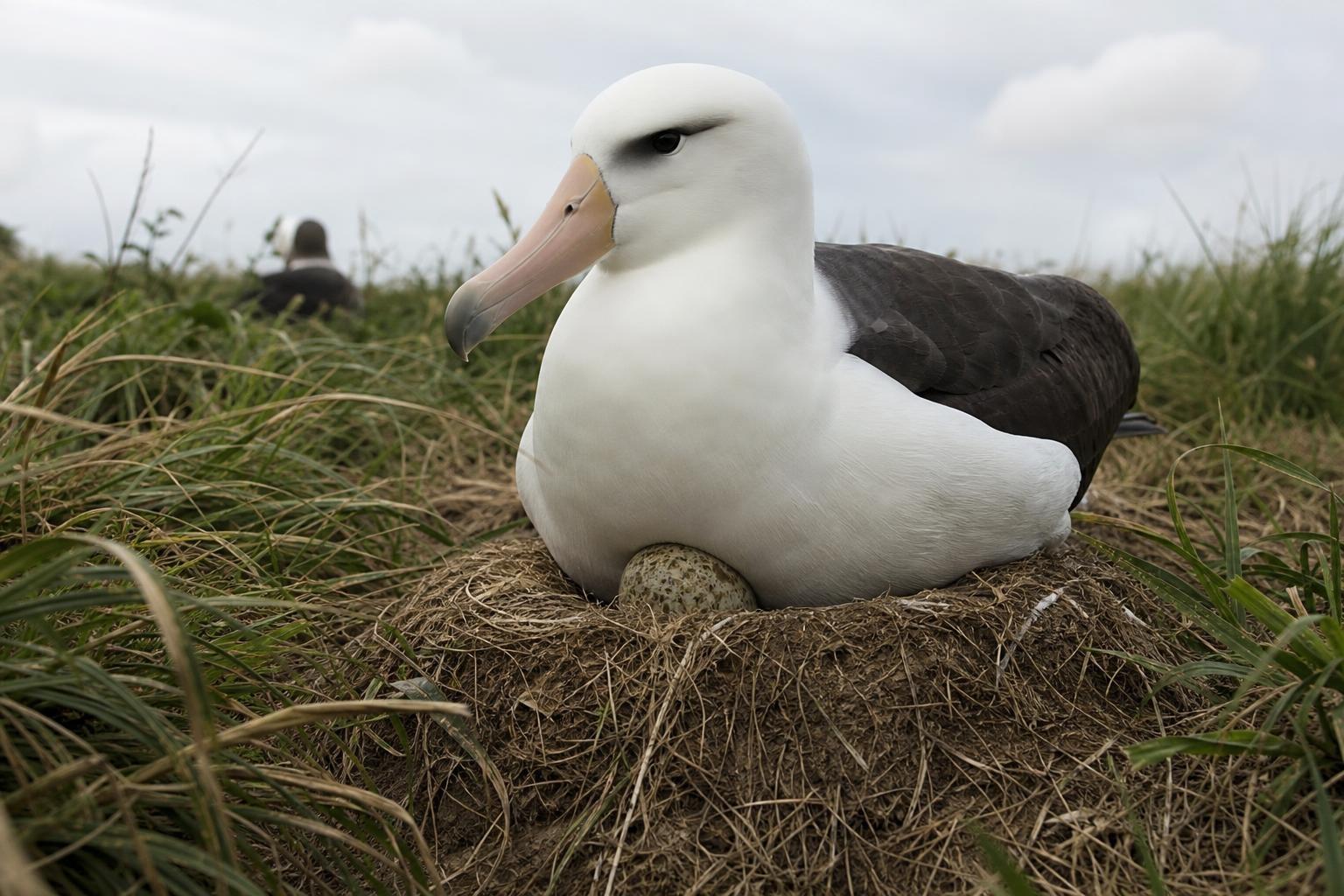
She was banded on a remote coral atoll, then outlived half a century of changing seas. Her story arcs from the dawn of modern ornithology to the era of satellites and microplastics, and still she returned to the same sand. People who never set foot on the Pacific refuge know her name, because endurance, it turns out, has a way of feeling personal.
A band, a mystery
In 1956, a U.S. biologist slipped a small aluminum ring around the leg of a Laysan albatross on Midway. The mark was simple, the implication vast: now a life could be counted, year by year. Decades later, that same bird—already an adult at first capture—was re-sighted, rewriting expectations for longevity in wild seabirds.
Banding records suggest she hatched in the early 1950s, making her older than many research stations that studied her. Each return blurred the boundary between anecdote and data, turning a single life into a scientific benchmark. “Long life isn’t an accident for these birds,” one field biologist once said, “it’s a strategy.”
The physics of endurance
Albatrosses master the wind with a technique called dynamic soaring, trading altitude for speed across rolling air. Their wings lock in place, burning almost no energy over oceanic distances. That engineering, evolved over millions of years, underwrites a lifestyle of slow time: late maturity, long pair bonds, and few but precious chicks.
Such life histories demand survival, not sprinting. If you raise one chick every year or two, you must keep coming back through storm and scarcity. Longevity becomes your reproductive engine, and the calendar turns into a survival scorecard.
Parenthood across generations
She nested on the same sweep of coral grit, often within meters of previous scrapes. Season after season she incubated, defended, and fed chicks that soon launched into the trade-winds. Imagine the map her tracks would draw: a lattice of gyres and fronts, stitched trips from Midway to the wide North Pacific and back again to a waiting partner.
Observers watched her lay eggs into her sixties, a span that boggles mammalian intuition. “Age didn’t look like decline out there,” a refuge volunteer once remarked, “it looked like competence.” Chicks fledged, mates met again after months at sea, and an elder kept rhythm with a rookery of loud neighbors.
What scientists learn
A single band connects moments across eras—analog notebooks to digital databases. From her re-sightings, researchers estimate adult survival rates, age-specific breeding success, and how ocean conditions ripple through a colony’s demography. She is proof that long-term monitoring can turn patience into insight.
Fieldwork makes its own kind of philosophy. “She’s a data point with a heartbeat,” one researcher mused. The lesson isn’t just that a bird can live a very long time, but that ecosystems repay attention kept over long horizons.
Perils on an open ocean
The ocean she learned as a young bird does not match the ocean of today. Longline hooks, drifting plastics, and warming seas have reshaped the risks of every foraging loop. On colonies, sea-level rise threatens low nesting grounds; offshore, prey shifts with changing currents and expanding marine heatwaves.
Still, these birds remain astonishingly capable. They navigate rain bands and fronts, smell food over vast arcs, and adapt their timing to shifting winds. Persistence is their art, but it needs room to work—protected waters, safer fisheries, and beaches kept habitable.
How people help
Small acts can scale across oceans when multiplied by millions. If you’re far from Midway, you can still shape the seas these birds depend on:
- Choose plastic-free alternatives, support seabird-safe certified fisheries, keep cats indoors, cut balloon releases and monofilament, and back refuges that protect colonies.
A different kind of timekeeper
Some animals measure time by litters; albatrosses measure it by returns. She stitched seven decades of open water to one speck of land, reminding us that home can be both a point and a pattern. Her life expands the scale at which we imagine care, because caring for a long-lived seabird means thinking in lifetimes.
“No spreadsheet can capture the hush before a dawn landing,” a volunteer once whispered. But spreadsheets and hush together make the full, improbable picture: a single wild bird, tagged when rock ’n’ roll was young, still riding wind-lines so dependable they feel like faith.
If you listen, you can hear the colony chatter, the clack of bills, the shuffle of webbed feet. A breeze lifts the salt and the smell of guano, and beyond the breakers the trade-winds begin their endless work. Out there, endurance is not a record; it is simply how a life is lived.
