
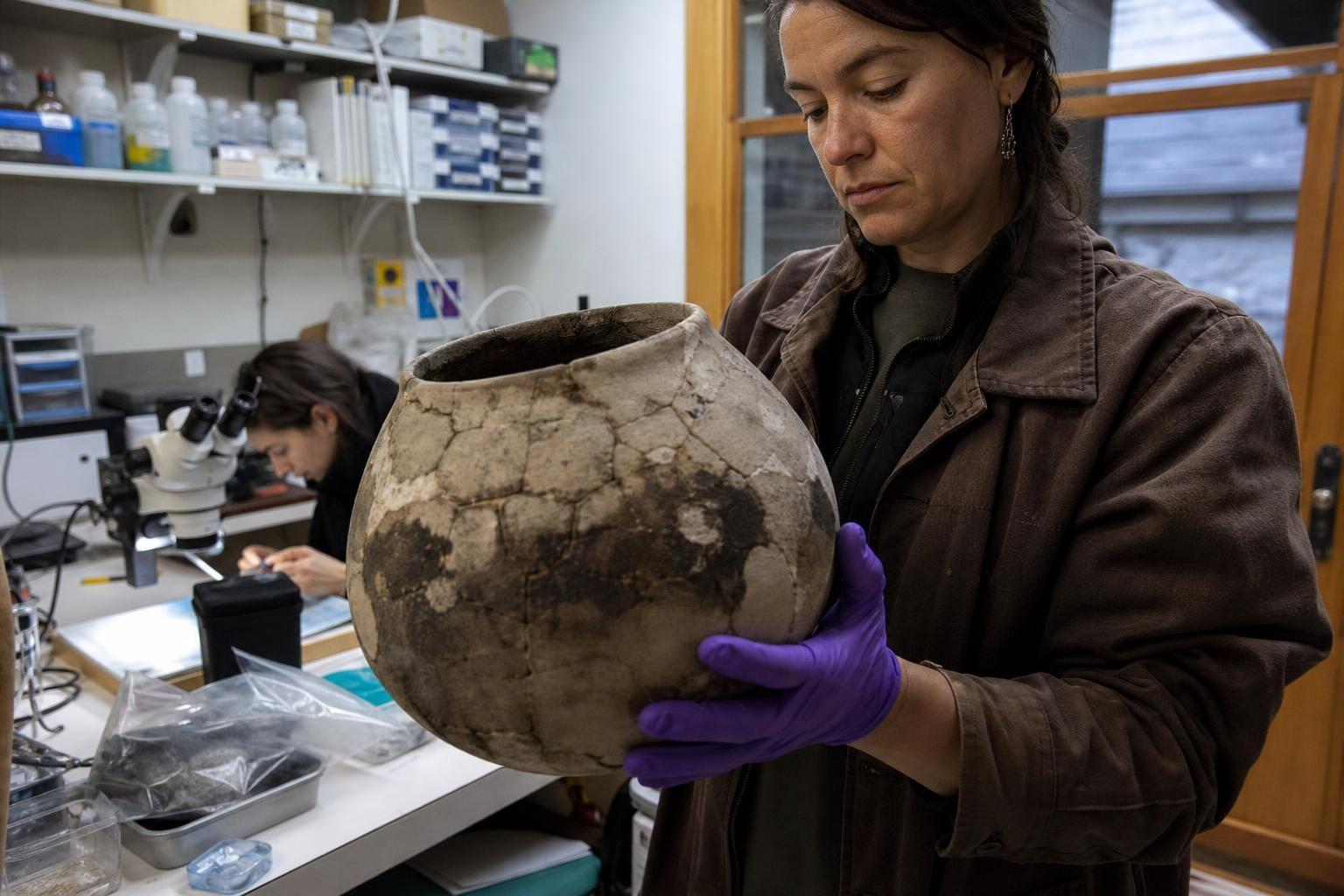
The desert keeps secrets, and pottery remembers flavors. In the heart of the high plateau, archaeologists tested a set of ancient jars and found chemical whispers of a tropical tree. Those whispers point to cacao, the seed that becomes chocolate, moving across mountains and canyons to reach a ceremonial center in the American Southwest. It’s a story of taste, status, and distance, carried not by myth but by molecular evidence. “Residues don’t lie,” the lab work suggests, “they listen.”
What the Jars Revealed
Inside tall, cylindrical vessels, researchers detected the telltale compounds of cacao: theobromine, caffeine, and theophylline. These biomarkers are rare in native plants of the Southwest, but common in Theobroma cacao, tying the jars to a tropical origin. The pottery dates to about a millennium ago, when Chaco’s great houses thrummed with ritual energy. This wasn’t a casual brew; the jar form echoes Maya drinking vessels, designed to pour, froth, and share. The microbes are long dead, but the chemistry is very much alive. One shard after another, the results lined up into a pattern both unlikely and precise.
“Think of it as a fingerprint in clay,” the analysts remark. Cacao’s molecular signature sticks to porous surfaces, surviving centuries of burial, drought, and wind. When extracted and scanned by modern instruments, those traces separate into peaks that shout their identity. Small fragments, big story.
A 2,000-Kilometer Web
To get tropical cacao to a high, arid plateau, you need routes, partners, and promises. The most direct path runs roughly 2,000 kilometers across desert, canyonlands, and volcanic uplifts. Chaco’s people already drew distant goods inward—turquoise, scarlet macaw feathers, copper bells—so cacao joins a familiar roster. Roads radiated from the core like spokes, straight as rules scored across the land. Pack trains, runners, and staged exchanges likely moved perishable goods in careful relays. “Every cup,” a line of thought goes, “records an alliance over many footsteps.”
Distance wasn’t just measured in miles, it was measured in relationships. Chiefs, brokers, and ritual specialists would have orchestrated the flow, timing feasts to the arrival of a rare taste. In a dry world, liquid luxury speaks loudly.
Drink of Ceremony and Power
Cacao drinks in Mesoamerica were often bitter, spiced, and frothy—a culinary grammar of status and occasion. The Chaco jars, with their elongated bodies, fit a similar choreography of pouring, whisking, and display. Picture night gatherings in great rooms, firelight flickering across plastered walls, as attendants distribute a dark, invigorating brew. “This wasn’t just a beverage,” the scene seems to say, “it was an event tied to authority.” Recipes may have varied—chile, flowers, or herbs—but the point was shared intensity.
Control over cacao could signal rank: who could host, who could gift, who could remember a ceremony by its taste. In a society that built monumental architecture from earth and ritual, a rare stimulant would have been a tool as much as a treat.
- What the evidence suggests: long-distance trade, specialized ritual use, and elite-controlled hospitality centered on a scarce, high-impact drink.
How Chemistry Rewrites the Past
Residue analysis turns pottery into archives, readable with delicate methods. Researchers grind interior surfaces, wash the powder with solvents, and run extracts through high-performance chromatography. Theobromine’s peak separates from caffeine’s peak, the ratio aligning with cacao rather than local flora. Blanks, replicates, and cross-checks reduce noise, ensuring the story isn’t a ghost of lab contamination. “Residues are time capsules,” a useful refrain that keeps the focus on process. Each detection is a data point, but together they form a navigable map.
What’s striking is the scale: microscopic markers rebuilding macroscopic networks. A spoonful of powder, a century of trade recovered. Science thrives on constraints, and these jars deliver a disciplined, persuasive signal.
Rethinking Boundaries
For years, maps drew a hard line between the Southwest and Mesoamerica, as if deserts were cultural walls. These jars sketch a different border, one that is porous, negotiated, and seasonal. Goods moved, yes, but so did ideas, aesthetics, and rituals. Taste itself becomes a messenger, translating prestige across languages and landscapes. “If you can sip the same drink,” the archaeology implies, “you can share the same moment.”
The find also humanizes the logistics. Someone organized the trip, someone carried the bundle, someone boiled water, frothed the foam, and passed the first cup. In the residues we glimpse not just exchange, but care—the careful making of occasion.
Today, the evidence sits between shard and story, precise yet evocative. A few milligrams of powder redraw a continental conversation, reminding us that ancient roads still run through the present mind. The next sip you take—bitter, sweet, or spiced—travels older paths than most of us ever imagine.
