
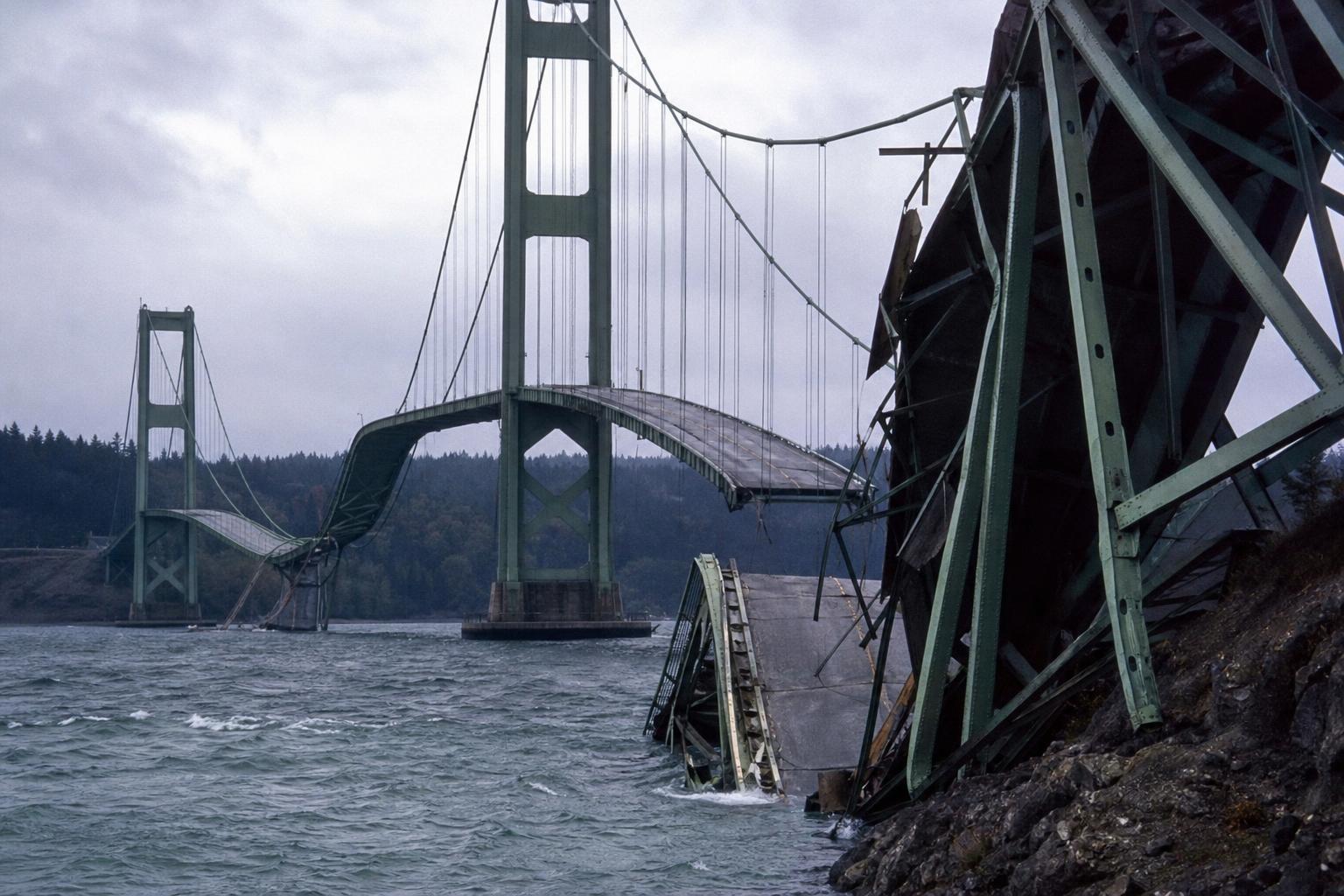
A young suspension bridge in Washington met its fate on a windy morning in 1940, barely four months after its celebrated opening. In moderate gusts—around 40 mph—the graceful deck began to writhe, then fracture, and finally fall into the Narrows below. The world watched a modern marvel become a modern lesson, captured on film and etched into engineering memory.
Slender dreams, bold assumptions
Engineers of the era pursued lighter, more streamlined bridges, chasing efficiency and elegance. The Tacoma Narrows design used plate girders instead of open trusses to save weight and cut costs, giving the deck a smooth, solid profile. The span was long, the deck was thin, and the margins for behavior under wind were tight.
"Light, slender, elegant—and vulnerable," a phrase that could summarize the ambition and the risk. Even before the collapse, locals nicknamed it “Galloping Gertie” because the deck undulated in modest breezes. It seemed dramatic, but also strangely normal—until it wasn’t.
The morning the deck learned to dance
On November 7, 1940, steady winds funneled through the Narrows and excited the bridge’s motions. At first the deck rose and fell, then it began to twist—one side up, the other down—in a growing, synchronized rhythm. Witnesses saw a structure that looked like a "ribbon in the wind," beautiful and terrifying all at once.
The twisting wasn’t a simple resonance like a glass shattering from a note. It was an aeroelastic phenomenon: the wind’s flow fed energy into the deck’s torsion, and the deck’s motion reshaped the flow, forming a runaway feedback loop. "It didn’t fail from strength; it failed from the air," as observers would later put it.
What really failed—and why it mattered
The bridge had ample material strength, but insufficient aerodynamic stability. Its closed girders created solid sides that trapped and channeled the wind, while the slender deck allowed large deflections. Once torsional flutter began, no ordinary stiffness or cable tension could stop the growth of motion.
The cameras rolled as panels buckled and suspender cables snapped, each failure changing the dynamics again and pushing the system over the edge. In the wreckage’s tally, a car was stranded, a dog perished, and a famous set of images became a staple of every engineering classroom.
Myths that stuck—and truths that endured
The dramatic footage invited simple explanations that weren’t quite right. It wasn’t just a single frequency problem, and it wasn’t only vortex shedding like a flag in a breeze. The core was aeroelastic flutter, a coupled dance of structure and flow that grows with feedback and steals energy from the wind itself.
"Bridges don’t simply stand in the wind; they negotiate with it," one writer noted, underscoring that motion can be both cause and effect. The lesson shifted design thinking from strength alone to behavior, from heavier steel to smarter shapes.
How the next generation changed the script
Designers responded with science, not superstition. They built wind-tunnel models, mapped pressure fields, and tracked torsional modes before committing full-scale steel to the sky. The replacement at Tacoma used open trusses to let air pass, more damping to absorb motion, and proportions that resisted flutter at practical wind speeds.
Across the world, long-span projects adopted similar principles:
- Open or perforated elements to reduce pressure differences
- Aerodynamically shaped girders and edges to tame separation
- Added structural damping and tuned controls for lively modes
- Rigorous scaled testing to capture coupled wind–structure effects
These weren’t cosmetic fixes, but a reframing of how bridges breathe with the air.
The broader legacy in steel and wind
What happened at the Narrows helped launch modern bridge aerodynamics as a full discipline. Designers began to treat wind as a partner to model, not an afterthought to resist. The episode also reshaped education, embedding dynamic analysis and aeroelasticity in the core of civil curricula.
Gusts of only about 64 km/h didn’t seem deadly, but the pattern mattered more than the raw number. The wind was steady, the deck was receptive, and the feedback closed the loop. In that narrow channel, a powerful modern idea took hold: stability is a dialogue between shape and air, not a monologue of strength.
Memory, film, and a quiet new crossing
The surviving film made the fall feel personal, turning a local catastrophe into a global classroom. Today, newer spans at the site carry daily traffic with calm, almost unnoticed grace. They are heavier where it counts, looser where air must pass, and wiser in their geometry.
"Failure is a harsh but honest teacher," another oft-quoted line goes. The Narrows paid a steep tuition, and the world learned a craft: build not just to stand, but to move—predictably, gently, and always in harmony with the wind.
