
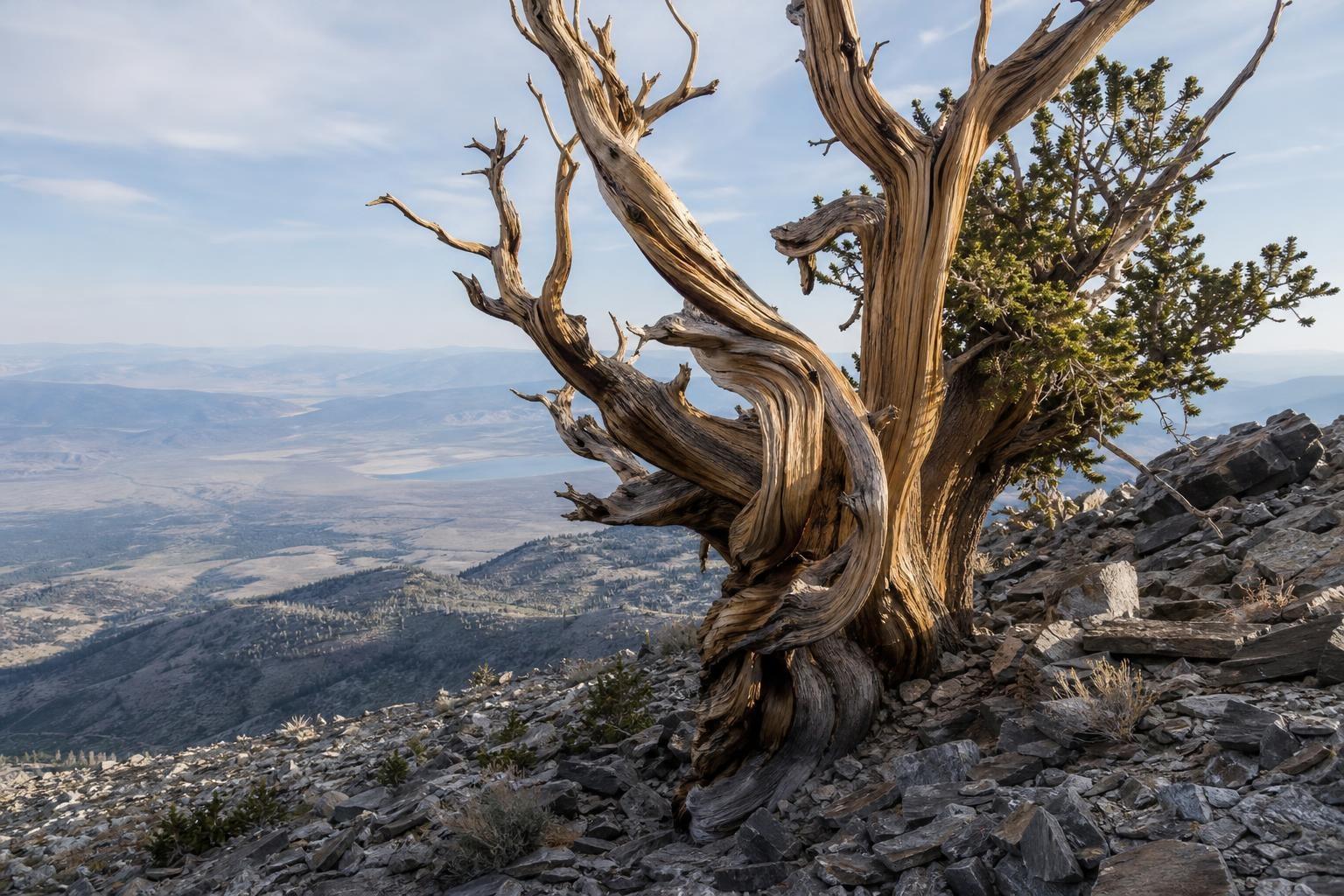
High on a chalk-white ridge in California, a gnarled bristlecone pine has been standing since before the pyramids were built. It has weathered ice, drought, lightning, and centuries of silence. People call it “Methuselah,” a nod to extreme longevity, but you won’t find a sign pointing the way. The exact spot is kept secret, and that secrecy is part of what keeps the tree alive.
Its story is equal parts science and restraint: a lesson in how much we can learn by looking closely, and how much we must protect by stepping back. “Sometimes the most responsible map is the one that fades,” goes a line you might hear repeated by careful stewards of wild places.
Why its location is secret
The tree lives in the White Mountains of eastern California, within the Ancient Bristlecone Pine Forest. Hikers can explore signed trails and meet other venerable pines, but staff won’t tell you which twisted monarch is the true elder. That deliberate opacity isn’t mystery-for-mystery’s-sake—it’s a safeguard.
Vandalism, trampling, unauthorized coring, and social media–driven crowds can all shorten a life measured not in decades but in whole civilizations. “Protect what you love before you need to save it,” say the rangers, and they mean it quite literally. The policy hardened after a different ancient bristlecone, the famed Prometheus in Nevada, was cut down in 1964—a mistake that echoes through time like a ring you can no longer read.
How a tree lives for millennia
Great Basin bristlecone pines (Pinus longaeva) evolved a survival toolkit that trades speed for staying power. Up here, life slows to a resilient crawl.
- Ultra-dense, resin-soaked wood shrugs off rot and many insects.
- Sparse, alkaline, dolomitic soils limit competitors and certain pathogens.
- Cold, dry, windy conditions reduce fungi and fuel slow growth.
- Partial cambial dieback lets only a thin strip of living tissue keep the crown alive, while dead sections stand as protective armor.
The result is a tree that grows so slowly its annual rings can be thinner than a sheet of paper. What looks weather-beaten is actually strategy: fewer resources spent on soft, vulnerable tissue; more invested in hard, enduring heartwood. In this ecological calculus, harshness becomes a shield.
Reading time in wood
Scientists date these trees through dendrochronology—matching patterns of narrow and wide rings across living specimens and long-dead wood. With overlapping sequences, researchers assemble continuous timelines that extend back nearly 10,000 years in the region, calibrating radiocarbon dates and reconstructing droughts, frosts, and even ancient volcanoes.
A single core, no wider than a drinking straw, can reveal summers of abundance and years of want, each ring a ledger line of climate’s careful bookkeeping. “Wood remembers what weather forgets,” as dendrochronologists like to say. In that memory, the old bristlecones are both archive and witness.
Visiting without finding it
You can still meet these elders without stepping on the toes of secrecy. The Schulman Grove visitor center and marked trails near Bishop, California, guide you through stands of bristlecones shaped by wind and time. Every trunk tells a private epic—twisted, banded, half-alive yet wholly present.
Bring layers; the elevation can make summer feel like early autumn. Tread lightly; high-elevation soils and roots are easily disturbed. Photograph the forms, not the coordinates. “Leave the place as if your favorite story started here,” a trail sign might well urge. The magic is not in tagging the oldest individual; it’s in walking among a population of almost impossible survivors.
What its future needs
Even toughness has its limits. Warmer temperatures climb the slopes, pests shift their ranges, and fire seasons stretch longer. At the same time, these trees have endured radical swings before, buffered by altitude, wood chemistry, and habitat’s stark simplicity. Stewardship today blends quiet management—limiting footfall, restricting disclosures—with broader climate action that keeps high places cold and dry.
The lesson travels well beyond one grove. Patience is a technology. Restraint is a conservation tool. And mystery—used wisely—is a form of care. We don’t need to stand beside the exact trunk to be changed by what it represents: continuity without haste, endurance without spectacle, knowledge balanced by humility.
Somewhere on that pale ridge, sap moves through a ribbon of living bark, just enough to feed a modest crown. Wind combs the needles like a quiet metronome. Another ring will come, astonishingly thin, another year added where years already feel like eras. And the place itself, unsignposted and unshared, keeps the most fragile part of the story safe.
