
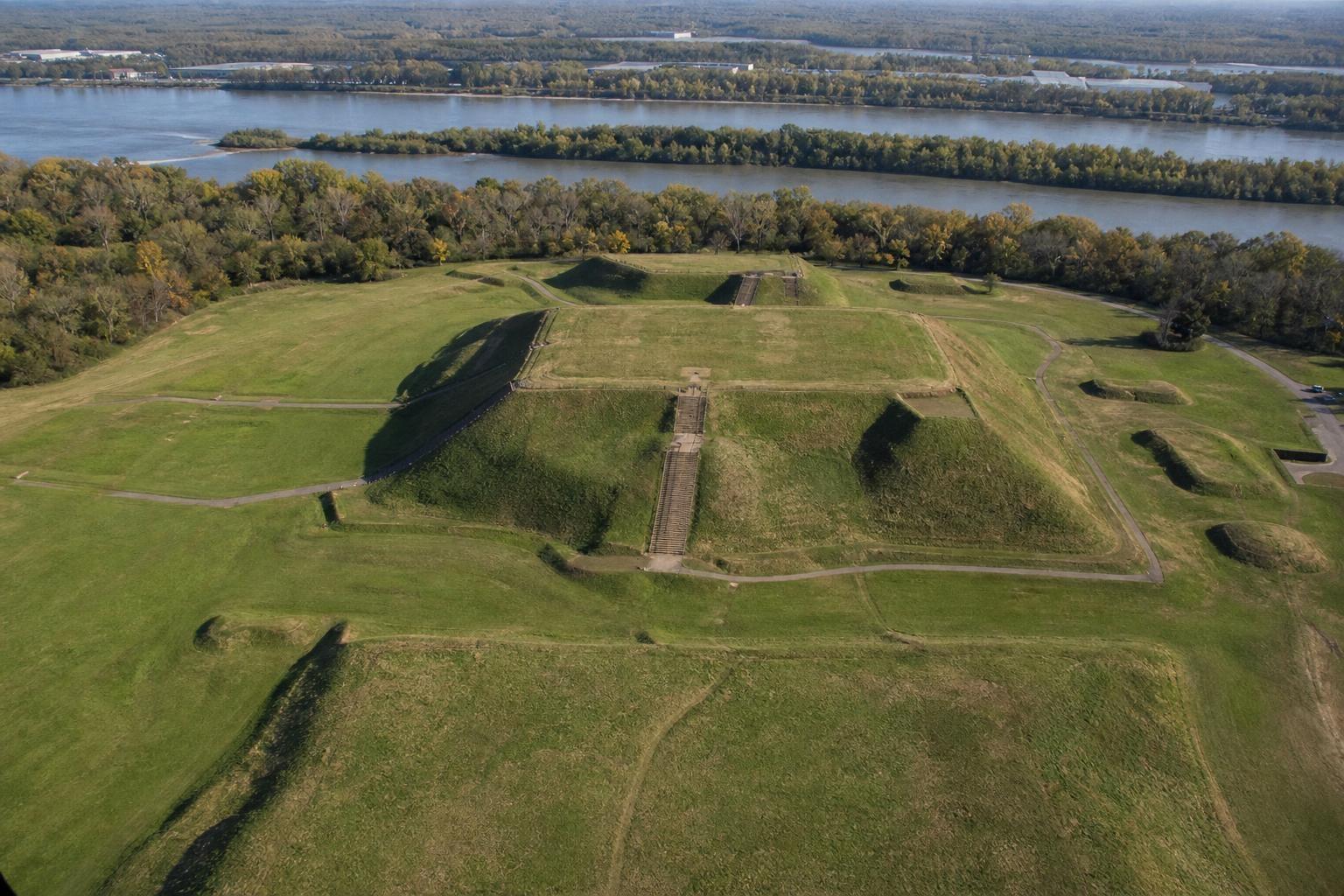
Mist rises off the Mississippi, and across the floodplain a city of earth and timber takes shape. Around the year 1100, opposite today’s St. Louis, thousands of people gathered to build, trade, feast, and govern from a ceremonial core crowned by a colossal earthen platform. One mound at the center was so vast at its base that it outspread even the footprint of the Great Pyramid in Egypt. “This was a place of ideas, not just objects,” one researcher likes to say, and its ideas remade an entire valley.
A City of Earth and Wood
Archaeologists call the settlement Cahokia, a sprawling hub that rose with a pulse of innovation and maize-fueled surplus. Its leaders organized labor into grand projects: plazas leveled with astonishing precision, avenues aligned to solar events, and more than a hundred mounds shaped for ritual, residence, and authority. Around its heart stood a stout wooden palisade, rebuilt several times as politics and belief evolved.
People here were farmers, craftspeople, fishers, and long-distance traders. Neighborhoods formed on low ridges above seasonal floods, each with houses of wattle and daub, storage pits, and communal spaces. The city felt both choreographed and alive, a place where daily routine braided with ceremony and power.
Monks Mound: A Colossus of Soil
At the city’s center rose Monks Mound, the largest earthen construction in North America. Four broad terraces stacked to about 100 feet in height, spreading over roughly 14 acres of base. The labor was hand by hand, basket by basket, millions of loads of soil sorted for stability and carefully layered like a vast engineered cake. On its summit stood a great timber building, shimmering with authority over the grand plaza below.
Visitors today marvel that the mound’s base exceeds the Great Pyramid in sheer spread, even if not in height. “It’s an architecture of patience,” a guide will say, “measuring time in footsteps, not stone blocks.” Every packed layer preserves choices about water, weight, and the social will to keep building.
Life in the Grand Plaza
The plaza itself, a carefully smoothed expanse, hosted gatherings, games, markets, and high ceremony. On festival days, cooks stirred stews of maize and pumpkin, while artisans displayed copper ornaments and finely made shell beads. Spectators watched the game called chunkey, where players rolled a stone disk and spears flew in arcs of skill and status.
To the west stood a circle of cedar posts nicknamed Woodhenge, a solar calendar whose sightlines mark solstices and equinoxes. At dawn, priests and timekeepers tracked the sun’s drift along the horizon, striking rhythms that organized planting, tribute, and ritual. “The sky was a ledger,” some say, “and the plaza a living page.”
Networks, Power, and Belief
Cahokia was stitched into continental networks that carried ideas along with goods. Excavations reveal offerings and ornaments sourced from far-flung lands:
- Copper from the Great Lakes, marine shells from the Gulf Coast, mica from the Appalachians, and high-quality chert from the Ozarks.
Such materials became symbols of rank, woven into ceremonies that elevated leaders and bound communities in shared story. Iconography shows falcon or “Birdman” motifs, where human and raptor blend in scenes of warfare, fertility, and cosmic order. In one burial cluster, known as Mound 72, archaeologists found elite interments, ritual sacrifices, and artfully crafted projectile points arranged like a spread wing—evidence of a cosmology as intricate as it was powerful.
Why It Faded
Within three centuries, the city thinned to silence. Environmental stress likely pressed hard: floods alternated with droughts in the Little Ice Age’s uneasy weather; forests were cut for fuel and construction; soils were tilled and retilled for maize harvests. Add political friction, disease dynamics, and shifting trade routes, and the delicate choreography unraveled into dispersal and change.
Archaeology suggests the palisade was rebuilt amid rising tension, and neighborhoods show signs of hurried abandonment. By the 1350s, the central precinct fell quiet, its mounds slowly greening over as prairie and woodland returned with patient roots.
What Endures
The city’s traces still speak—not of disappearance, but of continuity and influence. Many Native nations today carry descendants of Mississippian traditions, from stories and symbols to agricultural and artistic lineages. The site, preserved as Cahokia Mounds State Historic Site and recognized as a UNESCO World Heritage Site, reframes what “urban” can mean on this continent.
Cahokia shows that cities can be built from packed earth, organized by sky-borne calendars, and sustained by communal obligation as much as by coercive force. It whispers that complexity need not be written in stone to endure in memory and ground. Stand on the big mound at sunset, and the skyline of modern St. Louis wavers beyond the river; between the two, a wide shadow falls across the plaza, reminding us that American urbanism is deeper, and far more surprising, than we were ever taught to believe.
