
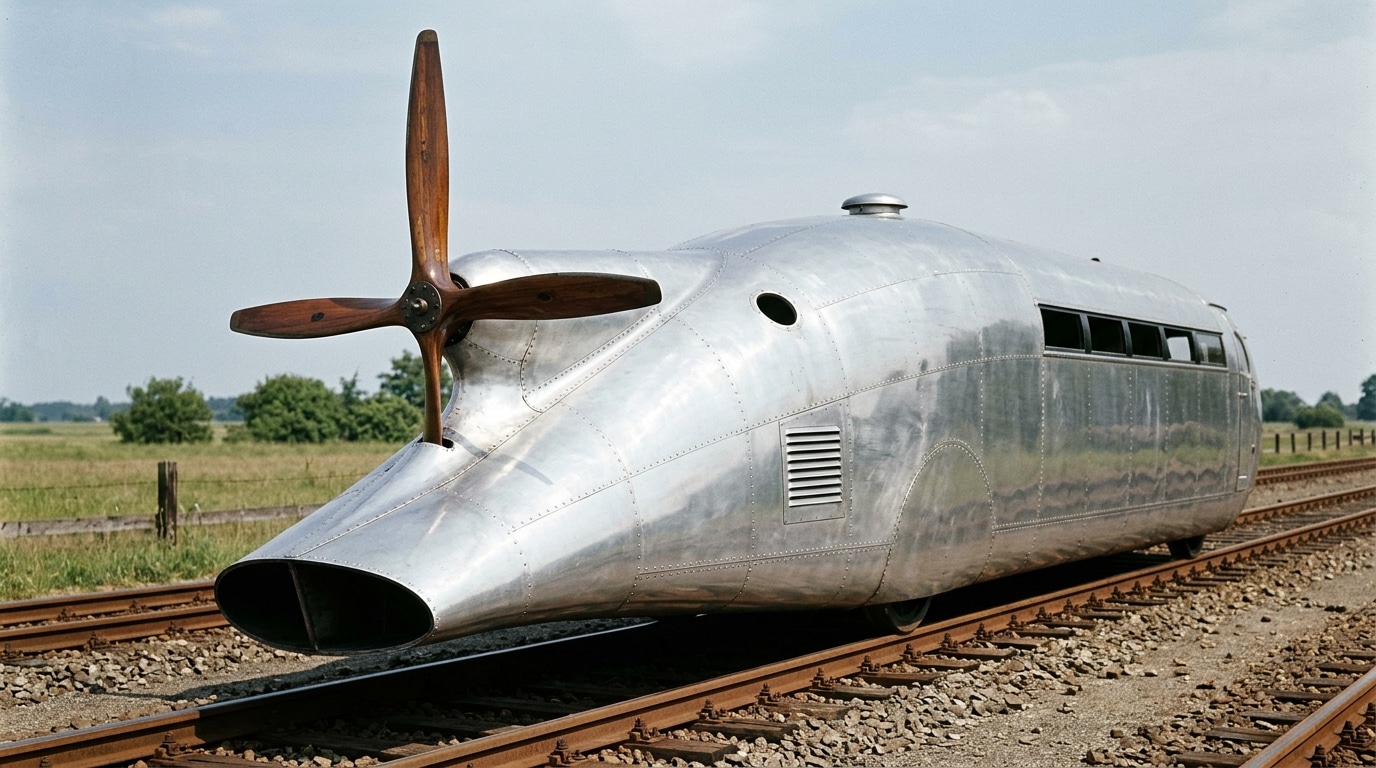
We often imagine extreme rail speed as a recent fixation, born with the TGV or the Shinkansen. Yet, as early as 1931, a single car propelled by an airplane propeller reached 230.2 km/h on a Prussian rail. Its history, as captivating as it is brief, ends eight years later in the workshops of the Wehrmacht.
- On June 21, 1931, the Schienenzeppelin reached 230.2 km/h between Karstädt and Dergenthin, a record unbeaten for nearly a quarter of a century
- The vehicle, powered by a 600-horsepower BMW VI aircraft engine driving a wooden propeller, could neither reverse nor haul additional cars, limiting its commercial use
- After losing its propeller as early as 1932 and making its final trip in 1934, the prototype was entirely dismantled in 1939 to supply materials for the Wehrmacht
- A train propelled by an airplane propeller on Prussian rails
- 230.2 km/h in 1931: the record no one beat for decades
- A gigantic propeller impossible to exploit: the Schienenzeppelin’s planned end
A train propelled by an airplane propeller on Prussian rails
Picture a 25.85-meter-long metal car, with a giant wooden ash propeller mounted at its rear. This is exactly what the Schienenzeppelin looked like, built in early 1930 in the Hannover-Leinhausen workshops for the Deutsche Reichsbahn, the German railway company of the era. Only one unit was produced, and for good reason: engineer Franz Kruckenberg had transplanted an aviator’s logic onto rails rather than that of a traditional railwayman.
Under the hood, a 12-cylinder BMW VI aircraft engine delivering 600 horsepower drove a fixed-pitch propeller. A curious technical detail: the propeller shaft was inclined seven degrees upward, a trick generating a slight downward thrust to press the vehicle onto its rails. Without this, staying stable at high speed on only two wheelsets spaced 19.6 meters apart would have been difficult.
The body itself leaned more toward aeronautical construction than conventional railway equipment. Made from aluminum, it weighed roughly 20.3 tons and could carry 40 passengers—a light weight compared with steel trains of the era. This combination of lightness and an oversized propeller was set to deliver performances unseen in a simple intercity train.
230,2 km/h in 1931: the record no one beat for decades
On May 10, 1931, the Schienenzeppelin first surpassed the symbolic 200 km/h mark. The machine quickly became a spectacle, displayed to the public across several German cities, much like how today a prototype electric car would be showcased at an auto show.
The real feat occurred on June 21, 1931. On that day, the train traveled from Hamburg-Bergedorf to Lehrter station in Berlin, covering 257 kilometers in just 98 minutes. Between Karstädt and Dergenthin in northern Germany, the needle climbed to 230.2 km/h, a figure etched into rail history.
This record stood for nearly a quarter of a century. According to the Berlin-Hamburg line’s historical record, no other railway vehicle managed to do better until the mid-1950s. Sources vary slightly on the exact year the record fell—between 1954 and 1955—but the duration remains remarkable for a prototype built in a matter of months.
Another notable innovation: the Schienenzeppelin was the first rail vehicle equipped with magnetic rail braking. This system could bring it to a stop from 160 km/h within 650 meters, a feat for an era when braking was largely mechanical and slow to react.
A gigantic propeller impossible to exploit: the Schienenzeppelin’s planned end
Behind the technical prowess lay a fatal flaw. The giant propeller, as spectacular as it was, simply could not move the train in reverse. In stations, it posed a real danger to staff and passengers on the platform, akin to parking a propeller-driven airplane in the middle of a crowd. For maneuvering, an additional electric motor had to be installed on the front axle merely to guide it.
Another limiting factor was commercial operation. The Schienenzeppelin could not haul any additional cars. With only 40 seats, it remained a technological demonstrator, not a mass-transport solution. For a railway company, a train that cannot easily increase passenger capacity by adding more carriages loses much of its economic appeal.
By 1932, the propeller was removed in favor of a more conventional hydraulic transmission. The train continued to run, reaching 180 km/h in 1933, but it never regained the aura of its initial record. Its final journey on the Berlin-Hamburg line occurred in July 1934, after which it was relegated to the status of a technical curiosity.
The end came in 1939: the Schienenzeppelin was dismantled, its materials diverted to the Wehrmacht’s war effort. A modest conclusion for a machine that had nonetheless opened the door to high-speed rail, inspiring later, more realistic projects such as the SVT 877 diesel-electric train, nicknamed the Flying Hamburger, put into service as early as 1932.
From this venture emerges a fairly universal lesson about innovation: pushing a technical boundary does not always yield a daily-use object. The Schienenzeppelin demonstrated that a train could glide almost on the ground, well before the era of the TGV, but its lack of practicality doomed it to remain a unique prototype, now vanished except in German railway archives.
👉 A small gesture for Space Group? Follow us on Google, add us to your bookmarks, and find us on Google News so you don’t miss any discoveries.
