
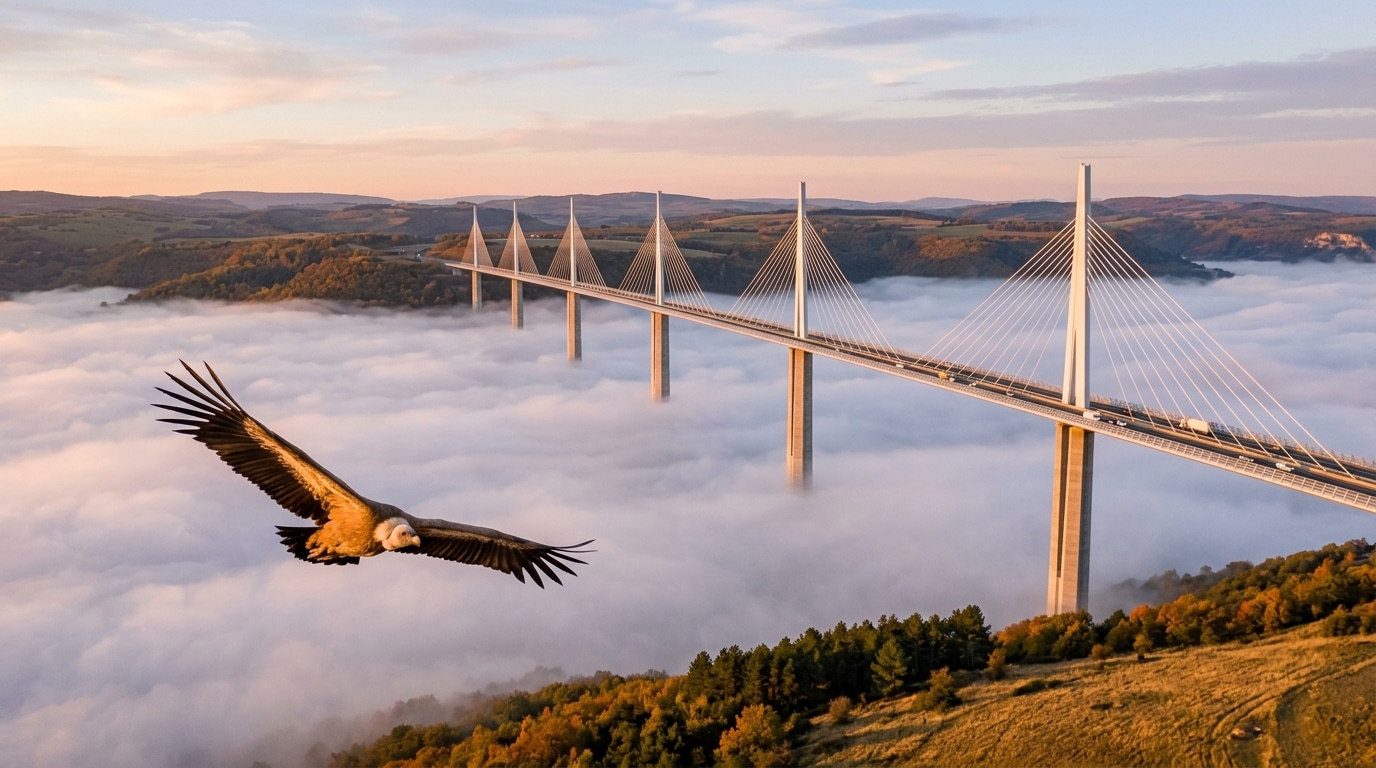
Beware of climatic optical illusions: what the eye perceives on certain autumn mornings above the Tarn is not a trick. The deck of the Millau Viaduct, suspended 270 meters above the void, seems to literally float over a valley that has turned vaporous. The explanation hinges on one word: thermal inversion.
- The Millau Viaduct’s deck rises to 270 meters and its tallest pylon reaches 343 meters above the Tarn.
- On clear autumn nights, a thermal inversion cools the air at the valley floor, causing it to condense into fog and letting the deck emerge above the clouds.
- This phenomenon also affects local wildlife, notably the griffon vulture monitored since 1981 by LPO Grands Causses and the Cévennes National Park, which benefits from the updrafts created by this inversion.
- 270 meters of void, zero meters of fog: the mystery of the floating deck
- When the Tarn valley disappears under an ocean of clouds
- 343 meters: the pylon that pierces the sky while the valley fades away
270 meters of void, zero meters of fog: the mystery of the floating deck
The Millau Viaduct is not like other bridges. Over 2,460 meters in length, it spans the Tarn valley with a deck perched 270 meters above the ground. Designed by engineer Michel Virlogeux and outfitted by architect Norman Foster, the structure was inaugurated in December 2004 for a cost of about 394 million euros, financed by Eiffage under a concession running until 2079.
Each year, more than 5 million vehicles use this strategic section of the A75 motorway. For most drivers, the viaduct remains simply an impressively tall bridge. But on certain autumn nights, calm and perfectly clear, it becomes the theatre of a meteorological phenomenon well known to scientists as thermal inversion.
The mechanism is easy to grasp. The ground cools by radiating heat away once night falls, with no clouds to trap the warmth. The air near the ground cools too, becomes denser, and slides to the lowest point: the bottom of the Tarn valley. As a result, on clear autumn nights, this cold, humid air accumulates in the valley floor and condenses into fog, while the deck at 270 meters and the tallest pylon at 343 meters remain above this stagnant mass of air.
When the Tarn valley disappears under an ocean of clouds
What makes the scene so striking is the contrast. While the fog traps the valley floor, the sky above the deck can stay completely clear and sunlit. Webcams installed on the structure have captured moments when the bases of the pillars vanish entirely, swallowed by a sea of clouds, while the deck appears to float on cotton.
This type of inversion is not unique to the Tarn. On September 12, 2026, Infoclimat’s network measured strong thermal inversions in several French valleys and dolines, with temperatures dropping to as low as -4.7 degrees at the Solaison doline in Haute-Savoie. A figure that aptly illustrates the scale of the phenomenon: a valley nestled in a hollow can become noticeably colder than a plateau located hundreds of meters higher.
This local climatic shift is not just a visual curiosity. It also shapes the wildlife of the Tarn and Jonte gorges. Since 1981, LPO Grands Causses and the Cévennes National Park have tracked the reintroduction of the griffon vulture here, recording 820 breeding pairs in 2021. These raptors soar precisely above these seas of clouds, benefiting from the updrafts that form at the boundary between cold air and sun-warmed air.
343 meters: the pylon that pierces the sky while the valley fades away
If the deck tops out at 270 meters, the viaduct’s highest pylon climbs to 343 meters above the base of the structure. That height no longer makes the Millau Viaduct the tallest bridge in the world, now surpassed by the Huajiang Canyon Bridge. During a pronounced inversion, this pylon becomes literally the last visible landmark, a metallic needle piercing the fog layer like the mast of a ship emerging from the mist.
The structure is not merely a subject of weather observation; it remains a place where people travel. On September 13, 2026, nearly 10,000 runners crossed the deck closed to traffic during the 8th Eiffage Millau Viaduct Run, covering a 4,920-meter out-and-back course at 270 meters above the Tarn. A tangible way to feel this vertiginous height, far from aerial images.
This dialogue between engineering and meteorology gives full meaning to the nickname “floating bridge” sometimes attributed to the viaduct. The structure itself does not move, of course, but it is the valley that vanishes before our eyes, during a cold and clear night, leaving the deck and its pylon to dominate a landscape momentarily erased.
Ultimately, the Millau Viaduct does not require digital trickery to impress. All it takes is a clear autumn night, a touch of cold air, and a sheltered valley to transform a simple bridge into a vessel suspended above a vaporized valley. Next time forecasts call for a clear sky and temperatures in free fall, keep an eye on the site’s webcams: the Tarn valley may well evaporate under the deck once again.
👉 A small gesture for Space Group? Follow us on Google, add us to your favorites, and find us on Google News so you don’t miss any discoveries.
