
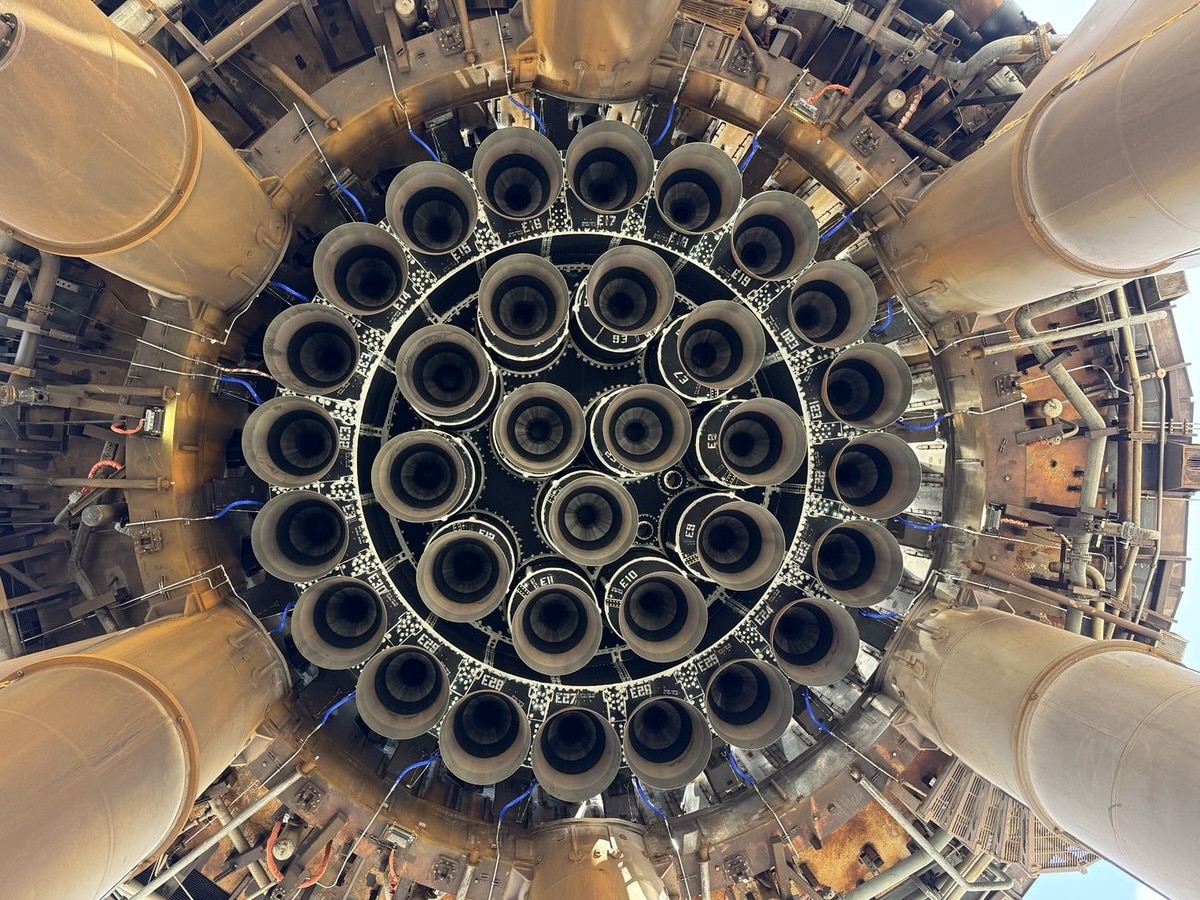
Imagine a hundred jumbo jets revving their engines to full power, all at once, on the same runway. That’s roughly the sensation conveyed by the Super Heavy’s takeoff. With its 33 Raptor engines firing simultaneously, SpaceX’s booster crosses a power threshold that no one had attempted to reach with a single rocket stage.
- The 33 Raptor engines of the Super Heavy generate a total thrust of roughly 74.3 meganewtons, nearly twice that of NASA’s SLS launcher.
- During Flight 14, all 33 engines successfully ignited despite one engine failing in flight, enabling orbital insertion and the deployment of 26 Starlink V3 satellites.
- The booster favors a single massive stage over multiple successive stages, thereby surpassing Saturn V’s capabilities while achieving a soft splashdown.
- 74.3 meganewtons: a thrust beyond human comprehension
- 33 engines ignited simultaneously: SpaceX’s most daring technical gamble
- Why a single stage is enough to propel a rocket twice as powerful as the Saturn V
74.3 Meganewtons: a thrust beyond human comprehension
The figure deserves a moment of pause: Starship’s Super Heavy uses 33 Raptor engines delivering a total thrust of about 74.3 meganewtons at liftoff. One meganewton equals roughly the force required to lift 100 tons. Multiply by 74, and you get an idea of the load borne by the launch pad at every launch.
To put this into even more tangible terms, the Eiffel Tower weighs around 10,100 tonnes. The thrust produced by Super Heavy at liftoff would, in theory, be capable of lifting several Eiffel Towers simultaneously. Such comparisons can be dizzying, but they remain the best way to render a force as abstract as a meganewton tangible.
This power comes directly from the Raptor 3 engines, SpaceX’s latest generation. Their combined thrust at liftoff approaches 18 million pounds-force, roughly double that of NASA’s SLS launcher, long considered a benchmark for heavy-lift rockets. The Super Heavy does not simply compete with institutional giants—it far surpasses them on this precise metric.
33 engines ignited simultaneously: SpaceX’s most daring technical gamble
Taming a single rocket engine reliably is already a feat of engineering. Aligning 33 and firing them within a second of one another, with none faltering, is a completely different order of challenge. Each Raptor runs on liquid methane and liquid oxygen, a propellant combination that demands extremely precise synchronization between valves, turbopumps, and ignition systems.
Recent test history illustrates the difficulty of the task. During Flight 12, the first test of this version 3 of the Raptors, booster B19 missed its return ignition and crashed into the sea. Weeks later, for Flight 13, eight of the thirteen engines planned for the landing ignition did not restart properly, causing a violent splashdown in the gulf.
Another launch attempt had even been halted at the very last second by the onboard computer, after four Raptor engines failed to start correctly. These incidents show how narrow the margin for error remains when handling so many energy sources at once.
That is why Flight 14 marks a turning point. The 33 engines lit up, before one of them shut down during ascent, allowing booster B21 and the S41 spacecraft to lift off from Starbase’s Launch Pad 2. Only one engine on the spacecraft shut down prematurely during ascent, but the orbital insertion and deployment of 26 Starlink V3 satellites proceeded, a first for the program.
Why a single stage is enough to propel a rocket twice as powerful as the Saturn V
Unlike traditional boosters, which typically stack two or three successive stages to reach orbit, the Super Heavy relies on a radically different concept. A single, massive stage housing all 33 engines supplies the bulk of the thrust needed to yank Starship away from Earth’s gravity.
This approach works thanks to the energy density of liquid methane combined with liquid oxygen, and especially because of the number of engines onboard. Whereas Saturn V relied on five enormous F-1 engines for its first stage, SpaceX opted for many more compact yet numerous engines. The result far surpasses the capabilities of the Apollo-era giant, while keeping a single liftoff stage.
Flight 14’s Super Heavy booster further confirmed the viability of this architecture by performing a gentle water landing off Starbase, this time without a tower capture attempt. The mission, initially planned to last about ten hours over six orbits, was shortened after deploying the satellites, with a splashdown scheduled in the North Pacific.
This technical success does not come at any random moment. NASA completed, at the end of September, the stacking of Artemis III’s two booster stages at Kennedy Space Center, a mission now reclassified as a demonstration of on-orbit docking with commercial landing systems. In other words, the reliability of the Super Heavy is no longer just SpaceX’s concern: it directly shapes the timetable for the United States’ return to the Moon.
Between the meganeutons shown and the incidents accumulated in earlier tests, the Super Heavy perfectly embodies SpaceX’s philosophy: aim for raw power, accept failures along the way, and adjust the plan flight after flight. Flight 14 proves that this high-risk method can pay off. It remains to be seen whether this newly gained reliability will hold up over time, as the lunar program’s stakes now partly depend on these 33 engines firing in unison.
👉 A small gesture for Space Group? Follow us on Google, add us to your bookmarks, and find us on Google News so you don’t miss any discoveries.
