
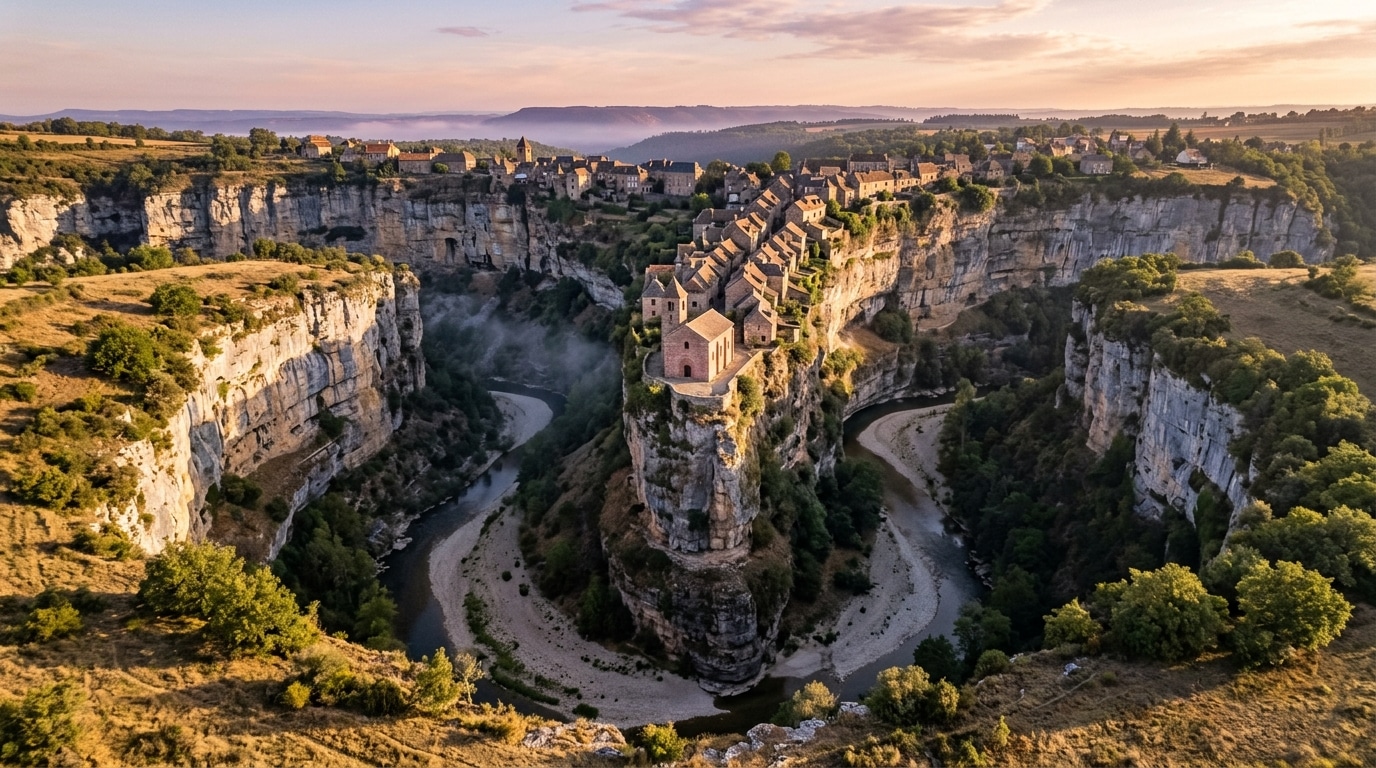
An entire village built along the edge of a 100-meter cliff is not a legend. In Aveyron, the Dourdou took millennia to carve this colossal fissure in the limestone of the Causse Comtal. The result: a nearly circular natural amphitheater, where a millennial church rises on a rocky islet surrounded by emptiness.
- The Dourdou de Conques carved this limestone amphitheater of the Causse Comtal over tens of thousands of years, forming a horseshoe with a diameter of more than 400 meters and a depth of nearly 100 meters.
- The fortified Romanesque church of Sainte-Fauste, built as early as the twelfth century, rises on a rocky spur about 100 meters high, isolated by the river, which once served as a natural defense.
- Despite this water-shaped past, the region experiences marked water stress, with a record-hot summer in 2026 and aquifers whose levels continued to fall—81% of them—by early October according to BRGM.
- A geological horseshoe carved by water for millennia
- Sainte-Fauste, the Romanesque church perched above the void
- Bozouls, the village that literally lives at the edge of the abyss
A geological horseshoe carved by water for millennia
The Trou de Bozouls resembles no other rock formation in France. The Department’s Sensitive Natural Area describes it as a natural horseshoe amphitheater carved into the secondary limestones of the Causse Comtal. A curve nearly perfect, as if traced with a compass by a giant hand.
The numbers are dizzying: over 400 meters in diameter and up to about 100 meters deep in places. To picture the scene, imagine a football stadium plunged into a gulf, with vertical limestone cliffs all around.
The architect of this colossal project is the Dourdou de Conques, a tributary of the Lot. Patiently, over tens of thousands of years, this river carved the limestone—softer and more soluble than other substrates. It is this slow erosion that explains the site’s distinctive looping shape.
Today designated as a Sensitive Natural Area, the Trou de Bozouls remains freely accessible. A rare privilege for a geological site of such magnitude, allowing everyone to stroll along the ridges and tilt their gaze into this open-air canyon.
Sainte-Fauste, the Romanesque church perched above the void
Winding through the limestone of the Causse Comtal, the Dourdou has isolated a rocky spur of roughly 100 meters on which Bozouls’ Romanesque church of Sainte-Fauste stands. It is this stretch of rock, almost entirely encircled by the river, that gives the site its distinctive character.
Built as early as the twelfth century, this fortified church was not placed there by accident. In a time when conflicts were common, the location offered a nearly impregnable natural defense, with the water acting as giant moats all around the building.
Its Romanesque, sober and massive architecture fits perfectly with the mineral surroundings. The stones of the church seem to extend those of the amphitheater, as if the building had grown directly from the rocky spur rather than being set there by builders.
The visual contrast is striking from the viewpoints laid out atop the rim of the circle. You can make out the bell tower barely peeking over the edge, surrounded by emptiness on almost all sides, while the Dourdou continues to flow at the bottom.
Bozouls, the village that literally lives at the edge of the abyss
The village of Bozouls grew up around this natural amphitheater, with houses conforming to the contours of the fault. Living here means accepting a distinctive geography, where streets run along cliffs of several tens of meters.
But this relationship with water is not merely a spectacular backdrop. Like elsewhere in France, the Dourdou de Conques experiences periods of pronounced hydric stress. The Aveyron prefecture eased water restrictions from October 17, 2026, as the river reached the alert level.
A few weeks earlier, in August 2026, the rivers of Aveyron showed very low flow levels despite some rainfall. The fishing federation was then closely monitoring refugia zones, essential for the survival of fish during water stress.
These tensions sit within a broader climate context. According to Météo-France, the summer of 2026 was the warmest on record since 1900, with an average temperature of 24 degrees Celsius, 3.6 degrees above normal, and 53 days of heatwaves. The following September did little to improve matters, with rainfall down by 70%, making it the third driest September since 1959.
BRGM confirms this worrying trend in its bulletin dated October 1, 2026: 66% of observation points remained below monthly normals, groundwater recharge had begun in only 7% of them, while 81% of levels continued to fall. All these signals remind us that even a canyon sculpted by water for millennia is not immune to the vagaries of today’s climate.
The Trou de Bozouls beautifully illustrates this tension between geological time and meteorological time. On one side, a river that shaped the rock over tens of thousands of years to offer this unique landscape. On the other, climatic variations now playing out over the span of a few months, underscoring how fragile the balance between water and land remains, even in a site as spectacular as this.
👉 A small gesture for Space Group? Follow us on Google, add us to your bookmarks and find us on Google News so you don’t miss any discoveries.
