
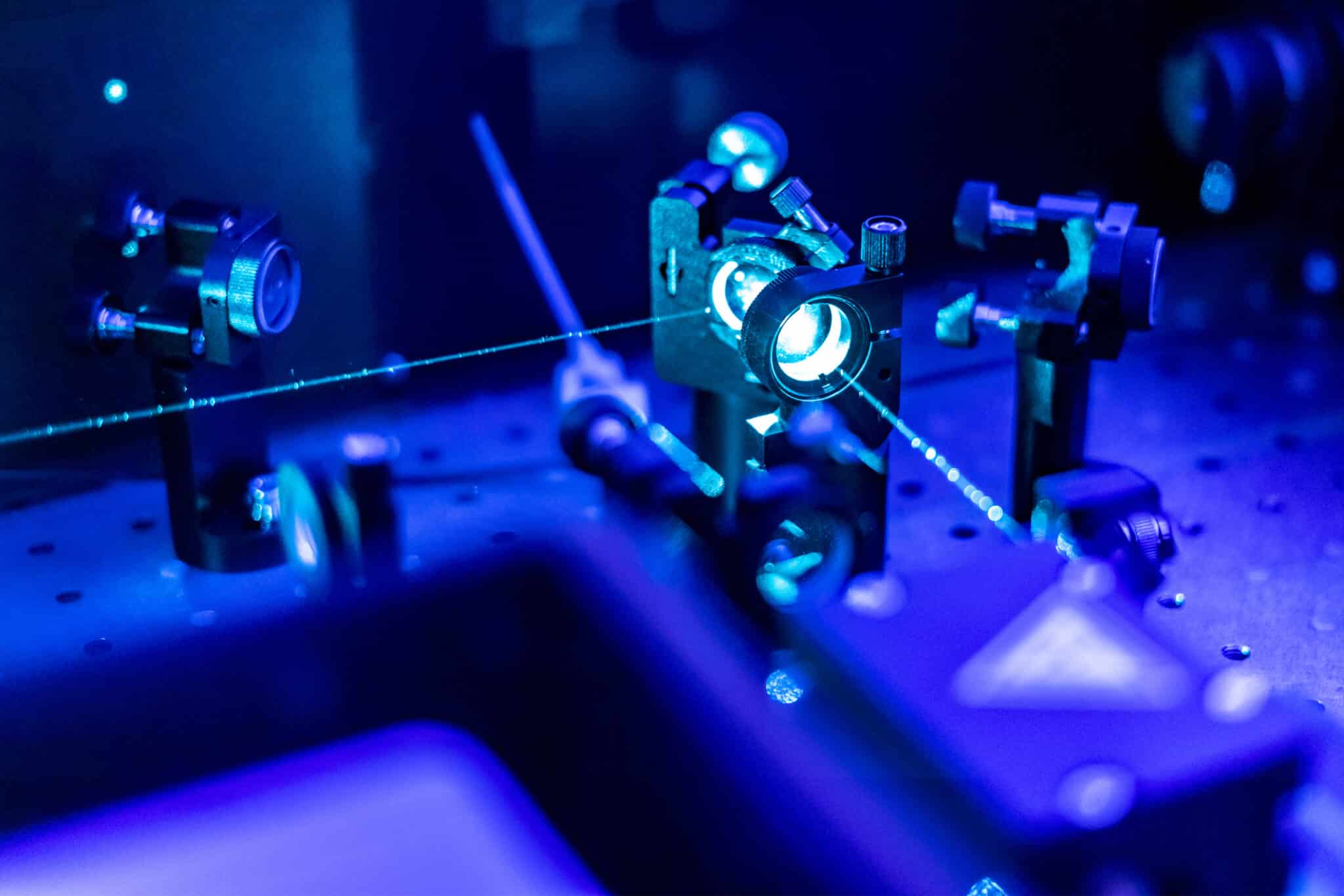
For the first time in history, researchers have used laser light to push the nucleus of a thorium atom to a higher energy level. This scientific achievement opens the door to a brand-new generation of clocks with unrivaled precision that could help us probe the universe’s most fundamental forces.
How do atomic clocks work?
Atomic clocks, which are currently the most precise instruments we have, rely on a captivating principle of quantum physics. They use atoms to measure time with extreme precision.
Imagine an atom as a tiny solar-system-like setup, with a nucleus at the center and electrons whizzing around it. These electrons can occupy different energy levels, much like floors in a building. When an electron gains a certain amount of energy, it can “jump” from one level to another. This is what we refer to as an energy transition.
Now bring in a laser, a focused beam of light. If we tune the laser’s frequency to match exactly the energy required to trigger that energy jump for a given electron, something quite remarkable happens. The electron absorbs the laser’s energy and climbs to a higher energy level. But this state is unstable, so the electron quickly returns to its original level by emitting a photon—a small packet of light.
This phenomenon is especially interesting for a clock: the frequency at which these photons are emitted is extraordinarily precise and constant. It directly depends on the energy difference between the atom’s electronic levels. By measuring this frequency, we gain an exceptionally accurate measure of time.
To put it simply, it’s a bit like each “tick-tock” of the clock being the result of an electron performing a tiny energy jump in the atom.
The promise of nuclear clocks
However, these atomic clocks have their limits. The electrons they rely on lie outside the nucleus, making them vulnerable to external interference such as stray magnetic fields or other environmental effects. These perturbations can subtly alter the electrons’ energy levels and, consequently, affect the clock’s running time.
That’s where the nuclear clock comes in. Unlike atomic clocks, it would exploit energy transitions within the nuclei inside the atoms, thus shielding them from external disturbances.
Yet, until recently, the challenge lay in the fact that the gaps between the nuclei’s energy levels are much larger than those of electrons, making laser-driven transitions hard to induce. This brings us back to these new studies. Physicists have recently used laser light to propel the nucleus of a thorium atom to the desired energy level.
A New Breakthrough
In the 1970s, scientists uncovered a fascinating detail about a particular thorium isotope, thorium-229. They noted that this isotope possessed an energy level that seemed to lie within the range accessible to laser light. In other words, laser light had the potential to push thorium-229 to a higher energy state.
Nevertheless, pinpointing this exact energy gap proved to be a major challenge. To achieve it, researchers had to excite thorium-229 to an energy level far higher than the two levels of interest. They then measured the subtle differences in the energy of the light emitted when thorium-229 descended toward the higher energy level.
After decades of effort and investigation, scientists ultimately reached their goal. They succeeded in directly observing a thorium-229 atom making this jump between energy levels, thereby demonstrating a precise energy change of 8.35574 electron-volts.
To observe thorium-229 directly, researchers employed a sophisticated method involving trapping the atoms inside calcium fluoride crystals. By confining them in a controlled environment, they were able to create the ideal conditions to observe the energy-level jump.
Before this advance, researchers were limited by the technology available to trap and manipulate thorium-229 atoms with precision. Progress in atomic manipulation techniques was essential to enable this direct observation.
This advancement marks a significant leap in our ability to probe the universe’s mysteries with unprecedented precision. By mastering the energy transitions of thorium-229, we move toward an era in which nuclear clocks could measure time with incomparable accuracy. Beyond simple timekeeping, these revolutionary instruments could also illuminate fundamental questions about the very nature of the universe, helping us explore phenomena such as dark energy and dark matter with a new level of scientific finesse.
The details of the study are published in Physical Review Letters.
👉 A small gesture for Space Group? Follow us on Google, add us to your favorites, and find us on Google News so you don’t miss any discovery.
