
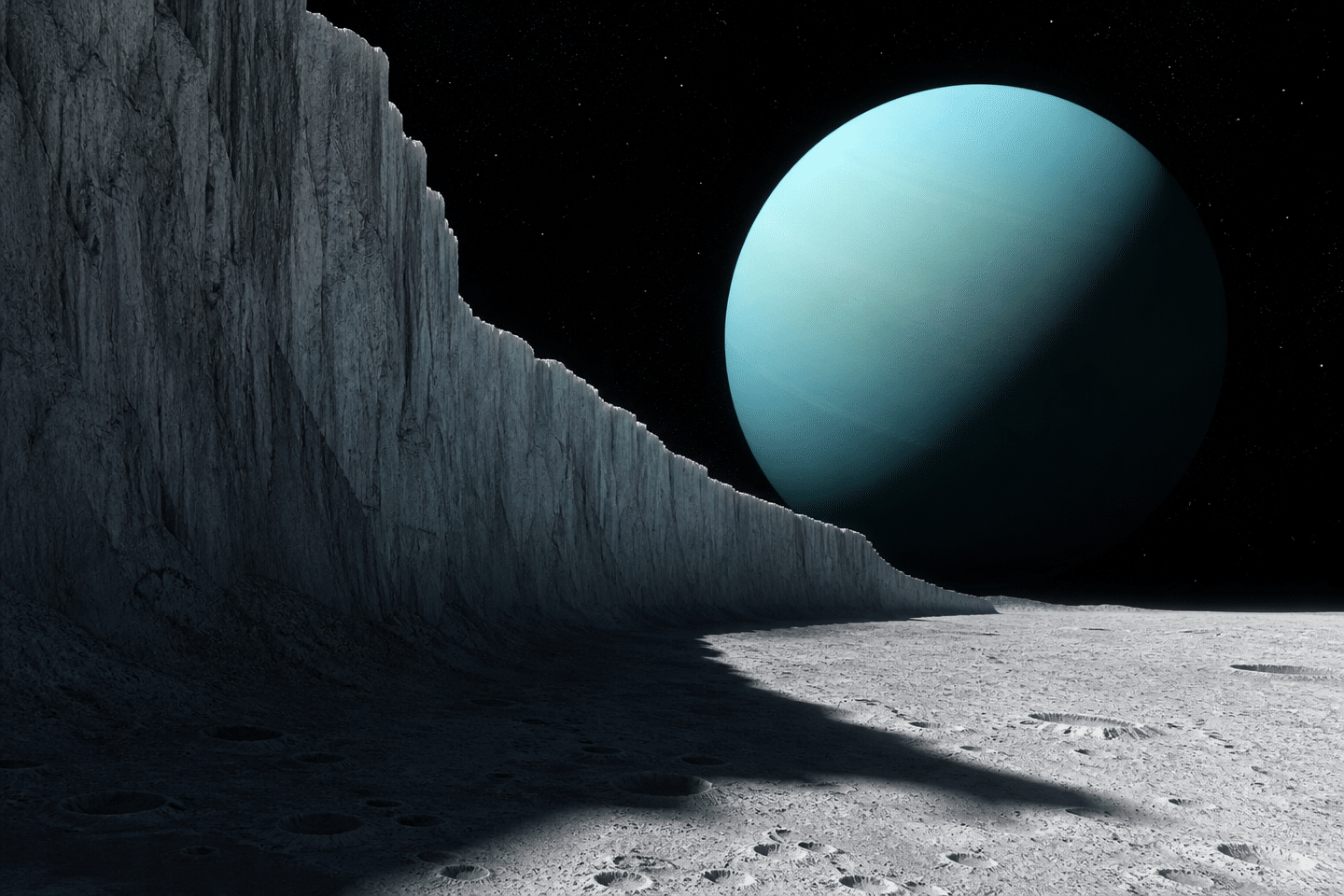
Imagine dropping into the void for twelve long minutes before reaching the ground. That is the scenario imagined for anyone who might fall from Verona Rupes, a vertiginous ice-and-rock cliff perched on Miranda, a small icy moon of Uranus. Photographed only once by Voyager 2 in 1986, it has not been seen again since.
- Verona Rupes, on Miranda, would stand roughly 20 kilometres tall, and a fall from its summit would last about 12 minutes, hitting the surface at nearly 200 km/h.
- photographed only by Voyager 2 in 1986; no subsequent mission has captured fresh imagery since.
- A 2024 study suggests Miranda may have hosted an underground ocean at least 100 kilometres deep 100 to 500 million years ago.
- Verona Rupes, the icy wall that defies gravity
- A single flyby in 1986, and no further news
- Why this cliff could dethrone all records in the Solar System
Verona Rupes, the icy wall that defies gravity
On Miranda, the small, frozen moon of Uranus, rises a vertical wall of ice and rock whose height is enough to induce vertigo. Observed by Voyager 2 in 1986, Verona Rupes is thought to tower about 20 kilometres above the surrounding terrain, potentially making it the tallest cliff known in the Solar System. NASA places its depth at around 20 kilometres, ten times the depth of the Grand Canyon—an Earthly benchmark that suddenly feels modest by comparison.
Yet the estimates have varied substantially across studies. Early analyses, produced shortly after the flyby, put the height somewhere between 5 and 15 kilometres. Later work has nudged this figure upward, with current consensus converging on roughly 20 kilometres. The discrepancy underscores how challenging it is to measure such distance remotely from Earth.
What makes Verona Rupes so remarkable is its coexistence with Miranda’s exceptionally weak gravity, less than one percent of Earth’s. According to NASA, a fall from the summit would take about 12 minutes, arriving at roughly 200 kilometres per hour. Other calculations, factoring in uncertainties about the exact height, yield fall times from 6 to 13 minutes, with impact speeds ranging from 25.2 to 54.8 metres per second.
A single flyby in 1986, and since no new data
To date, Voyager 2 remains the only probe to have approached Uranus’s system. Its January 1986 pass delivered the handful of images we have of Miranda and its colossal cliff. Since then, no mission has revisited the region, and Verona Rupes remains frozen in those nearly forty-year-old pictures.
This lack of fresh data has not stopped researchers from pushing forward. A study published in October 2024 in the Planetary Science Journal proposes that Miranda could have harbored an ocean at least 100 kilometres deep between 100 and 500 million years ago, hidden beneath a crust of ice no thicker than 30 kilometres. An idea that surprised even specialists in the field.
Tom Nordheim, a planetary scientist at the Johns Hopkins Applied Physics Laboratory, described as “incredibly surprising” the idea of an ocean beneath something as small as Miranda. This discovery shifts our view of the cliff itself: its origin remains uncertain, with NASA suggesting either a major impact or tectonic activity tied to the moon’s internal dynamics—perhaps even fueled by that vanished ocean.
Why this cliff could dethrone all records in the Solar System
With a 20-kilometre rise, Verona Rupes comes close to or surpasses the tallest features known elsewhere in the Solar System, even rivaling some Martian relief. The name is not chosen at random: Verona is the Italian city that frames Romeo and Juliet, reflecting the naming convention for Uranian moons, which borrow characters from Shakespeare and Pope.
The Uranus system continues to hold surprises, even without a new mission on site. In February 2025, the James Webb Space Telescope detected an additional moon, temporarily named S/2025 U 1, about 10 kilometres in diameter, increasing the planet’s known satellites to 29. This serves as a reminder that this remote region of the Solar System remains largely unexplored.
This lack of familiarity might soon change. The United States’ 2023–2032 Decadal Survey lists the Uranus Orbiter and Probe as a top-priority mission for the coming decade. The plan envisions placing an orbiter around Uranus and its rings and moons, plus deploying an atmospheric probe. If realized, Verona Rupes could finally be revisited from a fresh angle.
Until a new probe makes the journey to Uranus, Verona Rupes continues to captivate with its sole 1986 images. Between its debated dimensions, its enigmatic origin, and the hypothesis of a buried ocean, this icy cliff encapsulates everything the moons of the ice giants still have to reveal.
👉 A small gesture for Space Group? Follow us on Google, add us to your favorites, and find us on Google News so you don’t miss any discoveries.
