
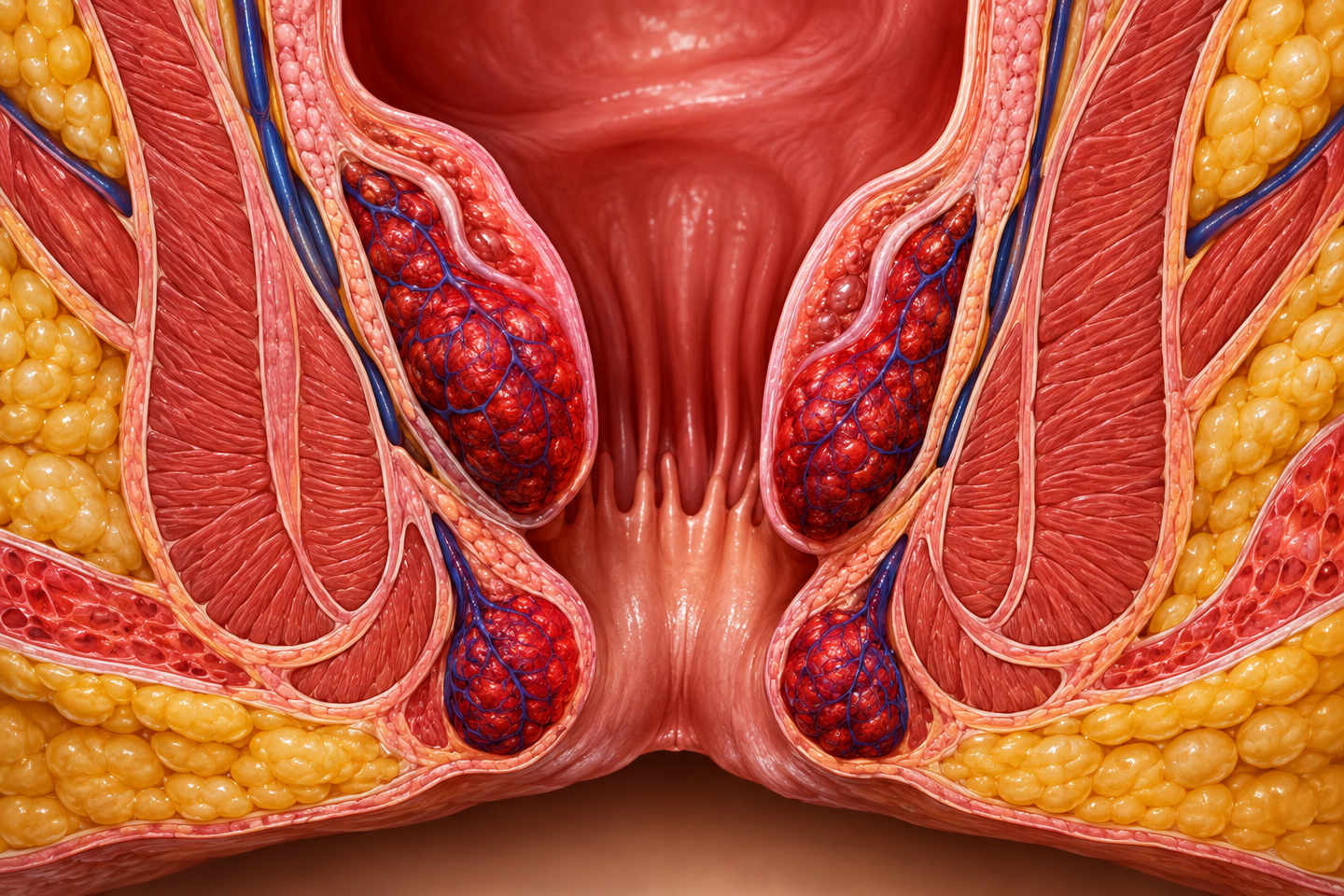
Hemorrhoids are not a disease. They are anatomical structures that everyone possesses from birth, nestled at the heart of the anal canal. Since 1975, medicine has known they serve a specific function. It is only when they become dysregulated that they turn into this silently dreaded condition.
- Since 1975, W.H.F. Thomson demonstrated that hemorrhoids are natural vascular cushions present in everyone from birth.
- These cushions provide 15 to 20% of the resting anal pressure and play a crucial role in continence.
- We only refer to hemorrhoidal disease when these cushions become abnormally swollen, bleed, or cause persistent pain.
- The day a physician proved that everyone hides vascular cushions
- 15 to 20% of a vital function that nobody suspected
- When these normal cushions suddenly tip into disease
The day a physician proved that everyone harbors vascular cushions
In July 1975, the British Journal of Surgery published an article that would rewrite the landscape of proctology. Its author, W.H.F. Thomson, presented the conclusions of his Master of Surgery thesis, titled The Nature of Haemorrhoids. The piece spans only a few pages, from volume 62, pages 542 to 552. Yet its content would permanently alter how we view a region of the body that is seldom discussed.
Thomson describes formations he calls cushions, lined with submucosal tissue and housed within the anal canal. There is nothing accidental or pathological about their presence. He argues that these cushions exist in every human being, from birth. The idea may feel unsettling, given that the word haemorrhoid is tied in popular imagination to suffering and discomfort.
His argument goes further. For Thomson, what is commonly referred to as pathological hemorrhoids does not correspond to the appearance of new structures. It is mainly the displacement of these already existing cushions, which can also swell or become congested. In other words, pathology does not create something new; it disrupts something that was already there and functioning normally.
This distinction, at first glance technical, has very real consequences. It explains why modern surgery now aims to preserve these cushions rather than remove them wholesale. Understanding their role helps explain why hemorrhoids are no longer treated as an anomaly to eradicate, but as an organ to rebalance.
15 to 20% of a vital function that nobody suspected
If these vascular cushions exist naturally, one must still know what they are for. The answer lies in a function as discreet as it is essential: continence. The filling of these vascular spaces would contribute 15-20% to the resting anal pressure, meaning the ability of the anal canal to stay closed outside of evacuation moments.
Another French proctology reference, citing the work of Lestar, puts a figure in the same vicinity—around 15%—to describe the cushions’ contribution to the basal tone of the anal canal. Two teams, two eras, one conclusion. Here we have a kind of internal inflatable cushion that helps maintain the digestive tract’s seal without drawing attention.
These cushions are not arranged randomly. They form what medical literature calls a three-valve system, organized into three precise positions within the anal canal: anterior-lateral right, posterior-lateral right, and left lateral. This triangular arrangement would enable a uniform closure of the canal, much like three cushions sharing pressure to prevent leaks.
That is where the answer to the question in the article’s title lies. Described by Thomson in 1975, these cushions provide 15 to 20% of resting anal pressure, consistent with Lestar’s 1989 findings. We only talk about disease when they swell abnormally or start bleeding. As long as they perform their role, they are merely a silent component of anatomy, akin to a muscle or a valve.
When these normal cushions suddenly tip into disease
The distinction between hemorrhoids and hemorrhoidal disease is not trivial for specialists. The literature clearly separates hemorrhoids, normal anatomical formations present from birth, from what is called hemorrhoidal disease. The term hemorrhoidal disease should be reserved for cases where the cushions become abnormal and symptomatic, not for every fleeting discomfort.
In practice, this vocabulary confusion should not obscure the magnitude of the phenomenon. Hemorrhoidal disease remains the leading reason for consultation in proctology, even if its epidemiology is poorly documented. French guidelines from the SNFCP describe a prevalence ranging from 4.4% to 86% depending on populations studied and the definitions used, a gap that shows how challenging it is to pin down precisely.
Yet some data are well established. According to the SNFCP, one in two patients would have already experienced hemorrhoidal symptoms after age 50. Pregnancy and childbirth are also risk periods, with the condition affecting about one in ten women during pregnancy and up to one in five after delivery, a context well known to midwives and gynecologists.
The topic continues to engage the medical community. During the 2024 National Days of General Practice, Dr. Vincent de Parades of Hôpital Paris Saint-Joseph spoke specifically about managing this condition. At the European level, the European Society of ColoProctology published its own recommendations on hemorrhoidal disease in the journal Colorectal Disease in June 2020, evidence that Thomson’s refined understanding still informs clinical practice, nearly fifty years later.
What ultimately changes is not the presence of these cushions, but the way we view them. Knowing they contribute to continence invites us to contextualize the worry that the word hemorrhoid can provoke. The real signals to monitor remain: bleeding, persistent pain, or abnormal swelling—those that justify a consultation rather than a shrug.
👉 A small gesture for Space Group? Follow us on Google, add us to your favorites, and find us on Google News so you don’t miss any discoveries.