
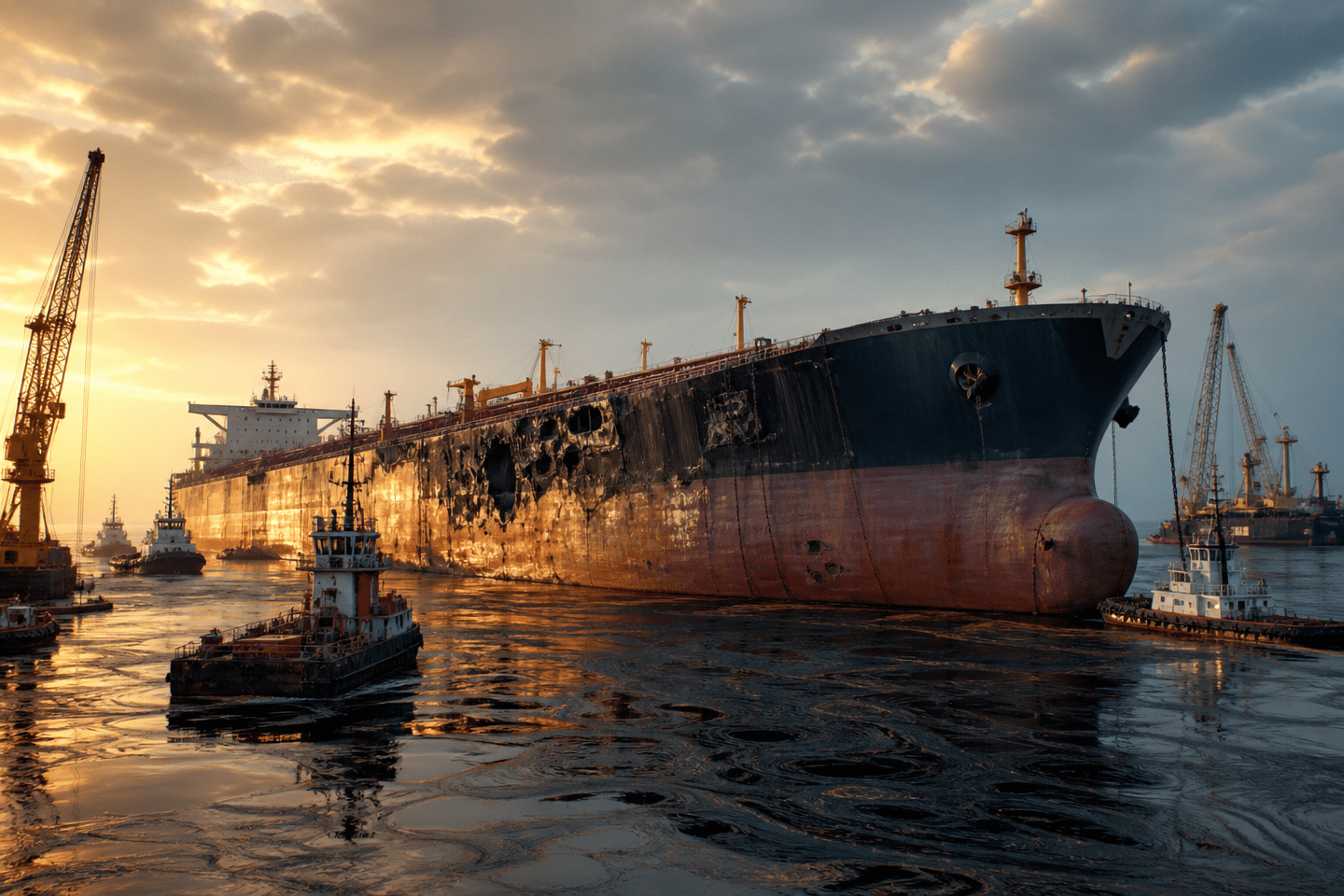
How can a ship officially declared lost, struck by missiles and left for dead, manage to set sail again for more than a decade? This is the story of the Seawise Giant, a tanker so colossal that it remains to this day the longest ship ever built. Its career blends war, wreck, and industrial resurrection.
- The Seawise Giant measured 458.45 meters in length and 69 meters in width, with a deadweight of 564,763 tonnes.
- struck by Iraqi Exocet missiles in 1988 off Iran, it was declared a total loss by insurers before being bought back and rebuilt with 3,700 tonnes of new steel.
- After returning to service under the names Happy Giant and then Jahre Viking, it sailed for more than a decade before ending its days as a floating storage unit in Qatar and finally being dismantled in India in 2010, its anchor preserved at the Hong Kong Maritime Museum.
- A supertanker so large it outstripped the height of the tallest skyscrapers laid flat
- Two Iraqi missiles later, insurers sign the death warrant for the giant
- Bought for a bargain, the colossus rises from the ashes and returns to sea
A supertanker so large it dwarfed the tallest skyscrapers when laid flat
Imagine the Eiffel Tower resting on its side, and you would still be short by about forty meters to match this marine giant. The Seawise Giant measured 458.45 meters in length and 69 meters in width. A figure that defies belief when you consider that most modern freighters struggle to exceed 400 meters.
Its cargo-great capacity was just as staggering: 564,763 tonnes deadweight, equivalent to the weight of hundreds of thousands of vehicles. Guinness World Records rightfully crowned it the longest ship ever built, a record that still stands today.
Paradoxically, this outsized scale was also its greatest vulnerability. With a full-load draft of 25 meters, the vessel could not pass through the English Channel, the Suez Canal, or the Panama Canal. A behemoth doomed to navigate only in the open sea where deep waters posed no problem.
Two Iraqi missiles later, insurers sign the death warrant for the giant
In 1988, the Iran–Iraq War had been raging for years, and tankers transiting the Gulf were prime targets. The Seawise Giant, carrying Iranian crude, lay anchored off Larak Island when Iraqi aircraft targeted it with Exocet missiles.
Hit full on, the ship caught fire. Flames consumed part of its structure as the behemoth, left to its own devices, drifted with the currents. Contrary to what one might expect for a wreck of such magnitude, it never truly sank into deep water.
It finally came to rest in relatively shallow waters, an almost accidental circumstance that would set the stage for what followed. On paper, however, the story appeared finished: insurers declared the vessel a total loss, a verdict that usually marks the definitive end for a ship of this scale.
Bought for a bargain, the colossus rises from the ashes and returns to sea
This is where the story truly takes a turn. Once the conflict ended, the Norwegian company Norman International acquired the wreck, which still lay off the Iranian coast. The gamble was audacious, but the vessel was towed to the Keppel shipyard in Singapore for an unprecedented salvage operation on a grand scale.
The restoration work was colossal. About 3,700 tonnes of new steel were required to rebuild the sections damaged by missiles and the blaze. The project concluded in 1991, after several years of work that was as meticulous as it was spectacular.
Renamed Happy Giant, then quickly Jahre Viking, the ship returned to commercial service. It carried oil for more than a decade, as if the Exocet episode had merely been a paragraph. In 2004, a new owner and a new name arrived: First Olsen Tankers bought it and renamed it Knock Nevis.
Its final mission was less glorious but equally enduring: it finished its career as a floating storage unit, permanently moored on the Al Shaheen oil field in Qatar. In 2010, renamed once again Mont under the Sierra Leone flag, it was towed to Alang, India, where Priya Blue Industries completed its dismantling.
Yet a tangible trace remains of this sea monster. Its anchor, weighing 36 tonnes and standing 7 meters tall, was preserved and donated to the Hong Kong Maritime Museum. Installed on the Central waterfront in 2025, it now sits within the Jockey Club Anchor Plaza, completed in November of that year.
The tale of the Seawise Giant strangely echoes the current events in the Strait of Hormuz, once again a stage for incidents involving tankers, between mines and projectiles reported by the UKMTO. A reminder that these strategic sea routes have never ceased to be tense, and that even the giants of the oceans remain vulnerable to the conflicts playing out there.
👉 A small gesture for Space Group? Follow us on Google, add us to your bookmarks and find us on Google News so you don’t miss any discoveries.
