
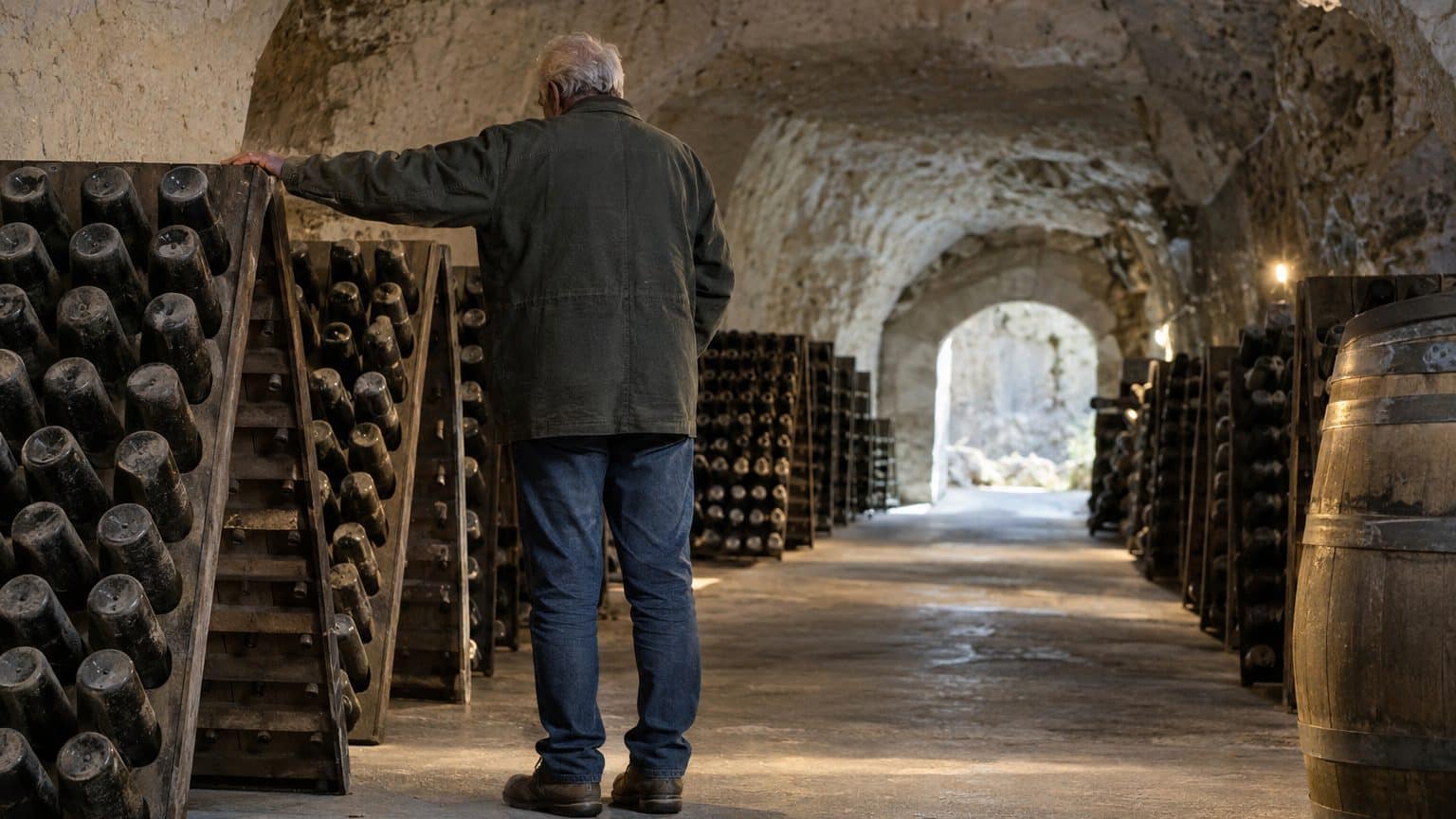
- Around 200 million bottles sit resting in the district’s cellars.
- The cellar network spans 110 km of galleries carved into chalk.
- A stable temperature of 10 to 12 °C prevails in these galleries year-round.
Four Names for the Same Street
About 200 million bottles lie sleeping in Épernay, within 110 km of galleries carved into chalk. All of this concentrates beneath a street about 1 km long and under a few neighboring streets. On the surface, a stroll around the avenue takes roughly a quarter of an hour, without hurrying past the golden gates and the façades of the houses.
It was called Rue du Commerce until February 27, 1925.
The Avenue de Champagne did not always bear such a flattering name. It was first the Hospital Way, then the Faubourg de la Folie, two appellations that gave no hint of the avenue’s destiny. During the Revolution, in 1793, it became Rue du Commerce. The municipal council finally gave it its current name on February 27, 1925, allowing 2025 to celebrate a hundred years of naming.
The trade mentioned by the old name was anything but abstract. Champagne wine merchants settled along it in large numbers, drawn by the quality of the cellars that could be dug beneath their feet, and houses sprang up along the route.
Under the Cobblestones, 110 km of Chalk
The avenue is often nicknamed “the wealthiest in the world,” and it isn’t thanks to its façades. About 200 million bottles rest in the neighborhood’s underground, roughly three times the population of France.
As early as the late 17th century, the champagne houses began digging cellars into the chalk. This rock is easy to carve and maintains a stable temperature, between 10 and 12 °C all year round, with humidity around 90%. The galleries descend to depths of up to 30 m, the height of a ten-story building, only inverted.
About 11 °C in August just as in January.
The largest house on the avenue embodies the scale of the project. It alone possesses 28 km of cellars, spread over three levels, between 10 and 30 m underground. That’s a little more than a quarter of the total network. Brought together, the 110 km represent more than two and a half marathons, largely dug by hand over the centuries.
A clarification is in order, for the tempting shortcut is to assume that these 110 km stretch under the roadway. The city speaks of cellars located beneath the avenue and the surrounding streets, a network that travels through the entire district and not merely beneath the main road itself.
To the South the Caves, to the North the Facades
Geology dictated the avenue’s layout. The technical buildings of the houses lie to the south, where chalk can be mined. To the north stand the grand townhouses, among them the City Hall and Château Perrier.
On the façade side, the straight road is lined with buildings whose late-19th-century architectural style is punctuated by tall, solid and ornate gates. Private mansions and trading houses form a coherent ensemble, aligned along the avenue.
In July 2015, in Bonn, the property “Vineyards, Houses and Champagne Cellars” was inscribed on the UNESCO World Heritage List. The Avenue of Champagne constitutes one of three central zones, alongside two other sites representative of the production, elaboration, and marketing of the wine. The inscription falls under the category of evolving, living cultural landscapes. And the avenue had already carried the label “Site Remarquable du Goût” since 1994.
Ten years of UNESCO and a hundred years of baptism: 2025 marked both.
What You Can Really See
To stroll along the avenue, you simply walk: from the railway station, it’s a 10 to 15-minute walk on foot. The cellars can be discovered beside the houses, but only a portion of the network is open to visits, and a light jacket is essential since the temperature remains around 11 °C even in midsummer.
The count of bottles shifts from year to year: official figures speak of nearly 200 million, sometimes a bit more. The length of the avenue also varies according to tourist descriptions, around 1 km, sometimes a little more.
👉 A small gesture for Space Group? Follow us on Google, add us to your favorites, and find us on Google News so you won’t miss any discovery.
Sources: vinateliste.com | ndf.fr
