
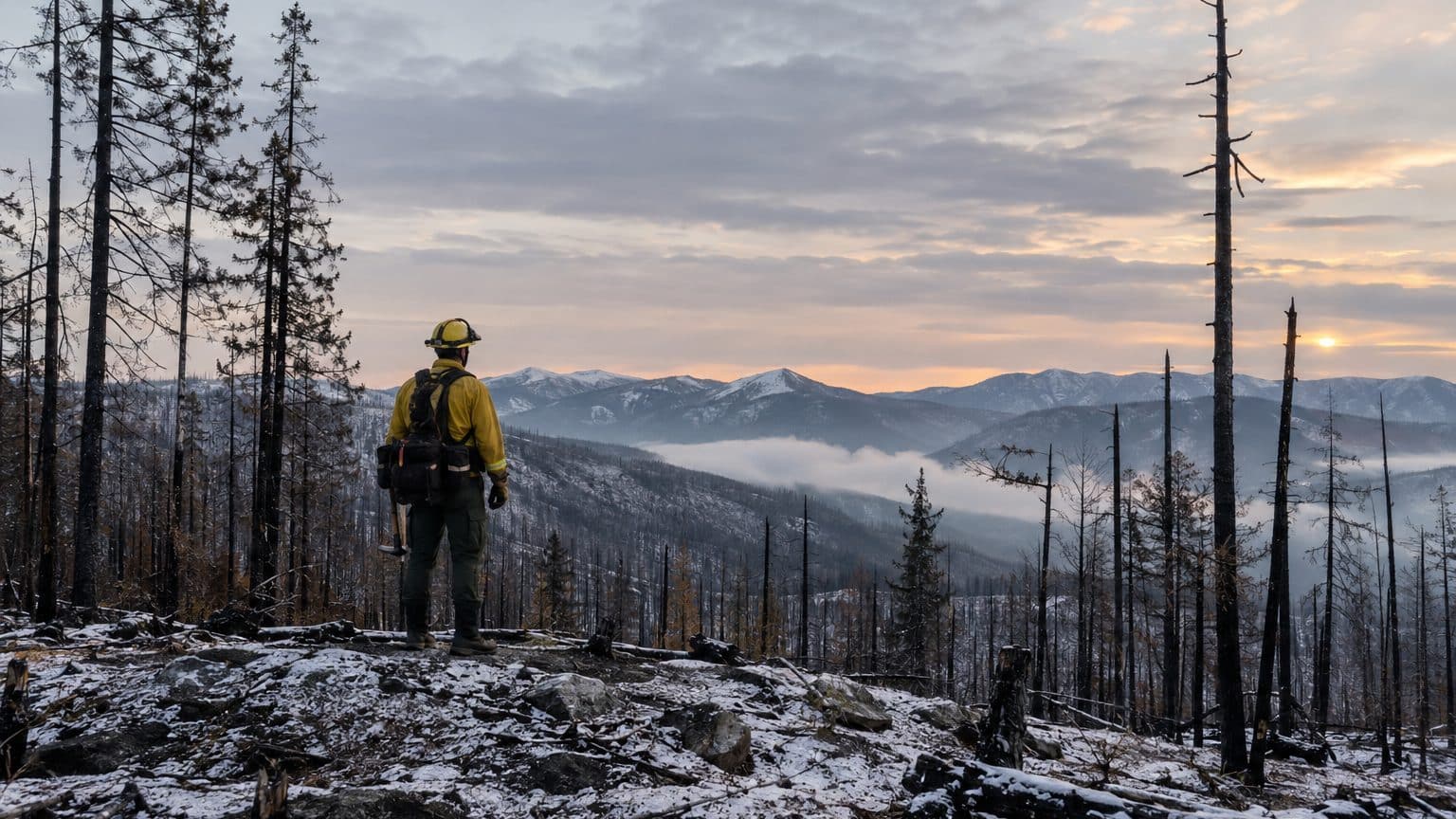
- On September 11, 1988, a snowfall of 0.64 cm halted the flames’ advance at Yellowstone, where thousands of firefighters had not succeeded in stopping them.
- Up to 9,000 firefighters worked simultaneously at the peak, with costs around $120 million.
- The fire affected 36% of the park’s area, in a mosaic of burned and intact zones.
Sixteen years of fires left to burn, then an extraordinary summer
On September 11, 1988, a snowfall of 0.64 cm halted the advance of the flames at Yellowstone, the place where thousands of firefighters had not managed to stop them. At its peak, as many as 9,000 were working simultaneously on the ground. When the front stopped progressing, 36% of the park’s area had been affected.
In total, more than 25,000 firefighters and military personnel were mobilized for about $120 million, which was then the largest firefighting effort in the history of the United States. The figure of 9,000 refers to a maximum reached at the same time, not cumulatively, so the overall mobilization far exceeded this peak.
Since 1972, Yellowstone has applied a rule that still surprises today: certain fires started by lightning are allowed to burn. Between 1972 and 1987, 235 natural fires thus had the right to run their course, burning a total of 33,759 acres, or about 13,700 hectares over sixteen years. Then came the exceptionally dry summer of 1988. By July 15, 18,307 acres had already burned across the region.
Measured per fire, this period remains modest: 235 fires for 33,759 acres yield an average of 144 acres, or about 58 hectares, roughly the size of 80 football fields. That was the ordinary regime of the 1972 rule, the one before the summer of 1988.
In 1988, the region recorded 248 fires, of which 45 occurred within the park.
The difference in scale is stark. Over sixteen years, the 235 fires left to burn consumed 33,759 acres. The single summer of 1988 burned 793,880 acres in the park alone, more than 23 times as much, counting all fires and not just those left to burn.
Among the fires of that season, only 25 had initially been left free to burn, of which 22 were within the park. That is about 1 fire in 10 for the region, but nearly half for the park.
The two totals should be compared with caution, since the perimeters differ. The scale is striking: 235 natural fires over sixteen years on one side, 248 fires in a single season on the other. The shift in scale results just as much from the number of starts as from the summer’s conditions. Even the 1972 rule, applied consistently, had never produced such a record.
July 21, 1988: the order to extinguish all fires
On July 21, 1988, park officials pivoted. All fires would henceforth be fought, including natural ones, within the limits of available personnel. At that moment, about 17,000 acres, nearly 6,900 hectares, were burning in the park.
Seven days later, the fires covered nearly 99,000 acres.
The burned area had multiplied by almost six in a week, rising from around 6,900 to nearly 40,000 hectares. This flare-up occurred just as the general attack order had been issued, with limited manpower. The park’s 99,000 acres already exceeded the region’s total from July 15 by more than fivefold, i.e., 18,307 acres.
Between July 21 and September 11, 52 days pass. A rough calculation, applying to this period the roughly 777,000 acres gained since the order to extinguish, yields about 15,000 acres per day: about 6,000 hectares daily, more than half the area of Paris proper (roughly 10,500 hectares), every day for seven weeks.
A quarter-inch against 9,000 firefighters
On September 11, 1988, a quarter-inch of snow, i.e., 0.64 cm, fell and halted the flames’ advance. Neither the 9,000 firefighters on the ground at the height of the fight nor the $120 million spent achieved this effect. The point is that the snow stopped the fire’s progress; it did not extinguish it. The front ceased advancing more than seven weeks after the July 21 order.
A layer this thin can be surprising. It nonetheless moistens surface fuels and cools the air, two brakes on spread.
In November, embers still smoldered after 5 inches of snow (about 13 cm).
This November snowfall was 20 times thicker than the September 11 one. The thickness matters less than the moment the snow falls.
Applied to the park’s 793,880 acres touched, the firefighting cost amounts to about $150 per acre. The order of magnitude is sufficient, since the bill also covers fires outside the park. As for the snow of September 11, it cost nothing.
A mosaic-patterned park burn
The park spans 2,221,800 acres. The fire touched 793,880, about 321,300 hectares, or 36% of the park’s area. That’s more than 30 times Paris proper, or the equivalent of a square about 57 km on each side. The fire did not burn uniformly but in a mosaic: fully burned areas, half-burned areas, and untouched zones.
Nearly two-thirds of the park remained untouched.
This accounts for 1,427,920 acres spared, about 577,900 hectares. Between the burned and intact zones, the half-burned areas create a gradual transition rather than a sharp boundary. From above, the park would resemble a patchwork rather than a solid black expanse.
A final reading impulse concerns the perimeter. The 793,880 acres and 36% apply only to the park’s interior, whereas the 18,307 acres from July 15 encompassed the entire region.
👉 A small gesture for Space Group? Follow us on Google, add us to your favorites, and find us on Google News so you don’t miss any discoveries.
Sources: wffoundation.org | wyohistory.org | ksl.com
