
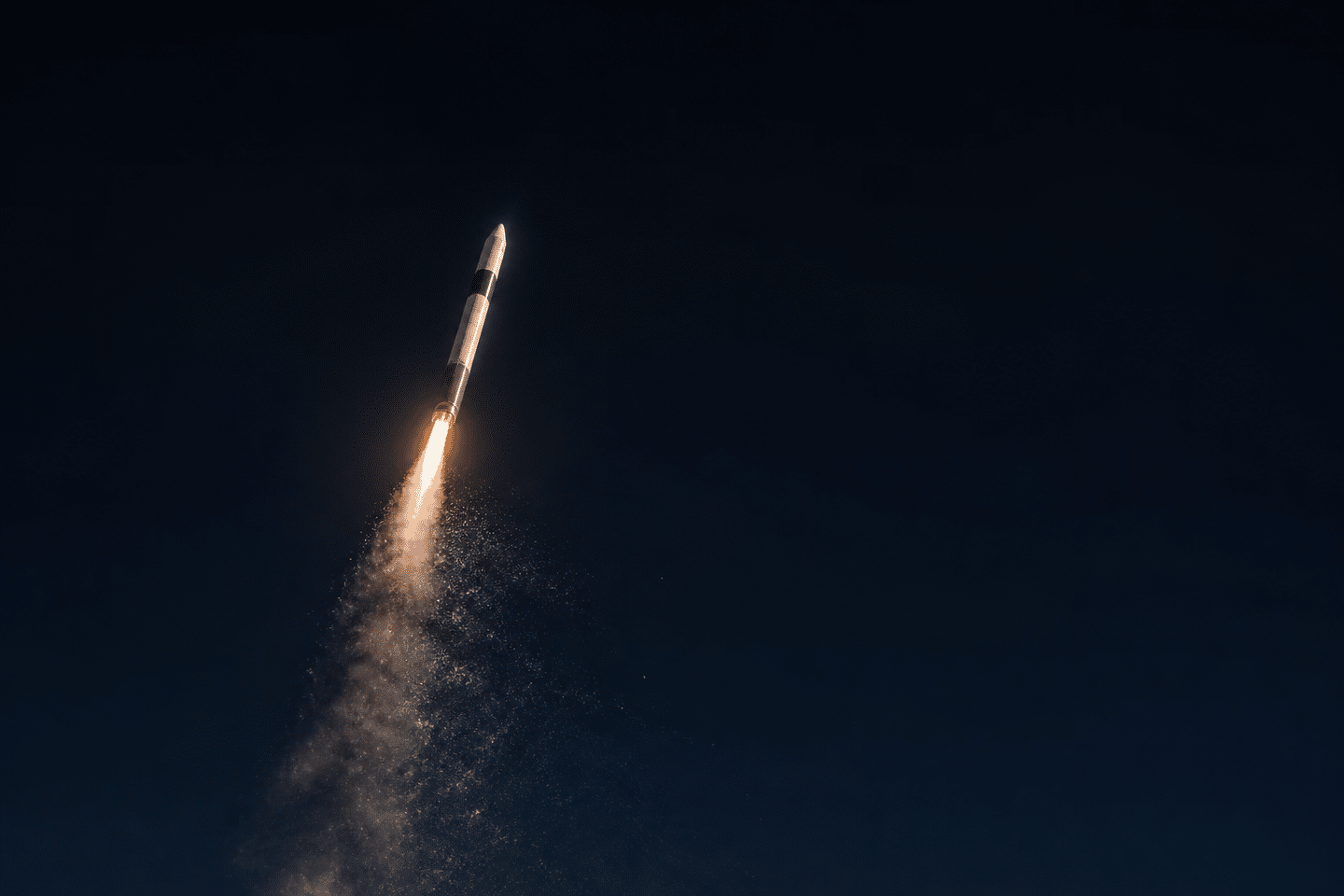
A stage that refuses to come to a complete halt, a burial capsule blasted into the void, and Scotty’s soul returning to Earth instead of streaking toward the stars. The failure of Falcon 1’s third flight is not a mere technical anecdote: it literally prevented a beloved Star Trek actor from reaching orbit, for four more years.
- The third Falcon 1 flight (August 2008) failed when the first stage, delayed by residual thrust, struck the second stage during separation.
- This failure was caused by a design error in the separation delay, quickly corrected on the subsequent flight, which reached orbit on September 28, 2008.
- The ashes of James Doohan, lost in this failure, ultimately reached orbit in May 2012 aboard a Falcon 9 on the COTS Demo 2 mission.
- When the Merlin 1C kept firing after the stop signal
- James Doohan, a Scotty who eventually reached orbit despite it all
- Falcon 1 and Falcon 9, two come-backs four years apart
There are failures that cost a satellite, and there are failures that cost a piece of popular mythology. On that August day in 2008, on a lost atoll in the Pacific, SpaceX experienced both at once. The Falcon 1 launcher was carrying a military satellite, two NASA experiments, and a burial capsule bearing the ashes of 208 people, among them James Doohan, the unforgettable actor who portrayed Scotty. The story of that failure deserves attention, for it blends precision engineering with an unexpected posthumous fate.
When the Merlin 1C still pushed after the abort command
The Falcon 1’s third flight lifted off from Omelek Island, a tiny speck of land belonging to Kwajalein Atoll in the Marshall Islands. The first stage performed as planned, pushing the stack up to about 217 kilometers in altitude. Then the Merlin 1C engine received the command to shut down, in preparation for the separation between the first and second stages.
That’s when the situation took a turn. The programmed delay between engine shutdown and stage separation was 1.5 seconds, a value that had worked perfectly on the engine used in the previous flight. The problem: the Merlin 1C used here was a regeneratively cooled engine, a different technology in which the propellant flows through channels to cool the nozzle before being injected into the combustion chamber.
According to SpaceX’s investigation, unburned fuel remained trapped in these cooling channels at the moment of shutdown. This leftover burned on, generating a residual thrust. A tiny thrust, but enough to overcome the force of the pneumatic pushers meant to push the stages apart.
The result: about two minutes and twenty seconds after lift-off, the first stage caught up with and struck the second. Elon Musk stressed a few days later that neither stage exploded. It was a collision, not an explosion. And, crucially, he insisted on one point: the problem stemmed from a design error, not a manufacturing defect. A detail that changes the trajectory of a space program, since it points to a calculation that must be corrected rather than a complete overhaul of a production line.
James Doohan, a Scotty who eventually reached orbit after all
Among the payloads on that failed flight was a rather special capsule, named Celestis Explorers. On board were the cremated ashes of 208 people who had chosen, during life, to see a portion of their remains depart into space rather than stay on Earth. A powerful symbol for space enthusiasts.
Among those 208 names, a few resonate particularly strongly. There was Gordon Cooper, one of the original Mercury Seven astronauts and a landmark figure in the American space program. Mareta West, an astrogology who helped select landing sites for Apollo missions to the Moon. Filmmaker John Meredyth Lucas was also among the departed carried aboard.
And then there was James Doohan, the Canadian actor renowned worldwide for portraying Montgomery Scott, better known as Scotty, the rugged and brilliant engineer of Star Trek. A delicious irony: the man who, on screen, fixed ships and saved missions, found his ashes blocked by a real-world delay of just 1.5 seconds.
Doohan was not new to the idea. A tiny portion of his ashes had already flown on a suborbital SpaceLoft XL mission in April 2007. But this time, the ambition was different: to actually reach Earth orbit, not merely skim the edge of space for a few minutes before falling back.
Falcon 1 and Falcon 9, two comebacks four years apart
The good news for SpaceX and for the memory of Scotty is that the story did not end in failure. Elon Musk had noted that a very small adjustment would have prevented the two stages from colliding. A slight extension of the separation delay, and the mission would likely have succeeded.
The fix was implemented promptly. On Falcon 1’s fourth flight, on September 28, 2008, the launcher reached orbit successfully. It marked the first privately funded orbital launch of a rocket, a foundational milestone for Musk’s company, which at the time was just one player among many in a field dominated by established giants.
As for James Doohan’s ashes, they had to wait longer for their revanche. It finally happened in May 2012, aboard the second stage of a Falcon 9 during the COTS Demo 2 mission, reaching Earth orbit. That mission also signaled a significant step, as it foreshadowed future private deliveries to the International Space Station.
Four years separate the blunt failure of 2008 from the quiet success of 2012. Between them, a once-trusty launcher learned to be reliable, and a fictional engineer became, in a posthumous way, a true space traveler in the stories we tell and the journeys we undertake.
This anecdote nicely illustrates the reality of spaceflight: behind every technical failure, however minor it may seem at first glance, lie sometimes symbolic consequences that are more surprising than the fault itself. A 1.5-second miscalculation can pin a symbol of popular culture to the ground. Fortunately, SpaceX learned from its mistakes, and Scotty eventually joined the stars he had roamed for decades, both on screen and in spirit.
👉 A small gesture for Space Group? Follow us on Google, add us to your favorites, and find us on Google News so you won’t miss any discoveries.
