
- Mount Rushmore was completed on October 31, 1941 after 14 years of construction.
- Dynamite accounted for roughly 90% of the sculpting work.
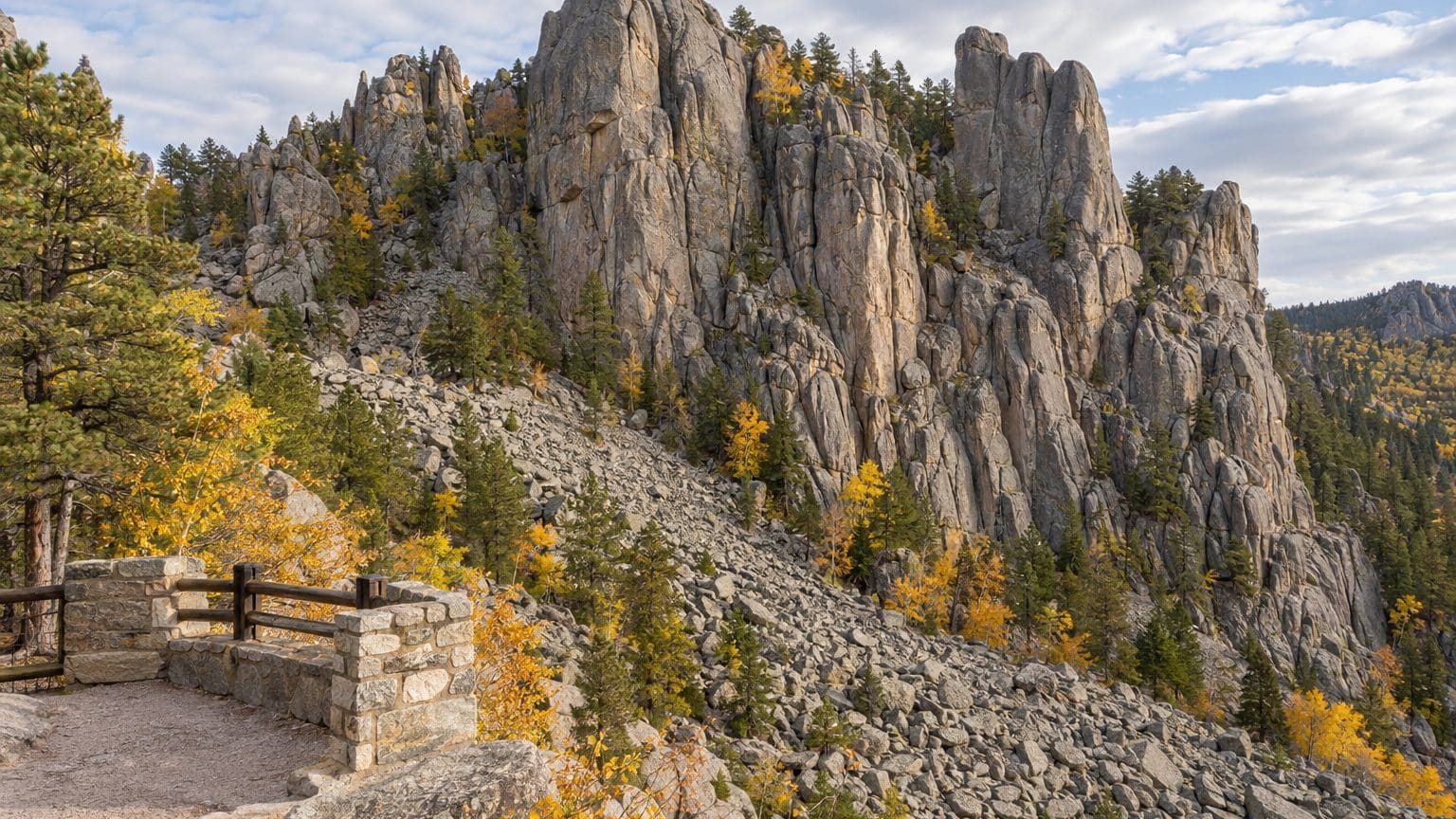
- A talus of about 410,000 metric tons remains protected at the base of the cliff.
A Sculpture Made with Dynamite
Everything begins with a tourism idea. In 1923, Doane Robinson, a historian from South Dakota, envisioned a monument capable of drawing visitors to the Black Hills. Congress gave its blessing in 1925, and it would take another two years before the project officially kicked off.
On October 4, 1927, the work officially commenced. It would endure for 14 years. Nearly 400 men and women passed through the site over time, but not all at once: that total counts the people who worked there over the years, not a single crew tied to the cliff face. Drillers, blacksmiths, messengers, and every trade had its place within the machine of the operation.
Conceptions of chisels and mallets come to mind, along with patience. In truth, 90% of the sculpture was carved with dynamite.
Charges were used to blow away rock until only about 3 to 6 inches remained above the final surface, roughly 8 to 15 centimeters, about the width of a hand. For the remainder, workers drilled very tight holes using the honeycomb technique to weaken the stone enough to detach it more easily. Finishing touches were then applied by hand.
The workers descended the cliff in swinging seats, a pneumatic drill in hand. Holes were bored into the rock, then charges were placed to remove the desired amount of granite. Washington’s face was the first to emerge from the wall. Weather, funding difficulties, and logistics slowed progress repeatedly, which explains why the project stretched across 14 years.
When scaled to the height of 18 meters—roughly the height of a six-story building—those few centimeters of margin seem tiny. Yet they represented the last layer to be removed before the nose or an eyelid could appear.
Everything that was blasted fell to the foot of the cliff.
A 410,000-Ton Talus, Protected Like the Sculpture
The talus is estimated at 450,000 US tons, or about 410,000 metric tons. This figure is an estimate, not the result of an exact weighing. Reading 450,000 without specifying the unit would overstate the mound by about 40,000 tons for someone accustomed to the metric system.
Gutzon Borglum, the project’s sculptor, recommended removing this pile. Yet it was left in place to illustrate the scale of the work accomplished. Over time, that choice acquired patrimonial value: the talus is now regarded as a cultural resource, to be preserved just as much as historic buildings, museum collections, and the sculpture itself. Extracting rock from this protected area is prohibited by law.
Looking closely at the slope, you can still see tool marks on the granite, honeycomb blocks, and shards of metal tools. They are remnants of the construction site, but they tell the method better than any diagram. The aligned holes show how the workers weakened the rock before detaching it.
A viewing terrace overlooks the slope strewn with debris. It is the closest point to the faces, and the only place from which one can see both the sculpture and what it cost in rock.
A Finish of the Project Without the Sculptor
Gutzon Borglum died in March 1941, just months before the work ended. His son, Lincoln Borglum, completed the task. October 31, 1941 marked the final day on the mountain, and the monument was declared finished. The original plan would have featured larger figures than the heads that were ultimately carved, which were never realized.
The total cost amounted to $989,992.32, just under a million dollars for 14 years of labor. During that period, nearly 400 people received salaries.
Not a single death occurred during those 14 years of work.
This record of human effort stemmed from highly controlled procedures, since the method relied on explosives handled on a cliff face. Visitors of the era were more intrigued by the honeycomb granite and often asked how to obtain a piece. The winch operator would pretend not to be able to part with any, until a visitor offered $6. Once buyers disappeared, he would call up the top of the mountain for another delivery.
👉 A small gesture for Space Group? Follow us on Google, add us to your favorites, and find us on Google News so you won’t miss any discovery.
