
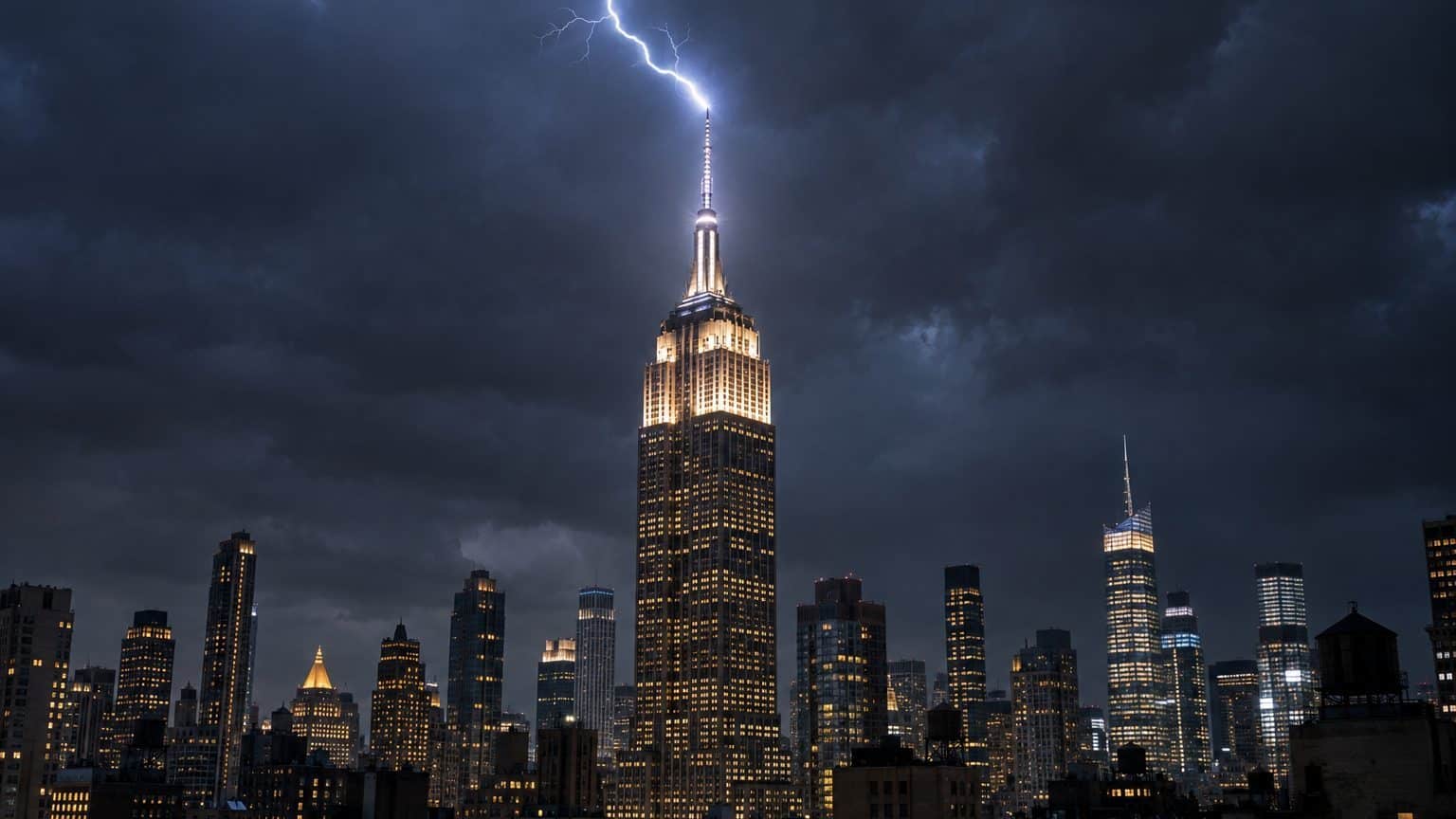
Yes, lightning can also originate from the ground. At the summit of the Empire State Building, engineers established in the 1930s that some lightning bolts begin at the tip of the tower and travel upward toward the cloud, in contrast to the usual image. They are called upward lightning.
This finding was published in February 1939.
- Some lightning bolts originate at the top of the tower and travel upward toward the cloud.
- The engineers photographed and measured them between 1935 and 1937.
- The results were published in February 1939 in a scientific journal.
- The tower experiences about 25 lightning strikes per year on average.
A 443-Meter Tower on the Path of Storms
The construction proceeded from March 1930 to May 1, 1931, totaling about 410 days of work, just over a year. The steel frame climbed roughly 4.5 floors per week, equating to about one floor every 37 hours. On May 1, 1931, a button pressed from Washington lit the tower’s lights for the first time.
The result comprises 102 floors. The roof peaks at 381 meters and the antenna brings the total to 443 meters, about a hundred meters taller than the Eiffel Tower. To reach the 102nd floor on foot, one would have to climb 1,860 stairs. The façade alone features 6,514 windows.
The weight of the structure is staggering: 365,000 tons in total and more than 7 million man-hours of labor, which would amount to nearly 800 years for a single worker who never stopped.
A structure of this size regularly attracts lightning. The tower’s owner and New York City’s emergency management services converge on the same figure: roughly 25 strikes per year on average. That corresponds to about one strike every two weeks, even though storms concentrate the hits into a few episodes only.
During a single storm, the tower absorbed 8 strikes in 24 minutes.
1935: A High-Speed Camera Trained on the Tip
As early as 1935, engineers from an American utility company decided to take advantage of this giant lightning rod to study lightning. They photographed the bolts striking the tower with a high-speed rolling-shutter camera, capable of breaking down a phenomenon that lasts only a fraction of a second. They simultaneously recorded the currents passing through the structure. By the end of 1937, they had gathered 62 photographed bolts and 99 current recordings.
Among these records, 20 were captured at the same moment as the lightning flash itself. The significance was considerable: one could link a luminous stroke to its electrical signature and connect what the eye sees with what the current is actually doing.
In this material, researchers identified an unexpected behavior. Some bolts do not descend from the cloud: they originate at the top of the tower and travel upward toward it, using upward tracers. The results appeared in February 1939 in a scientific journal, volume 227, from page 149 to page 217, spanning 69 pages of measurements and analyses.
Early data already traced back to 1935, four years earlier.
The same work also showed that currents that persist after the initial shock behave like a direct-current arc. It’s a technical detail, but it matters for those designing installations intended to withstand these discharges. The study was not merely a curiosity; it documented the physics of a lightning strike, observed up close and from the top of a building.
What the Metal Rod Actually Does
A persistent idea is that the metal tip of a building seeks out the lightning. The rod only conducts the current to the ground along a pre-planned path. The higher a structure rises above its surroundings, the more likely it is to be struck, which is why large buildings are equipped with a rod and grounding wiring.
The upward bolts from the Empire State Building show that a discharge can originate from the structure itself. It does not always come down from above onto a passive building. The tower, with its height and its antenna, participates in the phenomenon, and the 1935–1937 measurements established this with images and curves, not merely a hypothesis.
The figure of around 25 strikes per year remains an average. Depending on how one counts, estimates range from about 10 per year, when relying on detection networks, up to 100 per year.
👉 A small gesture for Space Group? Follow us on Google, add us to your favorites and find us on Google News so you don’t miss any discoveries.
Sources: scienceblog.com | ieeexplore.ieee.org
