
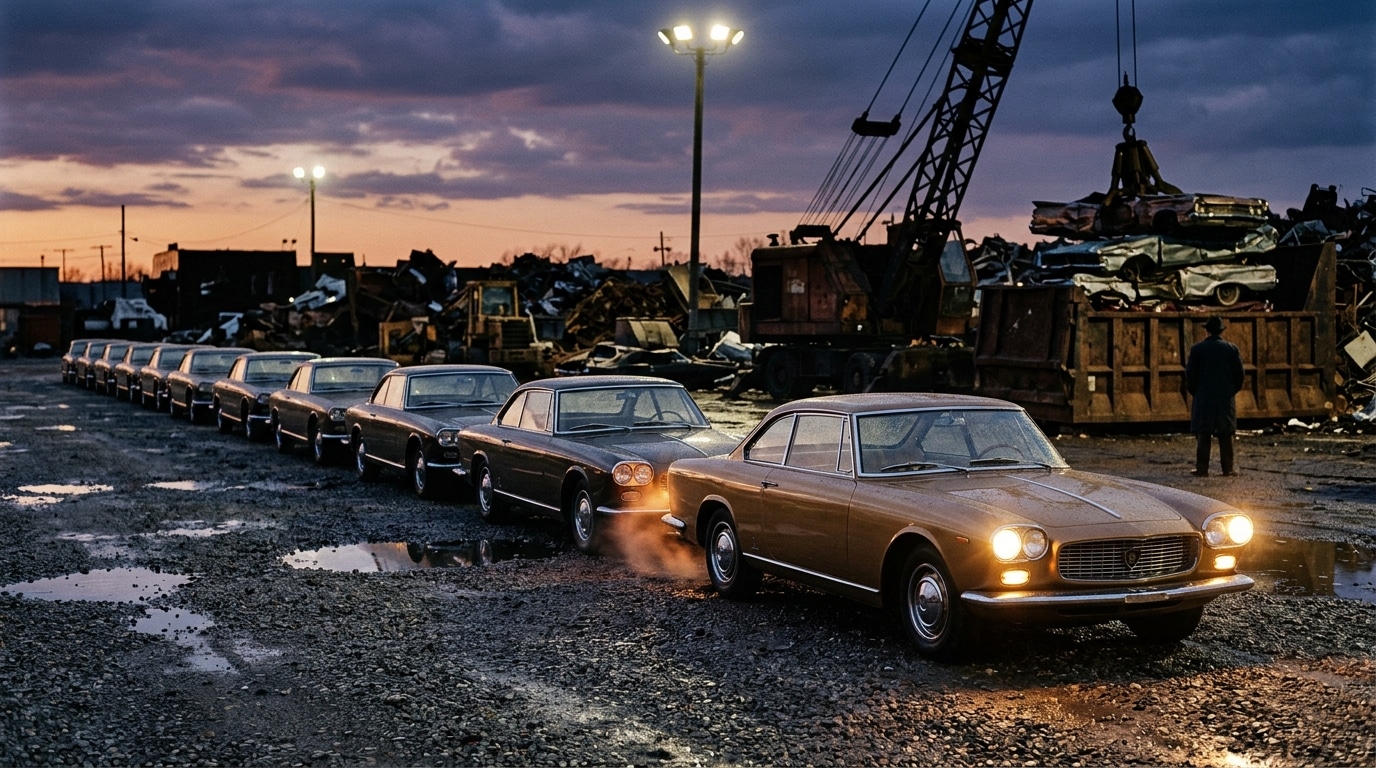
Imagine a car that starts up like a fighter jet and runs on nearly any liquid fuel, from gasoline to perfume to tequila. Chrysler built it, lent it to 203 American families, then destroyed most of the fleet with the shredder. An industrial story as fascinating as it is troubling.
- Between 1963 and 1966, 203 American families tested the Chrysler Turbine Car, equipped with a 130-horsepower turbine capable of running on a variety of liquid fuels
- After the trial program, Chrysler had 46 of the 55 cars destroyed, a decision reportedly motivated by tariff, legal, or strategic reasons
- Only nine cars survived, distributed among Chrysler archives, museums and Jay Leno’s collection, including the unit that was restored and presented in 2024
- An Aircraft Engine Under the Hood: Chrysler’s Audacious Bet to Win America
- Turin, Tariffs and Destruction: Why 46 Cars Were Shredded Instead of Taxed
- Nine Survivors Against All Odds: Jay Leno’s Hidden Treasure and Collectors
In the early 1960s, the American auto industry ran on technological optimism. People envisioned flying cars and smart homes, and Chrysler bet on a sci‑fi idea: replacing the piston engine with a gas turbine, a technology until then reserved for airplanes.
The result was the Chrysler Turbine Car. Between 1962 and 1964, the company oversaw the assembly of 55 units, including 5 prototypes and 50 cars designated for a truly unprecedented public test program. The bodies, crafted with elegance, were entrusted to Carrozzeria Ghia in Turin, before being shipped back to Detroit for final assembly.
What followed after this production was equally singular. Chrysler lent these cars to ordinary families for several months, creating a colossal real-world test. And the ending is far more brutal than one might imagine, with a shredder serving as the finale for most of the units.
An Aircraft Engine Under the Hood: Chrysler’s Audacious Bet to Win America
The heart of this one-of-a-kind automobile is the A-831 engine. A turbine that develops 130 horsepower and, most importantly, 425 pound-feet of torque available instantly, right at idle. No need to wind it up to feel the thrust, unlike a traditional gasoline engine.
The mechanical simplicity is astonishing. Where a conventional piston engine has nearly 300 moving parts, the Chrysler turbine manages with only about 60. Fewer parts mean less wear, less maintenance, and in theory, formidable long-term reliability.
Chrysler did not stop at building these cars for internal use. Between October 1963 and January 1966, the company launched an extraordinary user program: 203 drivers, spread across 133 American cities, took turns behind the wheel to log more than a million miles in total, roughly 1.6 million kilometers.
The goal was clear: gather as much real-world feedback as possible before considering, or not, a large-scale commercial deployment. The families who were lucky enough to drive these cars frequently recalled the distinctive sound, reminiscent of a jet’s hiss, and the ability to run on fuels as varied as diesel, kerosene, or even vegetable oils.
Turin, Tariffs and Destruction: Why 46 Cars Were Shredded Instead of Taxed
Here the story shifts from technological dream to industrial anecdote. Once the test program ended in 1966, Chrysler recovered all the loaned cars. And rather than keeping, selling, or displaying them, the manufacturer chose to destroy them—almost all of them.
Of the 55 units built, 46 ended up annihilated. The destruction occurred on two sites: 45 cars were shredded at a Detroit-area junkyard, while a final car was wrecked directly at the Chelsea Proving Grounds test center. Notably, this destruction is not urban legend: it was filmed by Chrysler staff themselves, leaving an indisputable visual record of this mechanical purge.
So why such waste? The most commonly cited explanation points to the bodies from Ghia in Turin. Imported to the United States under a temporary tariff exemption, they did not force Chrysler into a true dilemma once the program ended: pay retroactive customs duties or dispose of the cars. The manufacturer chose the latter, sending them to the shredder.
That tariff-related explanation is, however, contested by some sources who deem it incorrect. They instead point to a desire by Chrysler to remove any legal liability around these prototypes never certified for production, as well as to protect industrial secrets. A company executive even reportedly told Look magazine that they did not want “to see turbines reappear at used-car lots.” In April 1966, Harry E. Chesebrough, vice president of Product Planning and Development at Chrysler, had announced that the test cars would be taken out of circulation, production or not. A warning that proved prescient.
Nine Survivors Against All Odds: Jay Leno’s Hidden Treasure and Collectors
Of the 55 cars produced, only nine escaped the shredder. Chrysler kept two for its archives, six are today housed in American museums, giving enthusiasts the rare chance to admire this machinery from another era. The ninth belongs to a figure well known to classic-car fans: American host Jay Leno.
The manufacturing cost of these vehicles partly explains why preserving them bordered on miraculous. Each unit cost about $55,000 to produce, with nearly $20,000 of that going toward the Ghia body, entirely handcrafted. These sums were substantial for the era, making each destroyed car all the more costly from a purely accounting perspective.
Jay Leno’s exemplar has enjoyed a particularly meticulous second life. Its engine was completely rebuilt by Williams International, a company founded by Sam Williams — the engineer who had worked on Chrysler’s turbine development back in the day. For this restoration, the firm mobilized roughly sixty former members of the original team, all over 80 years old, using modern technologies such as 3D printing to recreate parts that had become unavailable.
The culmination of this work was publicly unveiled at the Woodward Dream Cruise in Pontiac, Michigan, on August 17, 2024. Hearing this turbine roar again, more than six decades after its conception, is something especially moving for anyone interested in automotive history and the winding paths that technological innovations sometimes take.
This story perfectly captures the paradoxes of industrial innovation. A promising technology, tested in real-world conditions by hundreds of families, then sacrificed for tax, legal, or strategic reasons, depending on the account. Today only nine physical witnesses remain of this venture, scattered among museums, private collectors, and Chrysler’s own archives. A reminder that technical progress never travels on a straight line, and that some brilliant ideas end up, literally, in pieces.
👉 A small gesture for Space Group? Follow us on Google, add us to your favorites, and find us on Google News so you don’t miss any discoveries.
