
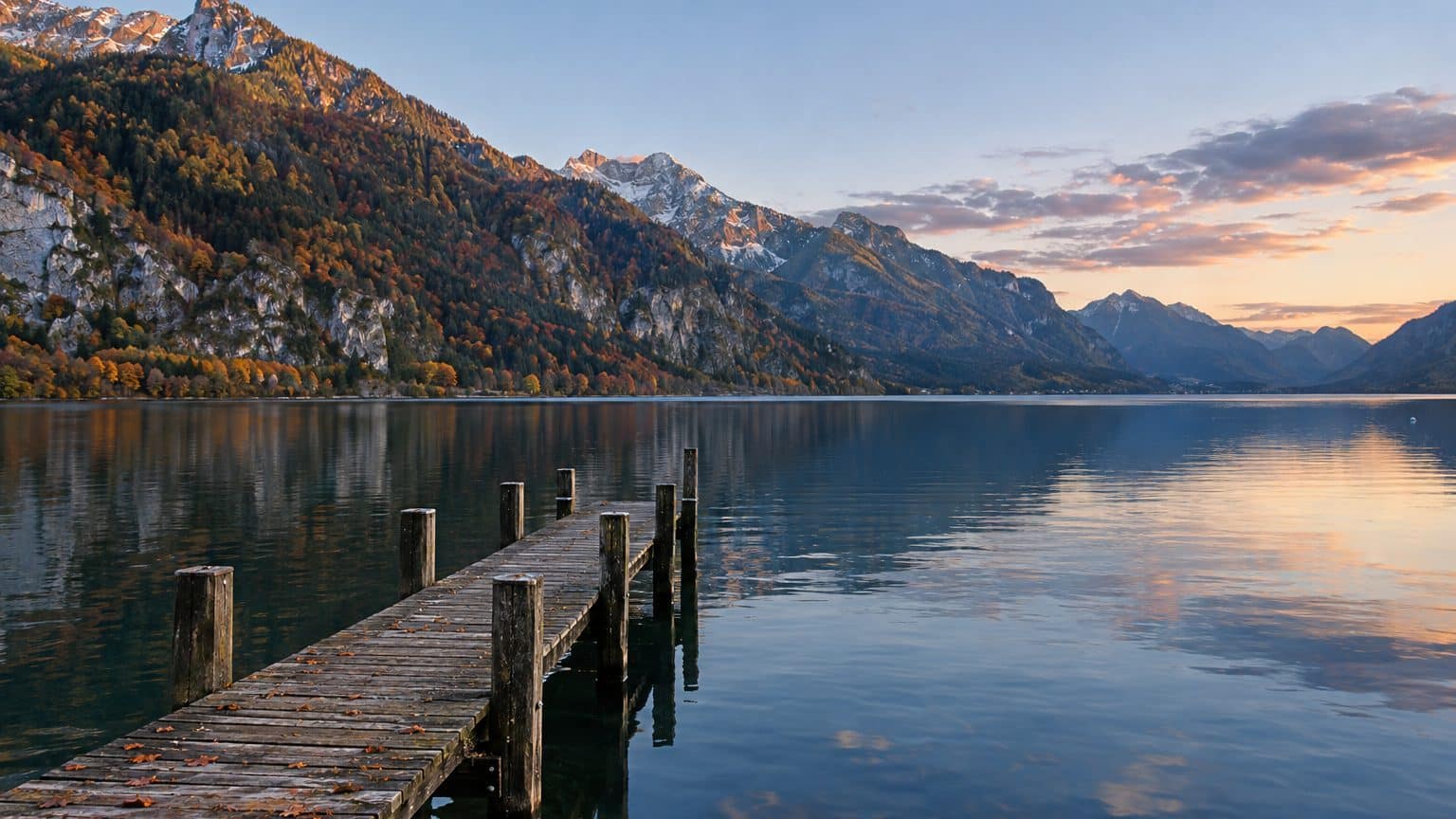
Geneva, 8 m of water, 70 minutes. These figures come from a simulation, the one simulating an event that occurred in 563 on Lake Geneva. According to this calculation, the wave reached the lake’s shore 70 minutes after the start of a landslide, which the collapse of a mountain section near the Rhône inlet would have triggered.
A freshwater tsunami, at the foot of the Alps.
The term is surprising for a lake. A tsunami denotes a wave born from the abrupt movement of a large mass, here sediments rushing underwater, and not necessarily from an undersea earthquake. Lake Geneva, the largest lake in Western Europe, is more than capable of hosting one.
- A landslide in 563 triggered an 8-meter wave at Geneva.
- A 250-million-cubic-meter mud layer at the bottom of Lake Léman preserves the record.
- Radiocarbon dating places the event between 381 and 612 CE, in line with chronicles.
Two bishops, a mountain, and a destroyed bridge
In 563, a portion of a mountain collapsed near the Rhône’s entrance into Lake Geneva, at a site known as Tauredunum. Two bishops of the time, Marius of Aventicum and Gregory of Tours, left accounts from their respective cities. According to them, a wave rose up the lake and destroyed villages, mills, and the Geneva bridge, killing men and livestock. It then passed over the city walls.
For a long time, this text hovered between chronicle and legend. Marius of Aventicum identifies Tauredunum as the name of the collapsed mountain, but the exact location of the site remains debated. Several hypotheses still clash about its location.
Three geologists from the University of Geneva, Katrina Kremer, Guy Simpson, and Stéphanie Girardclos, drilled into the deep bottom of Lake Geneva, between Lausanne and Évian, to see if the lake bore a tangible trace of the catastrophe. Their study, published in 2012 in a scientific journal, provided a physical foundation for the bishops’ account.
A mud layer of 250 million cubic meters
At the bottom, they found a giant mud layer of 0.25 cubic kilometers, i.e., 250 million cubic meters. Its thickness ranges from 1 to 7 meters, with about 5 meters on average. It forms an oval more than 10 km long and 5 km wide, a volume that would fill roughly 100,000 Olympic swimming pools. A deposit of this magnitude does not result from ordinary lake sedimentation: only an extraordinary event could have produced it.
At the bottom of a deep lake, sediments accumulate in fine layers year after year. An underwater landslide leaves suddenly a thick sheet, like a pile of rubble on a polished floor. The anomaly, spotted as early as 2010 during a lake survey, stood out from the rest of the sequence.
Radiocarbon dating provides a window: between 381 and 612 CE.
Broad, certainly, but 563 is the only major event known in this period. Biological matter taken from the layer was used for dating. The method measures the time elapsed since the death of an organism, which explains why the dating is expressed in centuries rather than years. The bishops’ narrative thus falls within the window offered by the mud.
A sliding delta, a wave that rises again
According to the authors’ explanation, the rocks would have fallen onto the Rhône delta (the pile of sediments at the river’s mouth), destabilizing it and causing it to slide into the lake. It is this sliding, not the fall of the blocks, that would have displaced the water, but the sequence remains a hypothesis. The wave would therefore have originated beneath the surface, at the delta’s mouth, and not at the foot of the mountain.
The digital model then calculates the wave’s propagation. In the simulation, a 13-meter wave hits the Lausanne shore after 15 minutes. It travels at about 70 km/h, weakens toward Thonon and Nyon, then climbs up into the lake’s narrow tip toward Geneva. There, it reaches 8 meters, 70 minutes after the start of the landslide.
These heights and times are computed results, not measurements. With only 15 minutes before reaching Lausanne, residents would have had little time to flee if the model is correct. An 8-meter wave is equivalent to the height of a three-story building. This figure for Geneva aligns with the bishops’ account, where the water breaches the city walls.
1 million residents, shores very different
Today, at least 1 million people live along the lake, enough to fill the Stade de France more than twelve times. In the 6th century, they may have been ten times fewer.
At the time, the region belonged to the Frankish kingdom. The shores housed villages, mills, and, in Geneva, a bridge, according to chronicles. The same banks now host entire urban areas.
A 2015 study counted six major landslides between 4000 years before present and 563. The lake had therefore experienced several episodes of this kind before the one described in the chronicles. These landslides have left their mark in the sediments, as in the 563 event. By contrast, the risk of a new episode has not been quantified by the authors of the 2012 study.
A sixth-century account and 250 million cubic meters of mud point to the same era.
👉 A small gesture for Space Group? Follow us on Google, add us to your favorites and find us on Google News so you don’t miss any discoveries.
Sources: laprocure.com | epflpress.org
