
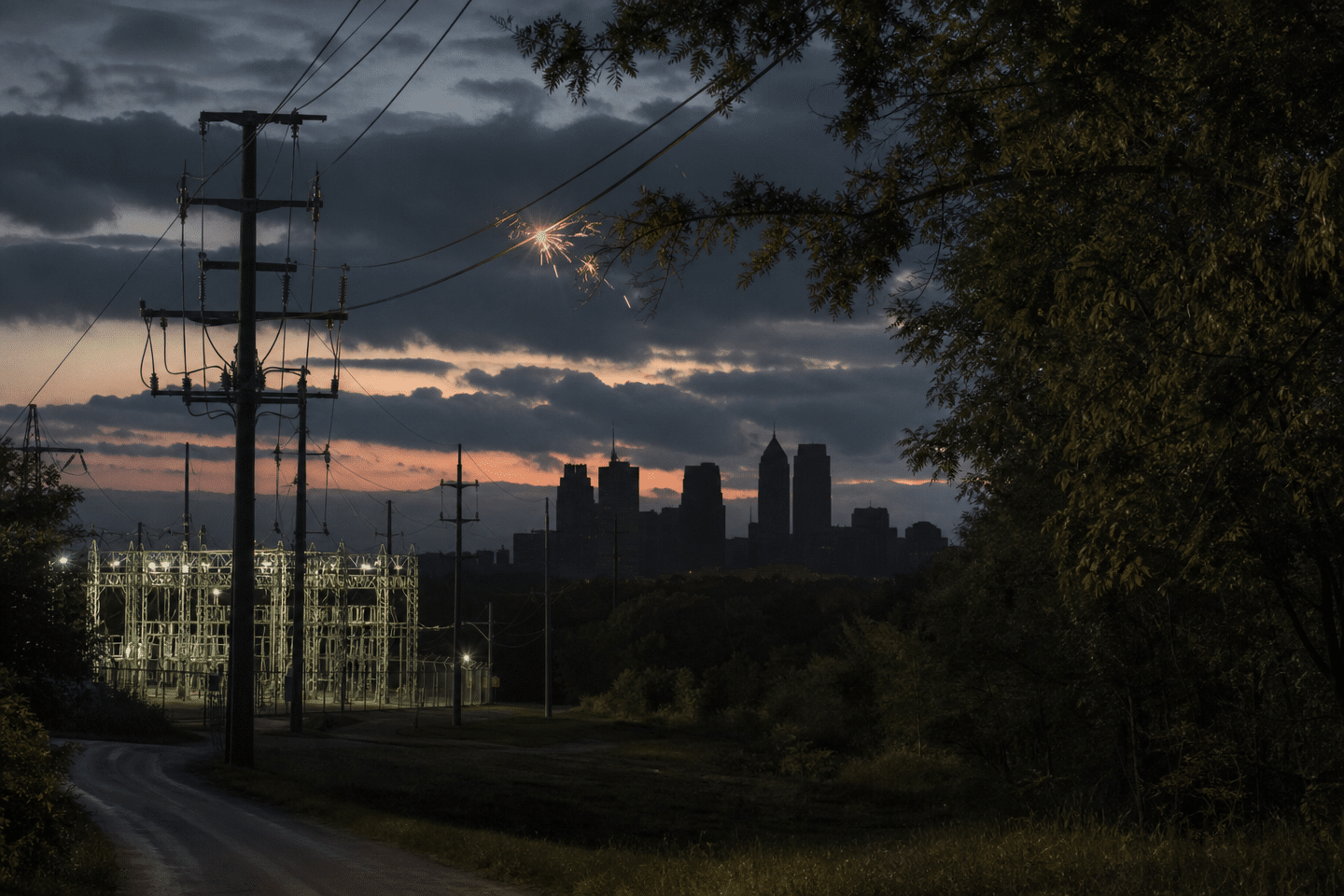
A tree branch brushes against an electrical cable in Ohio. At first glance, nothing extraordinary. Yet this seemingly trivial incident sparked the largest blackout in North American history. Within hours, about 50 million people found themselves in the dark, from the streets of New York to the shores near Lake Ontario.
- On August 14, 2003, an Ohio electric line skirting poorly pruned trees triggered the largest blackout in North American history.
- A software bug (race condition) in FirstEnergy’s XA/21 system disabled alarms for over an hour, preventing operators from understanding the scale of the crisis.
- The outage cut 61,800 megawatts and left up to 50 million people without power, with some areas staying off for up to four days.
- A tree branch and 50 million people in the dark
- The invisible bug that paralyzed operators for an hour
- 61,800 MW vanished: the domino effect that plunged a continent into chaos
A Tree Branch and 50 Million People in the Dark
It all began on August 14, 2003, in the early afternoon. At 3:05:41 p.m. Eastern Time, the Harding-Chamberlin line, a 345,000-volt transmission artery, came into contact with poorly pruned trees. Yet it was carrying only about 44% of its maximum capacity, a typical loading for a summer day.
This initial incident should have remained isolated. Power grids are designed to absorb such contingencies without faltering. But a few minutes after 4:00 p.m., the entire Northeastern United States, along with parts of the Ontario network, began to wobble and then collapse like a domino effect.
The shockwave swept through Ohio, Michigan, Pennsylvania, New York, Vermont, Massachusetts, Connecticut, New Jersey, and Ontario. In some American regions, electricity would not be restored for four full days. A delay that seems almost unreal for a highly industrialized country.
The Invisible Bug that Paralyzed Operators for an Hour
If the tree branch played the match, it was a software fault that turned the spark into a widespread blaze. FirstEnergy, the company responsible for the Ohio grid, used an energy-management system called XA/21, developed by General Electric. A redundant program, running on Unix, written in C and C++, designed to monitor the grid’s real-time state.
But a tiny defect slipped into this critical system: a race condition, meaning a situation in which two programs attempt to write to the same memory location simultaneously. Imagine two people scribbling on the same Post-it at the same time. One piece of information ends up disappearing, without anyone noticing.
The bug’s window spanned milliseconds, such a brief interval that it required half a dozen experts and eight weeks of hard work to reproduce it by artificially slowing the system to the extreme. The concrete consequence that day: FirstEnergy’s alarm system froze, leaving operators without any visual or audible alerts for more than an hour, even as their network collapsed before their eyes, literally blind to the unfolding catastrophe.
Meanwhile, calls poured in from everywhere, reporting lines in fault. But with alarms inactive, operators could not grasp the scale of what was really happening on their territory. This complete lack of situational awareness would cost the continent dearly.
61,800 MW Vanished: The Domino Effect That Plunged a Continent into Chaos
The Ontario grid operator, IESO, quantified the damage precisely: 61,800 megawatts of electrical load interrupted within minutes, starting at 4:11 p.m. To put that power into perspective, it equals the simultaneous output of several dozen standard-sized nuclear reactors.
The final joint report from the United States and Canada identified four root causes of the cascade. FirstEnergy did not understand the true weaknesses of its own system, its situational awareness was flawed, vegetation management around the lines was insufficient, and the regional reliability organization, MISO, failed to provide effective diagnostic support at the critical moment.
The following day, August 15, President George W. Bush and Prime Minister Jean Chrétien ordered the formation of a joint task force to investigate the exact causes of the chaos. The final document would yield forty-six concrete recommendations designed to prevent a scenario as improbable as it was devastating from repeating itself.
What stands out in retrospect is the disproportion between cause and consequence. A tree branch and a few faulty lines of code were enough to deprive electricity from an area as large as several European countries combined, reminding us of how much our energy networks rest on a fragile balance.
More than twenty years later, FirstEnergy, still based in Akron, Ohio, has learned from the episode. The company recently unveiled Energize365, a five-year, $36 billion investment plan aimed at modernizing its grid and strengthening the reliability of its transmission system in a lasting way. About $4.9 billion had already been deployed in the first nine months of 2026, evidence that a tree branch and a software bug have ultimately changed forever how we think about the resilience of electrical infrastructure.
👉 A small gesture for Space Group? Follow us on Google, add us to your favorites, and find us on Google News so you don’t miss any discoveries.
