
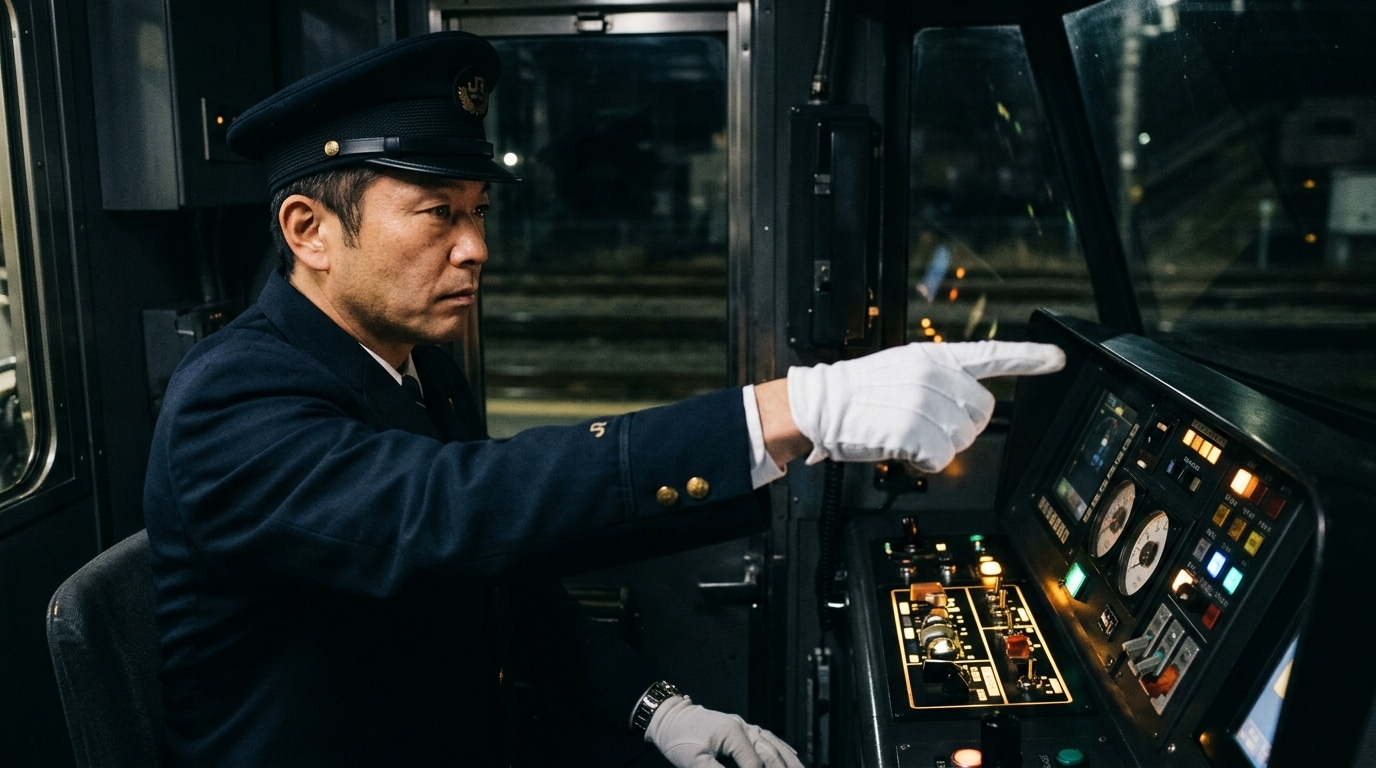
A Japanese driver never settles for a mere glance. Where a Western operator would discreetly check a gauge, he points with a finger, speaks aloud, almost alone in his cabin. This ritual, far from a cultural oddity, rests on an inexorable logic: it reduces human errors in a measurable way. Explanations.
- The shisa kanko consists of pointing to an element and verbally naming what is being checked, combining sight and hearing.
- According to the Railway Technical Research Institute, this method reduces the error rate from 2.38 to 0.38 per 100 checks, a drop of about 85%.
- Born in the 1910s at the Kobe Railway Administration Bureau, the practice inspired gestural adaptations in New York and Toronto subways.
- Speaking to oneself, pointing with a finger: the scene that intrigues all travelers
- Less than 85% of errors: the figure that convinced Japan’s JR
- A gesture born in factories, now a vital reflex on the rails
Speaking to oneself, pointing with a finger: the scene that intrigues all travelers
The scene consistently astonishes foreign travelers who ride trains or subways in Japan. The conductor, alone in his cabin, extends his arm toward a dial, a signal, or a door. He then aloud states what he has just indicated, as if conversing with himself.
This practice has a precise name: shisa kanko, which could be literally translated as “point and name.” The principle is simple on the surface. The agent points to the element he must attend to, pronounces its name or state aloud, then confirms once more by sight and hearing.
Nothing is left to chance in this choreography. For a speed check, for example, the conductor does not rely on a simple glance at the display. He physically points to the tachometer with his finger and announces: speed check, 80. The gesture and the spoken word respond to each other, like a built-in double-check within the conductor’s very body.
This silent ballet, repeated dozens of times per journey, is nothing like gratuitous folklore. It is a codified method, taught, and above all scientifically measured.
Less than 85% of errors: the figure that convinced Japan’s JR
If this practice has become so enduring in the Japanese railway sector, it is not solely a matter of tradition. Experiments conducted by the Railway Technical Research Institute, Japan’s railway technical research institute, sought to quantify its real effectiveness.
The results are clear. Without the pointing-and-naming method, researchers recorded 2.38 errors per 100 verification actions. With the method, this rate drops to 0.38 errors per 100 actions. This method, called shisa kanko, thus reduces human driving errors by nearly 85%, according to a study conducted by Japan’s railways.
Caution remains regarding the dating of this study. Some sources place these works in 1994, others in 1996, all from the same research institute. The figure, however, remains consistently reported: an error rate reduced by about a factor of six thanks to the combined gesture and vocalization.
The scientific explanation for this mechanism is documented by the Japan Industrial Safety and Health Association. Linking a task to a physical movement and to vocalization would raise what the institute calls the workers’ “level of awareness.” In other words, the human brain processes information more seriously when it engages multiple senses at once, rather than a mere furtive and automatic glance.
A gesture born in factories, now a vital reflex on the rails
The history of this method goes back further than many suppose. Its documented origin lies at the Kobe Railway Administration Bureau, a structure now gone, in the 1910s. As early as those years, the practice was recorded in the manuals for Japanese rolling stock staff under the name kanko otto, which can be translated as “verbal announcements and responses.”
More than a century later, the gesture has become widespread and codified across the entire Japanese railway network. It now appears in platform checks, signal confirmations, and door operations—critical moments where a lapse in attention can have heavy consequences.
What is striking is that the method has widely crossed Japanese borders. New York City’s subway has for decades required its drivers to point to a striped panel, known as the “zebra board,” before opening doors. According to the MTA, the agency that runs the network, this black-and-white panel installed in the middle of the platform helps verify that the entire train is properly aligned before any doors are opened.
This New York adaptation, purely gestural, was introduced after a series of incidents of doors opening off the platform or on the wrong side of the train. Toronto’s subway followed a similar approach, requiring its staff to point at a green triangle fixed on the platform wall, again after comparable incidents.
What may seem, at first glance, to be a cultural curiosity of Japan, is in fact a rational response to a universal problem: human vigilance wanes when tasks become repetitive. By forcing the body and voice to participate in the verification, shisa kanko turns a simple distracted glance into a conscious act of control. And the numbers speak clearly in its favor.
👉 A small gesture for Space Group? Follow us on Google, add us to your favorites, and find us on Google News so you don’t miss any discovery.
