
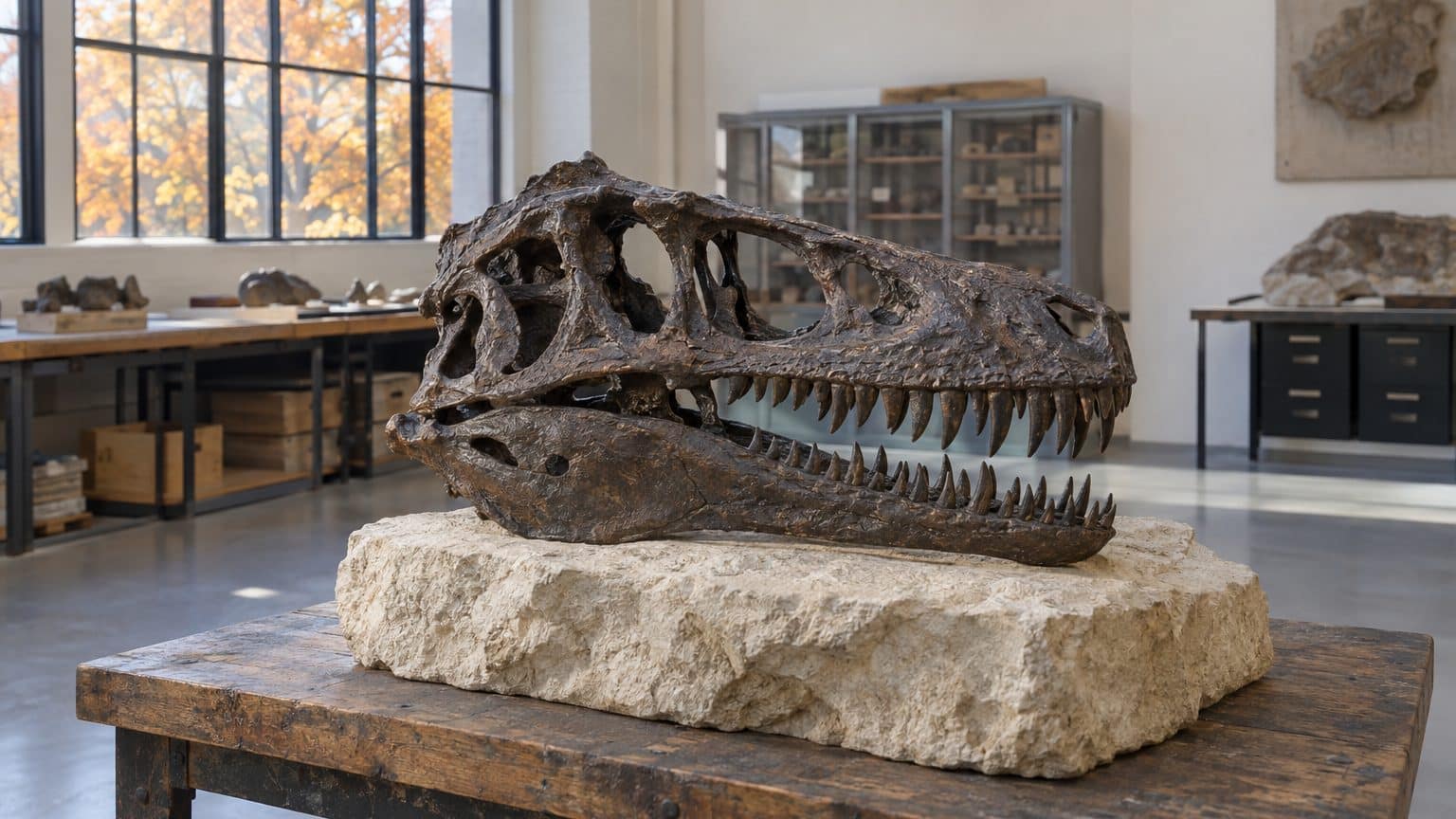
On Wednesday, November 18, 2026, at 2:00 PM, in Room 10 of the Drouot Hotel in Paris, the Millon house will auction Lot 203: the skeleton of Dubreuillosaurus valesdunensis, a carnivorous dinosaur found in Calvados. The estimate is €250,000 to €350,000 excluding fees. It is the holotype of the species, the reference specimen, and the only known one to date.
A few minutes of hammer blows for 167 million years of history.
- Lot 203 will be adjudicated at Drouot on November 18, 2026, with an estimate of €250,000 to €350,000.
- This skeleton is the holotype of Dubreuillosaurus valesdunensis, the only known specimen of its species.
- The State can pre-empt the fossil, but no museum has yet filed a request.
A Mayor, Excavations, and More than Thirty Years of Research
Everything began in 1994. André Dubreuil, then the mayor of Conteville (the sale catalog lists “Conteville, Val-ès-Dunes”), discovered the fossil in Calvados. The National Museum of Natural History (MNHN) and the CNRS led the excavations. The Centre for Paleontology Research – Paris (CR2P) subsequently prepared the skeleton over hundreds of hours, in a workshop where the skull was reconstructed in 2005.
The paleontologist Ronan Allain, from the MNHN, described the species in 2002. Three years later, he created its own genus, Dubreuillosaurus, in homage to the discoverer. His study of the skeleton’s anatomy presents the animal as a megalosaurid theropod—the carnivorous dinosaur of the Middle Jurassic.
An holotype is the specimen on which the official description of a species rests, the one researchers return to whenever a doubt arises. This one is the only known specimen of its species.
The Millon firm calls it one of the most important paleontological discoveries made in France in the last thirty years, with a continuous and well-documented provenance from discovery to museum display. Some paleontologists estimate that its skull is among the best-preserved theropod skulls in France. If the skeleton were to enter a private collection, its study would depend on the owner’s goodwill.
The Caen Stone, the Skeleton’s Setting
The fossil rested in the Caen limestone, a Middle Jurassic formation dating to the Bathonian. This rock stretches across Normandy, in the Paris Basin, to a thickness of about 22 meters. It was long quarried for construction, which gave it its name—the Caen stone.
The same limestone thus served to build walls and to house a carnivore.
Exhibited for Years, Never Donated
The skeleton was displayed for several years at the Paléospace in Villers-sur-Mer, open to the public. But since no donation had been formalized, the heirs of André Dubreuil retrieved it after his death at the end of 2024 and placed it on the market.
The museum paleontologists, gathered around the CR2P, denounce the lack of fossil-specific protection: in their view, no law protects such pieces, and France risks losing a dinosaur. The laboratory launched a crowdfunding campaign, the amount not disclosed, and a petition circulates calling for the suspension of the sale. Yet the law is somewhat more nuanced than this plea. If there is no dedicated fossil status, export is controlled and pre-emption remains possible.
In an op-ed, researchers acknowledge that the sale is legal, while deeming the potential loss potentially irreversible. Their phrasing: “dinosaurs are not works of art.”
What the State Can Still Do
The sales catalog classifies the fossil as a “cultural asset.” A buyer wishing to take it out of France would therefore first need to obtain the approval of the Ministry of Culture. The €250,000 to €350,000 estimate does not include the sale fees, which are added to the hammer price.
The State can also pre-empt, under Article L123-1 of the Heritage Code: it takes the buyer’s place, at the adjudicated price. For this, a French museum must send its file to the Service of Museums of France no later than eight days before the sale, i.e., by November 10, with the planned budget. The pre-emption is announced in the room immediately after the adjudication. It must then be confirmed within 15 days, i.e., by December 3 if the sale takes place on November 18.
To date, no museum has announced a pre-emption request.
One remaining scientific nuance. An article published in 2024 questions whether the fossil might be a juvenile Poekilopleuron, the genus in which Ronan Allain had initially placed it in 2002. The debate is open, and it argues for researchers to maintain durable access to the skeleton, regardless of the buyer.
👉 A small gesture for Space Group? Follow us on Google, add us to your bookmarks, and find us on Google News so you don’t miss any discoveries.
Sources: futura-sciences.com | laclepublique.fr
