
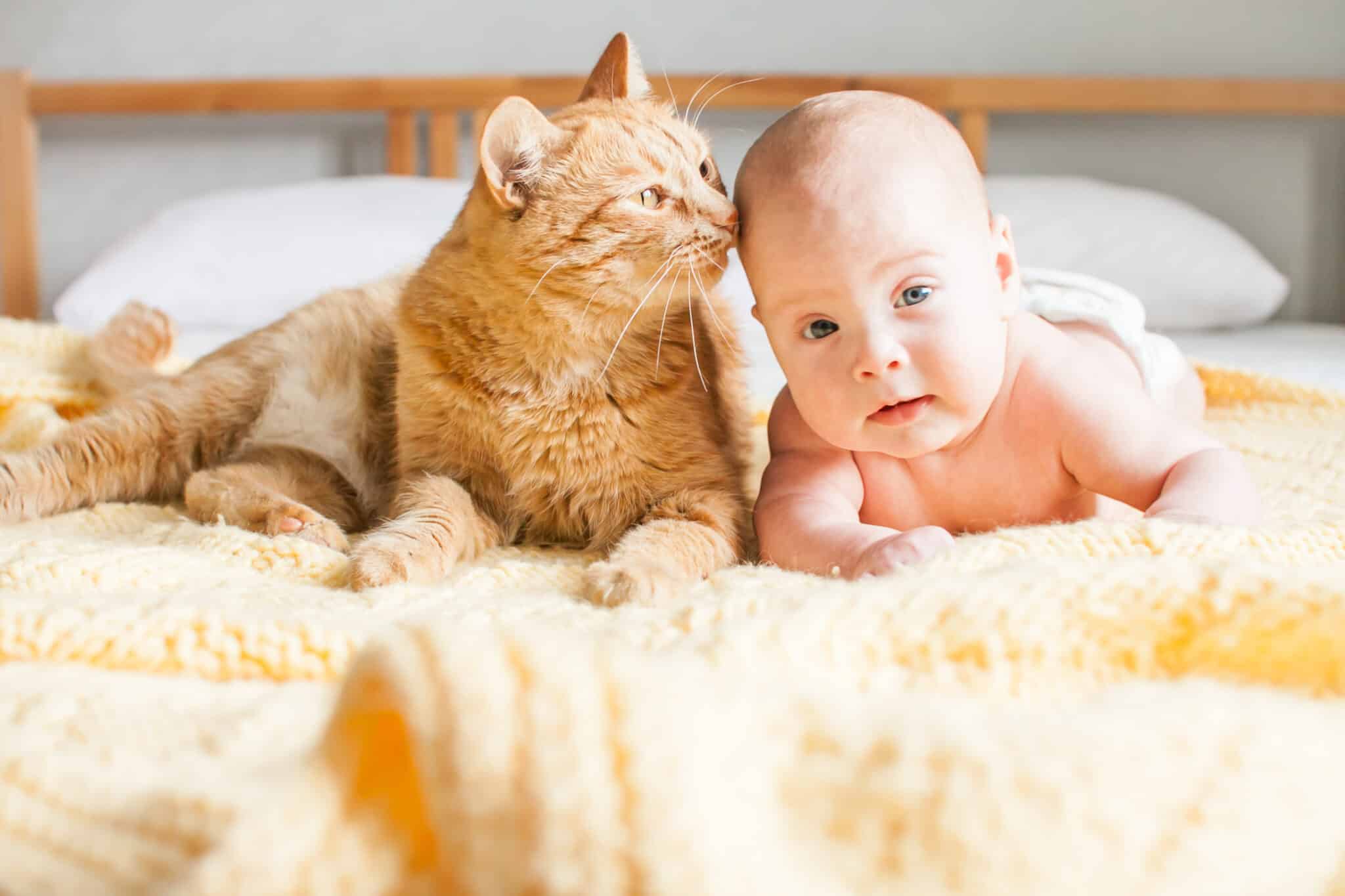
Can cats really understand certain words as well as, or even better than, young toddlers? A recent Japanese study found that our feline companions are capable of forming associations between images and words about four times faster than human babies. This surprising observation raises fascinating questions about how animals understand the world around them and, in particular, about the latent linguistic potential of cats.
When Animals Decode Language
Humans are not the only species capable of grasping language. Some animals have already demonstrated remarkable abilities in this field. For instance, monkeys can pair words with symbols or images, while African grey parrots can comprehend and respond to spoken instructions. Dogs, too, have been trained to recognize and react to a basic vocabulary, including their own name or simple commands.
But what about cats? Studies on language comprehension in felines are limited, and researchers have only recently begun to explore this area more thoroughly. It is established that cats are sensitive to the sound of words, such as their name or that of their human companions, and that they can recognize human intonations. However, the notion that they might link words to images in a way comparable to young children had not been tested until now.
A Playful Experiment with Surprising Outcomes
To probe the cats’ associative abilities, researcher Saho Takagi and her team at Azabu University in Japan devised an experiment inspired by studies used to examine baby-language comprehension. They showed thirty-one adult cats two short animated sequences lasting nine seconds each, with every image paired to an invented word. For example, a red sun was paired with the word “paramo,” while a blue unicorn was linked to the word “keraru.”
The sequences were repeated until the cats appeared to lose interest, signaling that they had memorized the pairings. Then the researchers swapped the words associated with the images: this time “paramo” referred to the unicorn, and “keraru” referred to the sun. The alteration clearly unsettled the cats, who paid more attention to the screen, indicating that they had noticed the inconsistency. Some felines even dilated their pupils, a sign of concentration and curiosity.
This reaction provides evidence that the cats formed a link between the initial words and images, and that they were
However, the researchers caution that comparing adult cats to young children is not straightforward: a toddler’s cognitive abilities are still developing, and interpreting the responses of another species is a delicate undertaking. “Humans are wired to understand the behaviors of their own species, but interpreting those of a domestic animal requires nuance,” notes Dr. Carlo Siracusa, a veterinary behaviorist.
What This Means for Us and Our Cats
These discoveries open up intriguing avenues for thinking about how we interact with our companion animals and how they perceive our attempts at communication. The study demonstrates that cats are not merely receptive to auditory and visual cues; they can associate them and detect inconsistencies. Yet many questions remain to be explored.
For instance, the research raises the question of whether this ability is innate in cats or the result of domestication and their ongoing interactions with humans. Moreover, although cats can form associations, this does not necessarily mean they understand words in the same way we do. Researchers still need to determine how closely this capacity approaches human language comprehension.
Thus, while it is unlikely that cats will ever “talk” or obey commands like dogs, this line of inquiry reveals that they are far more attentive to human interactions than we might have assumed.
👉 A small gesture for Space Group? Follow us on Google, add us to your favorites, and find us on Google News so you won’t miss any discoveries.
