
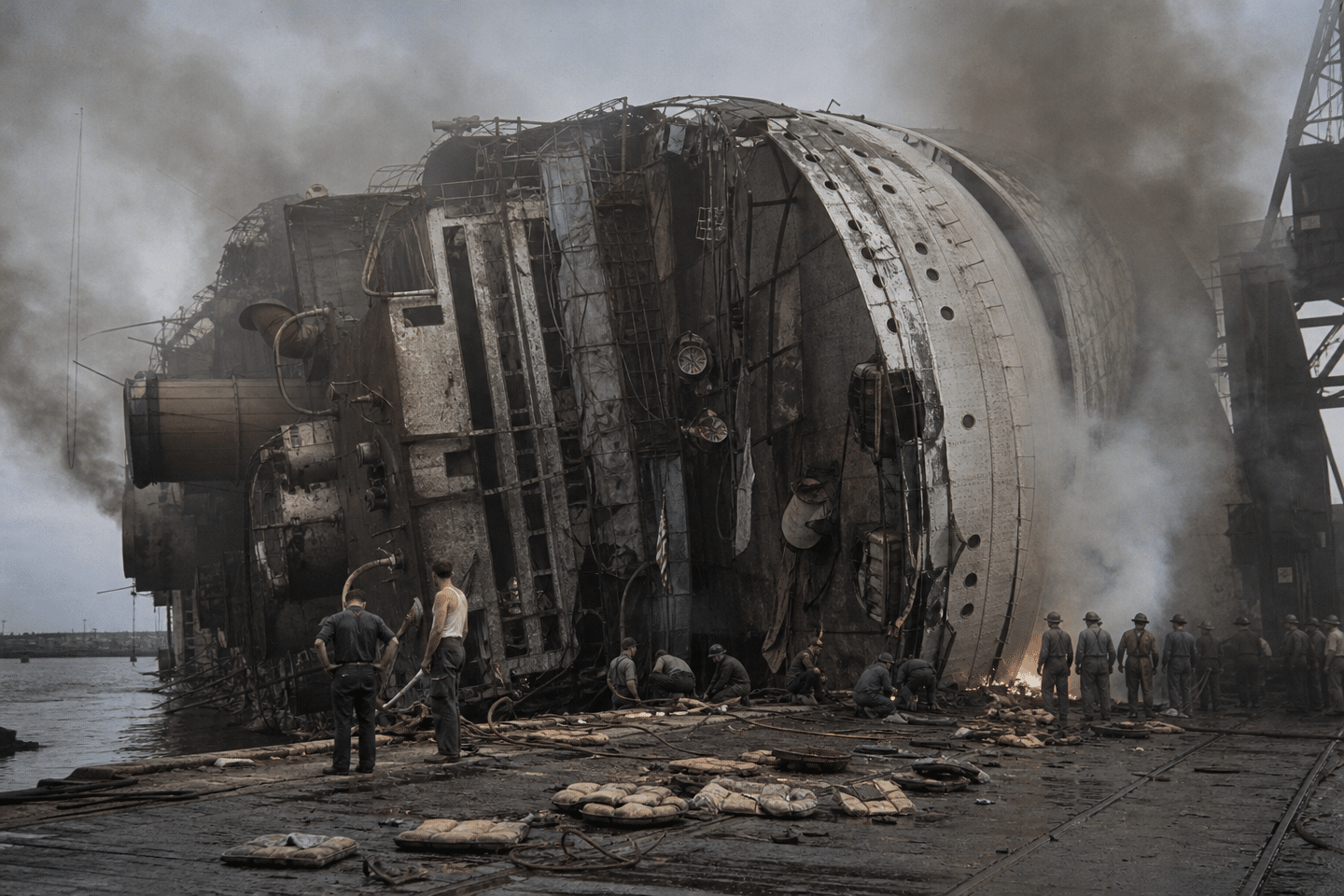
People often imagine a Nazi attack or a New York mob’s strike behind the loss of the Normandie, the jewel of French shipyards sunk in the midst of war in New York Harbor. The truth is far more prosaic: a blowtorch, kapok life jackets, and tons of firefighting water were enough to topple this sea giant.
- On February 9, 1942, a blowtorch ignited kapok life jackets stored in the Normandie’s grand salon during its military conversion.
- Firefighters, acting without coordination with the engineer Vladimir Yourkevitch, dumped about 6,000 tons of water that toppled the liner at Pier 88 in New York.
- Too damaged to be restored despite an expensive salvage, the Normandie was eventually dismantled and sold for scrap between 1946 and 1947.
- An innocuous blowtorch that triggers the loss of a giant of the seas
- Too much water sinks the ship: how the firefighters capsized the Normandie
- From national flagship to scrap heap: the interminable agony of the liner at Pier 88
An innocuous blowtorch that triggers the loss of a giant of the seas
In February 1942, the Normandie was no longer the luxury liner that had crossed the Atlantic in record time. Seized by American authorities after the United States entered the war, it was to become a giant troop transport capable of carrying thousands of soldiers to Europe. The conversion contract was awarded on December 27, 1941 to Robins Dry Dock and Repair Co, a subsidiary of Todd Shipyards, and the work proceeded at a brisk pace.
That day, the crew tackled four large steel columns installed in the ship’s grand salon. A routine cutting job, requiring the use of a blowtorch. Nothing unusual at first glance, except that the room bore none of the Art Deco décor that had given the Normandie its fame: emptied of its furnishings, it was now being used as a temporary storage area.
1,140 bundles of kapok life jackets were piled there, continually moved by a crew tasked with laying linoleum on the floor. Kapok, that lightweight vegetal fiber used before synthetic foam, has the peculiarity of catching fire very easily. The blowtorch flame ignited the life jackets stored there in the early afternoon, and the blaze spread immediately throughout the grand salon.
Too much water sinks the ship: how the firefighters capsized the Normandie
Faced with the blaze, New York firefighters and port tugs mobilized in large numbers. Their instinct was logical: drown the flames with copious amounts of water poured directly onto the ship’s superstructures. The problem was that the shipboard fire suppression systems were partly out of service and ill-suited, forcing the rescue teams to intervene mainly from the outside.
The engineer Vladimir Yourkevitch, designer of the Normandie’s hull, happened to be in New York that day. He knew the ship’s ballast circuits inside out and could have advised a more controlled water discharge. But the firefighters never called on him, and thousands of tons of water continued to accumulate on the upper decks.
Vice Admiral Andrews eventually ordered the abandonment of the ship shortly after midnight. Despite attempts at counterballasting to rebalance the hull, the Normandie continued to list under the weight of the 6,000 tons of water poured onto it. No sabotage or damage: weighed down by the water from the hoses, the Normandie tipped over and lay on its side at Pier 88 on February 10, 1942, around 2:45 a.m.
An FBI investigation, conducted in just one week, concluded that it was an accidental fire, a version later adopted by a U.S. Congressional report. The author Jean-François Pahun has since argued for a sabotage theory, orchestrated by the mob or Nazi agents, but this hypothesis was never accepted as an official conclusion.
From national flagship to scrap heap: the liner’s interminable agony at Pier 88
Raising a hull of more than 300 meters lying on its side is no simple operation. The Normandie’s salvage engaged substantial resources for several months, at a final cost of $4,750,000, a colossal sum for the era.
Once afloat, the liner never regained its pre-war splendor. Too damaged, judged too costly to restore amid the war effort, it remained moored at the quay, an unwelcome symbol of a vanished luxury. The American authorities ultimately conceded the obvious: the vessel would never sail again.
The Normandie was then sold for scrap. Demolition began in 1946 and concluded the following year, erasing piece by piece one of the most modern passenger ships of its time. From the pride of Saint-Nazaire’s yards, there soon remained only recycled steel plates.
This abrupt ending serves as a reminder of how a seemingly trivial on-site accident can have disproportionately large consequences. A blowtorch, kapok life jackets poorly stored, and a firefighting response lacking coordination with the ship’s engineers: these are the ingredients that managed to erase from the seas the greatest liner ever built in France, long before any enemy needed to lift a finger.
