
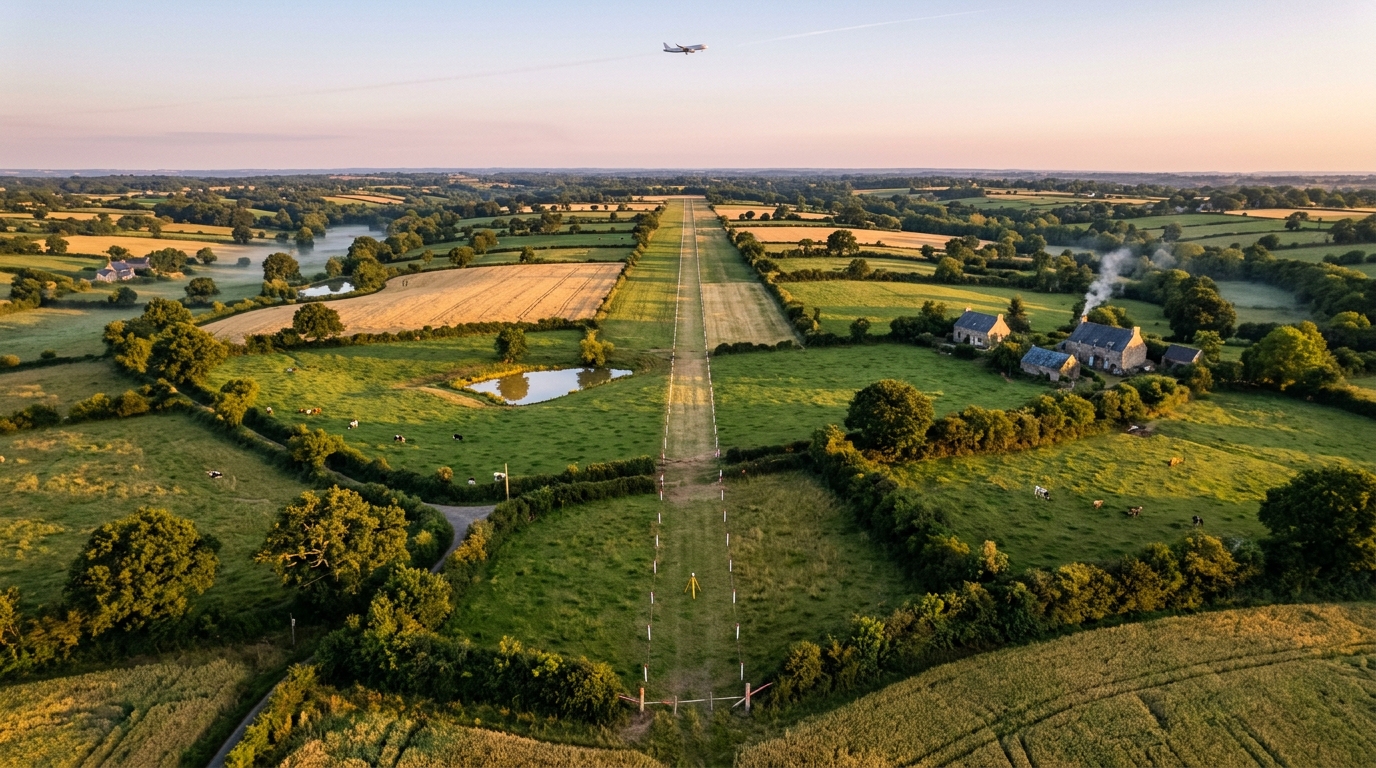
An unmapped airport can sometimes cost more than one that is completed. The Notre-Dame-des-Landes saga stands as a stark illustration: roughly 9 million euros spent on the site, yet a bill claimed from the State that exceeds 1.5 billion euros. Between political abandonment and legal battles, here is a look at a financial dossier as vertiginous as it is symbolic.
- Vinci, via AGO, n’a investi qu’environ 9 millions d’euros avant l’abandon du projet d’aéroport en 2018 et la résiliation du contrat en 2019.
- Le 20 mars 2024, devant le tribunal administratif de Nantes, AGO et ses actionnaires ont réclamé 1,6 milliard d’euros à l’État, montant basé principalement sur le manque à gagner sur les 47 années d’exploitation prévues.
- Le tribunal a reconnu le 10 avril 2024 un droit à indemnisation sans faute de l’État, tout en précisant qu’un éventuel retour de Vinci comme concessionnaire de Nantes-Atlantique, scénario évoqué pour 2026-2027, devrait être déduit du calcul final.
- 9 millions d’euros engloutis pour un aéroport qui n’a jamais vu le jour
- Vinci et l’addition la plus salée de l’histoire aéroportuaire française
- 47 ans de manque à gagner : le calcul vertigineux derrière le milliard et demi réclamé
9 million euros spent on an airport that never came to fruition
It all begins in late December 2010, when the State signs a concession contract with the company Aéroports du Grand Ouest, better known by its acronym AGO. The aim is ambitious: to build a new airport at Notre-Dame-des-Landes, near Nantes, while also operating the existing facilities at Nantes-Atlantique and Saint-Nazaire-Montoir.
On paper, the project looks like any major infrastructure undertaking. In reality, it quickly turned into one of the most contested dossiers of the 2010s, crystallizing years of on-the-ground mobilization. As a result, on January 17, 2018, the Prime Minister announced the outright abandonment of the project, while the contract binding the State to AGO was terminated in October 2019.
During these years, Vinci, AGO’s majority shareholder, had nonetheless injected funds into the operation. According to Ouest-France, the investment amounts to nearly 9 million euros before the definitive halt. A modest sum by construction standards, but one that would become the starting point for a very different story: a demand for compensation from the State, vastly exceeding the initial outlay.
Vinci and the steepest bill in French airport history
Behind AGO’s acronym lies a triad of clearly identified shareholders. Vinci Airports holds 85%, a dominant stake. The Nantes-Saint-Nazaire Chamber of Commerce and Industry adds 10%, while AGO5 retains the remaining 5%.
Following the 2018 announcement, a figure quickly circulated in the press and even in the National Assembly: compensation estimated at at least 350 million euros. A substantial amount, but one that would be far exceeded later in administrative court proceedings.
It was before the Nantes Administrative Court, on March 20, 2024, that the true amount of the claim surfaced. AGO and its main shareholders were seeking 1.6 billion euros from the State. A figure that leaves one dizzy, especially when compared with the 9 million invested on the ground. The gap between the initial outlay and the final demand alone illustrates the magnitude of the financial stakes behind this case.
47 years of lost profits: the dizzying calculation behind the one-and-a-half-billion claim
To understand how a few million euros spent can translate into such a colossal amount, one must look at the length of the initial contract. The concession signed in late 2010 covered fifty-five years of operation. An immense time horizon that completely changes the nature of the calculation.
In front of the judges, AGO argued precisely this logic: the amount claimed does not merely reflect expenditures incurred, but primarily the foregone profits estimated over the entire forty-seven years of operation entrusted to them. In other words, it is not the unfinished works that weigh heaviest, but the theoretical profits never earned.
On April 10, 2024, the Nantes Administrative Court delivered its ruling. The judges found that the concession termination was justified on grounds of public interest, and that no fault could be attributed to the State in this matter. But the ruling did not stop there: it recognizes that this termination entitles the concessionaire to compensation, intended to cover both the expenses incurred and the foregone profits. The exact amount, however, remains to be determined.
The court also provides an important clarification for the calculation going forward. If AGO or its shareholders were to be designated as new operators of Nantes-Atlantique, the gains they would derive from it should be included in the final indemnity assessment. A way to prevent double benefit for the company.
And this scenario is far from theoretical. As early as October 2019, a first bidding process had been launched to award the concession of Nantes-Atlantique and Saint-Nazaire-Montoir, before failing. The DGAC relaunched a new procedure in December 2023. And according to L’Informé, by September 2026, the Ministry of Transport and the DGAC were preparing to designate the Vinci-led consortium as the anticipated concessionaire, with a signing expected by March 2027.
This dossier shows how the abandonment of a major infrastructure project can generate financial consequences that extend over more than a decade. Between the initial 9 million invested, the 1.5-billion claim pursued in court, and the prospect of Vinci returning to lead the Nantes airport, the Notre-Dame-des-Landes affair evidently has not finished making headlines on the budget front.
